Voyager 1 Has Left the Building, Entered Interstellar Space

The New York Times has a very charming, informative piece on the Voyager 1 spacecraft, which has been confirmed to have left the influence of our brave and noble Sun, and entered the depthless black between the stars.
The piece–and the ongoing work of both the Voyager spacecrafts[*] (which were only supposed to run for about 4 years, their original mission wrapping up in the early 1980s) and team (most of whom seem to be pulling AARP discounts)–is an excellent meditation on progress and age and the simple fact that, for most of us, doing something great is not about a single dazzling moment, but about continuing to plug away, day after day, decade upon decade, until the many small success add up to something bizarre and wonderful.
Exiting the Solar System and Fulfilling a Dream – NYTimes.com

Voyager 1 left the solar system the same month that Curiosity, NASA’s state-of-the-art rover, landed on Mars and started sending home gorgeous snapshots. Curiosity’s exploration team, some 400 strong, promptly dazzled the world by driving the $2.5 billion robot across a patch of Martian terrain, a feat that turned the Red Bull-chugging engineers and scientists of Building 264 of the Jet Propulsion Laboratory campus into rock stars. By comparison, the Voyager mission looked like a Betamax in the era of Bluetooth.
The 12-person Voyager staff was long ago moved from the Jet Propulsion Laboratory campus to cramped quarters down the street, next to a McDonald’s. In an interview last month at Voyager’s offices, Suzanne R. Dodd, the Voyager project manager, said that when she attended meetings in Building 264, she kept a low profile in deference to the Mars team.
“I try to stay out of the elevator and take the stairs,” Ms. Dodd said. “They’re doing important work there, and I’ll only slow them down.”

Incidentally, the Voyager spacecrafts carry the “Golden Records“–analog phonograph records featuring sounds of Earth, as well as encoded photographs, and etched with pictograph instructions on how to play the cosmic record. Of the two dozen musical pieces included, only three are from the United States: A Navajo chant[**], Chuck Berry’s “Johnny B. Goode,” and Blind Willie Johnson’s “Dark Was the Night—Cold Was the Ground.”

Blind Willie Johnson, you’ve finally made it into interstellar space–on vinyl, and a gold record, no less! If that’s not the American Dream, then we’ve got the wrong kind of Americans.
At any rate, all of this is especially resonant for me, because the Voyager crafts were put into space the year I was born. Slowly but surely, we’re each getting somewhere. Amen.

Continue reading “Voyager 1 Has Left the Building, Entered Interstellar Space”

Voyager 1 Has Left the Building, Entered Interstellar Space

The New York Times has a very charming, informative piece on the Voyager 1 spacecraft, which has been confirmed to have left the influence of our brave and noble Sun, and entered the depthless black between the stars.
The piece–and the ongoing work of both the Voyager spacecrafts[*] (which were only supposed to run for about 4 years, their original mission wrapping up in the early 1980s) and team (most of whom seem to be pulling AARP discounts)–is an excellent meditation on progress and age and the simple fact that, for most of us, doing something great is not about a single dazzling moment, but about continuing to plug away, day after day, decade upon decade, until the many small success add up to something bizarre and wonderful.
Exiting the Solar System and Fulfilling a Dream – NYTimes.com

Voyager 1 left the solar system the same month that Curiosity, NASA’s state-of-the-art rover, landed on Mars and started sending home gorgeous snapshots. Curiosity’s exploration team, some 400 strong, promptly dazzled the world by driving the $2.5 billion robot across a patch of Martian terrain, a feat that turned the Red Bull-chugging engineers and scientists of Building 264 of the Jet Propulsion Laboratory campus into rock stars. By comparison, the Voyager mission looked like a Betamax in the era of Bluetooth.
The 12-person Voyager staff was long ago moved from the Jet Propulsion Laboratory campus to cramped quarters down the street, next to a McDonald’s. In an interview last month at Voyager’s offices, Suzanne R. Dodd, the Voyager project manager, said that when she attended meetings in Building 264, she kept a low profile in deference to the Mars team.
“I try to stay out of the elevator and take the stairs,” Ms. Dodd said. “They’re doing important work there, and I’ll only slow them down.”

Incidentally, tThe Voyager spacecrafts carry the “Golden Records“–analog phonograph records featuring sounds of Earth, as well as encoded photographs, and etched with pictograph instructions on how to play the cosmic record. Of the two dozen musical pieces included, only three are from the United States: A Navajo chant[**], Chuck Berry’s “Johnny B. Goode,” and Blind Willie Johnson’s “Dark Was the Night—Cold Was the Ground.”

Blind Willie Johnson, you’ve finally made it into interstellar space–on vinyl, and a gold record, no less! If that’s not the American Dream, then we’ve got the wrong kind of Americans.
At any rate, all of this is especially resonant for me, because the Voyager crafts were put into space the year I was born. Slowly but surely, we’re each getting somewhere. Amen.

Continue reading “Voyager 1 Has Left the Building, Entered Interstellar Space”

Destroying AM Radio to Save It

A Quest to Save AM Before It’s Lost in the Static – NYTimes.com

The digital age is killing AM radio, an American institution that brought the nation fireside chats, Casey Kasem’s Top 40 and scratchy broadcasts of the World Series. Long surpassed by FM and more recently cast aside by satellite radio and Pandora, AM is now under siege from a new threat: rising interference from smartphones and consumer electronics that reduce many AM stations to little more than static. Its audience has sunk to historical lows.
But at least one man in Washington is tuning in.
Ajit Pai, the lone Republican on the Federal Communications Commission, is on a personal if quixotic quest to save AM. After a little more than a year in the job, he is urging the F.C.C. to undertake an overhaul of AM radio, which he calls “the audible core of our national culture.” He sees AM — largely the realm of local news, sports, conservative talk and religious broadcasters — as vital in emergencies and in rural areas.
“AM radio is localism, it is community,” Mr. Pai, 40, said in an interview.
AM’s longer wavelength means it can be heard at far greater distances and so in crises, he said, “AM radio is always going to be there.” As an example, he cited Fort Yukon, Alaska, where the AM station KZPA broadcasts inquiries about missing hunters and transmits flood alerts during the annual spring ice breakup.
“When the power goes out, when you can’t get a good cell signal, when the Internet goes down, people turn to battery-powered AM radios to get the information they need,” Mr. Pai said. . . .

Sadly, the changes that are being suggested to save AM–including moving it to all-digital broadcast–are so fundamental that they obliterate some of the utility of the AM system. The article implies that really the only useful aspect of all-analog AM is that it’s powerful (and thus has really long transmission distances, esp. at night). That’s true, and awesome, but what makes AM extra special is that the scheme is so bone *simple*[*]
Heck, in this two paragraph snippet from my book, I teach you to make an AM receiver in about three seconds:


Building a receiver from scratch isn’t much harder, and AM transmitters are likewise within the grasp of novice electronics hobbyists. In a deep-down insane zombiepocalypse disaster scenario, we kinda *want* to have an all analog AM system blanketing the country, giving out instructions, don’t we? The greatest asset of the network isn’t just signal strength, but the ubiquity and simplicity of the gear you need to decade that signal back to human voices giving you decent advice for what to do when the Zombie Dolly Parton and Rush Limbaugh coming banging on your door.

Continue reading “Destroying AM Radio to Save It”

Careers, Co-working, Forbes, and Our Blessed Age of Telecommuting

A couple of quick items now that I’m back in town and in the computing seat:
1) I continue to write a monthly column for the Ann Arbor Chronicle. The August column (which obviously snuck in kinda late; I was out of town) is about How To Launch Your Writing Career in Four easy steps:

Launching a writing career is a four-step process:
1. Get a Baby
2. Write Some Stuff
3. Go to Library Story Time
4. Check Your Email
I know, I know, you have a few questions. So, I will clarify in detail below, with footnotes.
. . .
“Hey!” you’re about to type, “This isn’t a career plan, it’s just a string of random events involving a nameless baby! None of it applies to me; I don’t even have a baby! What a rip-off!”
What’s tripping us up is this word “career.” . . .

It’s just that easy! Learn more and ACT NOW: The Ann Arbor Chronicle | In it for The Money: How to Career as a Writer
2) A few months back a nice blogger from Forbes visited my coworking community to talk about remote workers and coworking and stuff. So, if you want to read a little more about the “terrible investment decisions” portion of my “career,” check that out.

Chomsky and I Are Everyman! #RaceIsOver #FACT

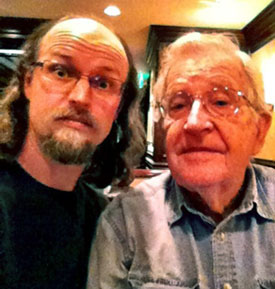
It’s come to my attention that, according to Google, this selfie of Chomsky and me:
(from this article)
is “visually similar” to these selfies:


It’s as though Google Image Search is the true Mexican magical realism camera: In his heart of hearts Chomsky is saucy chicks and happy black kids (*Race is over!*), while I’m the stern bartender/goofy galpal/cranky trannie–which is all pretty accurate, actually.

Noam Chomsky and a “Journalist” Walk into a Bar . . .

I continue to write a monthly column for the Ann Arbor Chronicle. In a bit of a departure from my normal tedious exegeses of gun statistics and local bridge policy, this latest column is based on a conversation I had with Noam Chomsky in early July. It begins something like this:

I’m interviewing Noam Chomsky in the bar of the Campus Inn a block from the University of Michigan campus in Ann Arbor, Michigan. The bar is dim and entirely abandoned at 10 a.m. on a Friday morning. Because I’m highly distractible, I can’t help but periodically marvel at the symmetry of this: I only ended up interviewing Noam Chomsky at all because I’d Tweeted a link to a joke about Heisenberg, Gödel, and Chomsky walking into a bar [1], and Dave Askins (editor of this fine publication) had responded by noting that Chomsky would be speaking at the University of Michigan a week or so later, and essentially dared me to interview him.

I’d agreed, on the assumption that it would be impossible to land an interview with the man almost universally regarded as America’s foremost public intellectual. I was wrong [ . . . ]

. . . and goes downhill from there. Enjoy!

(For those more interested in Chomsky and less in my chatter, you can read the unedited transcript of the interview or listen to all 48 minutes of the audio.)

Linguistics Krazy Korner: “Lion-Eating Poet in the Stone Den”

“The Lion-Eating Poet in the Stone Den” is a 92-character modern poem written in Classical Chinese by Yuen Ren Chao, in which every syllable has the sound shi (in different tones) when read in modern Mandarin Chinese. [Lion-Eating Poet in the Stone Den – Wikipedia, the free encyclopedia]

In other words, the following series of sushes is this poem:

In a stone den was a poet called Shi, who was a lion addict, and had resolved to eat ten lions.
He often went to the market to look for lions.
At ten o’clock, ten lions had just arrived at the market.
At that time, Shi had just arrived at the market.
He saw those ten lions, and using his trusty arrows, caused the ten lions to die.
He brought the corpses of the ten lions to the stone den.
The stone den was damp. He asked his servants to wipe it.
After the stone den was wiped, he tried to eat those ten lions.
When he ate, he realized that these ten lions were in fact ten stone lion corpses.
Try to explain this matter.


Man, now I’m mad-crazy craving stone-lion sushi . . .

Continue reading “Linguistics Krazy Korner: “Lion-Eating Poet in the Stone Den””

“Being Art Isn’t a Property of a Thing, but a Property of How We Perceive that Thing” — Vi Hart

Twelve Tones – YouTube

This video is ostensibly about twelve-tone composition techniques–but do not let a disinterest in “experimental” music cause you to miss out.
First off, the music Vi tosses off to illustrate her points is so hauntingly beautiful it’s just about crippling. This arrangement of “Mary Had a Little Lamb” (explored at length around the 21min mark) is so beautiful it makes me ache. I love it, without irony or snark. I just *love* it, love how the sound of the 12-tone recombination has guided the dark and tortuous new text.
But, although that’s the focus of the video, this talk (recitation? recital? lecture? demo? “vlog”?) is really about creativity and the rudimentary mechanics of artistic craft (both for the nominal creator and nominal audience), as well as the concreteness of artistic “abstraction” and the fucktardity of current US copyright law[*].
This video is incredible and wonderful; it’s worth your 30-minutes, especially if you aspire to *any* creative endeavor.
*thx for the tip @logista!*

Continue reading ““Being Art Isn’t a Property of a Thing, but a Property of How We Perceive that Thing” — Vi Hart”

The US-Canada Border: Signifiers and Signified, Precision and Accuracy, Errors All the Way Down

OK, this video makes no direct mention of the things it makes me think about—nonetheless, it’s neat unto itself and worth your time.
But what it gets me thinking about is the difference between being “accurate” (i.e., mating the objectively observable world) and “precise” (i.e., being broken into suitably small gradations for the work at hand)—because this is a story about both human failures in accuracy and precision. And, to the degree this is about politics (which is usually how the US-Canada No Touching Zone is presented; this is the third or fourth time this has come up for me [DISCLOSURE: I’m from and reside in Michigan]), it’s about how quickly humans begin to fully and deeply conflate the signifier (the word, the map, the photo) with the signified (the notions these hashes and squiggles imply, the *actual* land you’re standing on, your *actual* living-breathing child). It also makes you think about all the kinds of *errors* there are out there, beyond simple fat-fingering and typos. I mean true, legit errors in how we compartmentalize things in our damn little monkey brains.
Canada & The United States: Bizarre Borders Part 2 – YouTube