Wanna Review My Forthcoming DIY Musical Noise Toy Book? Drop Me a Line! #diy #maker
Are you a REVIEWER TYPE PERSON? Are you interested in MAKER stuff and DIY? Do you like FREE BOOKS? I’m in the midst of writing my second DIY book for No Starch Press, this time focused entirely on musical instruments and noise toys (both traditional and odd-as-hell–see a few early prototypes in the videos below). If you are possibly interested in a review copy, hit me with your contact info and a link to your venue (or blog, Tumblr, Twitter, Goodreads, Amazon account, etc.)
Wondering what my books are like? There are SNEAK PEEKS and FREE SAMPLES from my first book at the No Starch Press website and on Amazon.
Please feel free to pass this on to others you know who might be interested! Thanks!
See you at STEAMTOPIA!!!
Hey All: I’ll be at the Steamtopia Steampunk Convention in Dearborn, MI, June 12-15. Here’s a really slick version of the Steamtopia Schedule.
I’ll be teaching workshops on DIY booze and hummingbird feeders and homebrew electric stringed instruments, as well as sitting on a publishing panel, running a few writing workshops, selling and signing books, and generally hanging around. We can drink some beers and then get into a foam knife-fight! See you there!
Hey Nifty! My Story “The New Guys Always Work Overtime” Won the 2014 Asimov’s Science Fiction Readers’ Award for Short Fiction! #scifi
. . . or tied for it, at least:
WINNERS: Analog Science Fiction and Fact’s AnLab Award / Asimov’s Science Fiction’s Readers’ Award – SF Signal
Asimov’s Science Fiction Readers’ Award Winners
- Best Novella: “The Application of Hope” by Kristine Kathryn Rusch (8/13)
- Best Novelette: “Over There” by Will McIntosh (1/13)
- Best Short Story (Tie)
- “The Wall” by Naomi Kritzer (tie) (4-5/13)
- “The New Guys Always Work Overtime” by David Erik Nelson (tie) (2/13)
- Best Poem: “Rivers” by Geoffrey A. Landis (6/13)
- Best Cover Artist: Kinuko Craft
Wanna read it? Well, you’re in luck: You can buy the ebook or get it for FREE (many formats available).
Lost Your Glasses? Make a Pinhole “Lens” with Your Fist #PROTIP
This is *vital* survival skill for folks who depend on corrective lenses. For example, both my mother and wife are basically blind without their glasses (my mom is actually legally blind without hers); misplaced glasses are a huge problem.
If you are an optometrist, you should teach this to folks first thing when you prescribe lenses for them. It can be an actual life saver, right up their with hands-only CPR and the knowing to Heimlich an infant[*].
If you’re generally curious about pinhole technology and how pinholes work, you can check out this article I wrote for The Magazine, “Light Motif.”
Continue reading “Lost Your Glasses? Make a Pinhole “Lens” with Your Fist #PROTIP”
My novelette “There Was No Sound of Thunder” is in the current ASIMOV’S (plus a *BONUS* story for FREE!)

My latest novelette, “There Was No Sound of Thunder,” is featured in the issue of ASIMOV’S SCIENCE FICTION magazine that’s on newsstands for the next week or so. If you don’t believe in dead-tree reading, you can get it for Kindle *cheap!* If you don’t believe in paying for stuff–well, you can work that via Kindle, if you kill your subscription fast enough, or just go to your local library.
BONUS: My other story set in this same commercial time-portal universe, “The New Guys Always Work Overtime” (first published in the February 2013 ASIMOV’S) is now available as an ebook. Gimme your email address and you’ll get an absolutely FREE!!! copy:
(If you aren’t cool with sharing your email, you can buy a copy of the story for a buck from any number of ebook retailers.)
And, hey, one last thing: here’s a little flash fiction I wrote as a favor to a friend last week–in an easy-2-retweet format, no less!
Reminder: Springtime is an Awful Time for Kite Flying
As the wind blows the hanging chair in my big old maple up to a 45-degree angle, then whips it around to batter the tree and threaten dog-walkers, I’m reminded of this incontrovertible fact: Springtime is an Awful Time for Kite Flying.
In most of North America spring breezes are gusty and move around the compass; this is *awful* for flying kites, which really work best with a steady, constant breeze (even a fairly weak one). But thanks to the Peanuts Industrial Complex, Americans have inseparably associated Spring and kite flying, much to their enduring frustration.
That’s not to say getting a kite up in the Springtime is impossible, just that it’s much harder. While ground-level breezes are often all over the place, higher wind can be nice and steady, so if you can get the kite to climb fast, you can still make a go of it. The diamond kite in my book performs pretty well in fickle spring breezes (the book includes two kite designs and lots of tips; there’s a brief version of just the diamond-kite build available for free online).
Here are some more kite flying and building tips: Snip, Burn, Solder Blog: Kite Season is Here! (N.B.: This post was written in the *Fall*)

Imogene Heap’s Goofy Magic Music Gloves
Since I’m neither a musician nor a computer programmer[*], these don’t excite me personally (I imagine using them–for me–would be as frustrating as the goddamned Nintendo Power Glove), but OMFG do I ever wanna buy a pair of these for Girl Talk!
Imogen Heap’s musical gloves – Boing Boing
And, for those who don’t know Girl Talk, please go seek enlightenment *now.*
QUICK UPDATE: I’ve got a novelette in the July/August issue of THE MAGAZINE OF FANTASY AND SCIENCE FICTION #SF
Hey All,
Been sitting on this news for a bit, but happy to now share that my mostly-math-and-also-something-very-much-like-a-transporter-plus-marathons-and-Nebraska-and-wheelchairbound-air-travel novelette will be in F&SF this summer. The rest of the issue looks pretty rad, too:
July/Aug F&SF Contents Announced | C.C. Finlay | ccfinlay
In alphabetical order by author, these are the twelve stories that will appear in the July/August issue of Fantasy & Science Fiction:
William Alexander, “The Only Known Law”
Charlie Jane Anders, “Palm Strike’s Last Case”
Paul M. Berger, “Subduction”
Haddayr Copley-Woods, “Belly”
Sarina Dorie, “The Day of the Nuptial Flight”
Annalee Flower Horne, “Seven Things Cadet Blanchard Learned From the Trade Summit Incident”
Cat Hellisen, “The Girls Who Go Below”
Alaya Dawn Johnson, “A Guide to the Fruits of Hawai’i”
Sandra McDonald, “End of the World Community College”
David Erik Nelson, “The Traveling Salesman Solution”
Dinesh Rao, “The Aerophone”
Ian Tregillis, “Testimony of Samuel Frobisher Regarding Events Upon His Majesty’s Ship Confidence, 14-22 June, 1818, With Diagrams”
Some notes:
“Five Tales of the Aquaduct” by Spencer Ellsworth was also purchased but it didn’t end up fitting into the issue due to length. (I bought too much!) It will appear in a future issue.
The cover story is going to be Charlie Jane Anders’s “Palm Strikes Last Case.”
The Annalee Flower Horne story is her first professional fiction sale. If you know her, go wish her congratulations — it’s been very hard for her to sit on the news this long!
My blog post about the submissions process and how I chose these stories can be read here:http://www.ccfinlay.com/blog/nectar-for-rejectomancers.html
William Alexander, “The Only Known Law”
Charlie Jane Anders, “Palm Strike’s Last Case”
Paul M. Berger, “Subduction”
Haddayr Copley-Woods, “Belly”
Sarina Dorie, “The Day of the Nuptial Flight”
Annalee Flower Horne, “Seven Things Cadet Blanchard Learned From the Trade Summit Incident”
Cat Hellisen, “The Girls Who Go Below”
Alaya Dawn Johnson, “A Guide to the Fruits of Hawai’i”
Sandra McDonald, “End of the World Community College”
David Erik Nelson, “The Traveling Salesman Solution”
Dinesh Rao, “The Aerophone”
Ian Tregillis, “Testimony of Samuel Frobisher Regarding Events Upon His Majesty’s Ship Confidence, 14-22 June, 1818, With Diagrams”
Some notes:
“Five Tales of the Aquaduct” by Spencer Ellsworth was also purchased but it didn’t end up fitting into the issue due to length. (I bought too much!) It will appear in a future issue.
The cover story is going to be Charlie Jane Anders’s “Palm Strikes Last Case.”
The Annalee Flower Horne story is her first professional fiction sale. If you know her, go wish her congratulations — it’s been very hard for her to sit on the news this long!
My blog post about the submissions process and how I chose these stories can be read here:http://www.ccfinlay.com/blog/nectar-for-rejectomancers.html
FYI: If you’re interested in the ins and outs of fiction submissions (i.e., ALL WRITERS), Finlay’s blog post (linked above) is very worth your time.
President Dad (for better or worse)
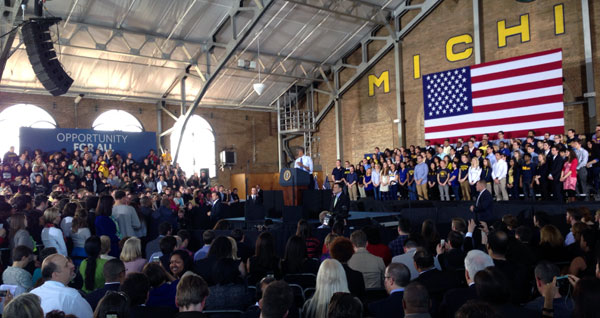
I continue to write a column for the Ann Arbor Chronicle. This month I covered the President’s visit to Ann Arbor. He mostly came to talk about minimum wage, but we mostly showed up to See the Man Himself (as is oft the case with these Presidential types), so that we could say that we were there, and had seen the guy in person (*hint* he’s the tiny dude in the middle of the pic to the left), and could tell you what kinda guy he is because of that.
But what kinda guy *is* he? Well:
What is the PotUS? For one thing, apparently, he is a Dad. And I don’t just mean to say he’s the biological father to Sasha and Malia; there hasn’t been childless PotUS since James K. Polk (who, Batmanishly, took on a nephew as his ward – so you could argue there’s never been a childless PotUS). I’m talking about the Nature of the sitting PotUS. George W. Bush was a “Cool” Big Brother – which is to say half rake, half bully. His father was a Study Hall Proctor. Reagan was, obviously, a Hollywood Actor. Clinton? He was an Elvis. And the current PotUS is a total Dad.
The PotUS arrived in his shirtsleeves, because he was ready to Get Down to Business and Hit Us with Some Straight Talk about wages and stuff. The PotUS complimented us as good-looking, and commended our work ethic and academic achievements. He seemed to legitimately admire the quality of the prominent sportsball players in the audience, which pleased the audience a great deal.
Then, like somebody’s dad, the PotUS cajolingly admonished us to sit down – which might have seemed sort of cryptic to home-viewers, because the crowd was cropped out of the shot. Everyone had given a standing ovation upon his entrance, and then remained standing. Many folks were standing on their rickety folding chairs – which any dad will tell you is dangerous, and bad for the chairs. C’mon, guys; settle down. I’ve gotta talk to you about something important.
This was all in the first three minutes and thirty seconds of his speech.
. . .
The PotUS arrived in his shirtsleeves, because he was ready to Get Down to Business and Hit Us with Some Straight Talk about wages and stuff. The PotUS complimented us as good-looking, and commended our work ethic and academic achievements. He seemed to legitimately admire the quality of the prominent sportsball players in the audience, which pleased the audience a great deal.
Then, like somebody’s dad, the PotUS cajolingly admonished us to sit down – which might have seemed sort of cryptic to home-viewers, because the crowd was cropped out of the shot. Everyone had given a standing ovation upon his entrance, and then remained standing. Many folks were standing on their rickety folding chairs – which any dad will tell you is dangerous, and bad for the chairs. C’mon, guys; settle down. I’ve gotta talk to you about something important.
This was all in the first three minutes and thirty seconds of his speech.
. . .
More here: The Ann Arbor Chronicle | In It For The Money: Presidential Stinkburger