If you want to understand the last three years in American politics, read Stephen King’s 1985 novella “The Mist”

This is, by no means, any sort of endorsement of any of the film/TV/radio-drama adaptations of this work—all of which either entirely miss what gives this story its lasting power, or convert a fundamentally profound work about kitchen-table American politics (i.e., the only kind that actually matters) to a moderately stupid and lazily nihilistic creature features.

Read the novella (which is also the first story in Skeleton Crew—a whole book of classic King shorts that costs just a couple buck more than the standalone novella—and is bootlegged here).  Ignore the monsters and the titular mist; watch the people.  And never lose sight of the final word in the story.


Listen to (or Read) My Story “Whatever Comes After Calcutta” on @PseudoPod

The Pseudopod team always does great work, but I’m especially thrilled with what the reader—Rish Outfield—has done here; the story has lots of voices, and he captures them all.  Such a treat. (For those less inclined to audio drama and more to old-fashioned reading, they have the full text of the story posted, too.)

PseudoPod 649: “Whatever Comes After Calcutta

And here’s a YouTube video of the audio, if that’s your jam:

Enjoy!

Are you a grown-up American? Do you vote? Then plz take three minutes to get yr head around “marginal tax brackets”🇺🇸🌟

WaPo-wrong-on-tax-brackets2About half of all Americans fundamentally misunderstand how U.S. “tax brackets” work.  (Ironically, those in the traditionally “fiscally conservative” party are significantly more likely to fundamental misunderstand our tax system.)  As a result, many, many, many Americans argue and vote against both public interest and their own interest, with the sole beneficiaries being the extremely rich (both human and corporate).

Now’s the time to get your head straight.  The Twitter thread embedded below lays it out nicely, as does this article from the Washington Post (which takes just three minutes to read, and even explains why we use this somewhat counter-intuitive and often confusing tax bracket scheme).

This is your Civics homework for today.  It’s pretty easy.  I’m sure you’ll get a gold star!🌟

Xappy Xanukah! ♪♫♪♬

I’m a Jew—born and raised—but I come from a “mixed” family (they say “interfaith” now).  My dad is a Jew, but my mom was raised Christian.  Both my maternal grandparents—with whom I spent a lot of time growing up—were practicing Christians. Far from shockingly, my own marriage is mixed (my wife was raised Catholic, our kids are Jews who end up participating in a lot of Xtian traditions).  Interfaith families are really common now, but were much less so when I was young.

As you’re likely aware, back when I was a kid there weren’t a lot of Xanukah songs for us Jewish kids. There weren’t many songs for Jewish kids, but there were some; there were absolutely zero songs for mixed half-a-Jews with an Xmas tree and a Xanukiah and a cat that managed to catch fire in the Xanukah candles every year and Xtian grandparents who came to town on Xmas Eve specifically to partake in the Jewish tradition of Xmas Chinese food.

Not to put too fine a point on it, but we’re sort of a nation that always wants everyone to be one thing or another thing—black or white, nerd or jock, Jew or Gentile, girl or boy—and doesn’t have much patience for things that are mixed and ambiguous and a lil-o’-both.  I was in my 20s, and in a Women’s Studies class, before I learned what the hell “intersectionality” was, and my identity began to make any sense to me.

This year—for the third year running—my local Jewish Community Center is collecting donations of Christmas presents, to be given to the Syrian refugees relocated here.

On the one hand, that sounds almost too perfectly absurd: Jews giving Muslims Christmas presents.  On the other, it feels like basically the most perfect possible introduction to America.🕎🎄☪🇺🇸

Anyway, there weren’t many mixed kids like me when I was growing up—and there weren’t any songs or holiday specials or children’s books that reflected what I saw and felt and loved about wintertime.

So these are my songs, for all the little intersectional mixed kids out there, who don’t have any holiday songs to sing.

Enjoy!

REBEL NELL X NELSON FOUNDATION #GIVINGTUESDAY

Rebel Nell works with local organizations to hire women transitioning from homelessness and teaches them to craft unique, wearable accessories made from the fallen layers of graffiti that grace the buildings and underpasses of Detroit.

DISCLOSURE: I’m from the Detroit Metro Area. My dad was born and raised in Detroit. We love that stupid city, my family has planted their hearts there, and I’ve bought Rebel Nell jewelry for my wife. It’s neat stuff!

But Rebel Nell isn’t just mining the lead-flecked ruins of Detroit to sell bougie baubles.  Through their non-profit arm—Teaching. Empowering. Achieving. (T.E.A.)—Rebel Nell provides all the wrap-around services to empower vulnerable women and families as they transition to a life of independence.  T.E.A. invests in training, education, skills development, coaching, and mentorship services (including basic employment opportunities), in addition to other support and assistance to these women. 

This ain’t giving away fish; it’s teaching folks how to fish, and making sure they’ve got a decent rod and reel to get them started.

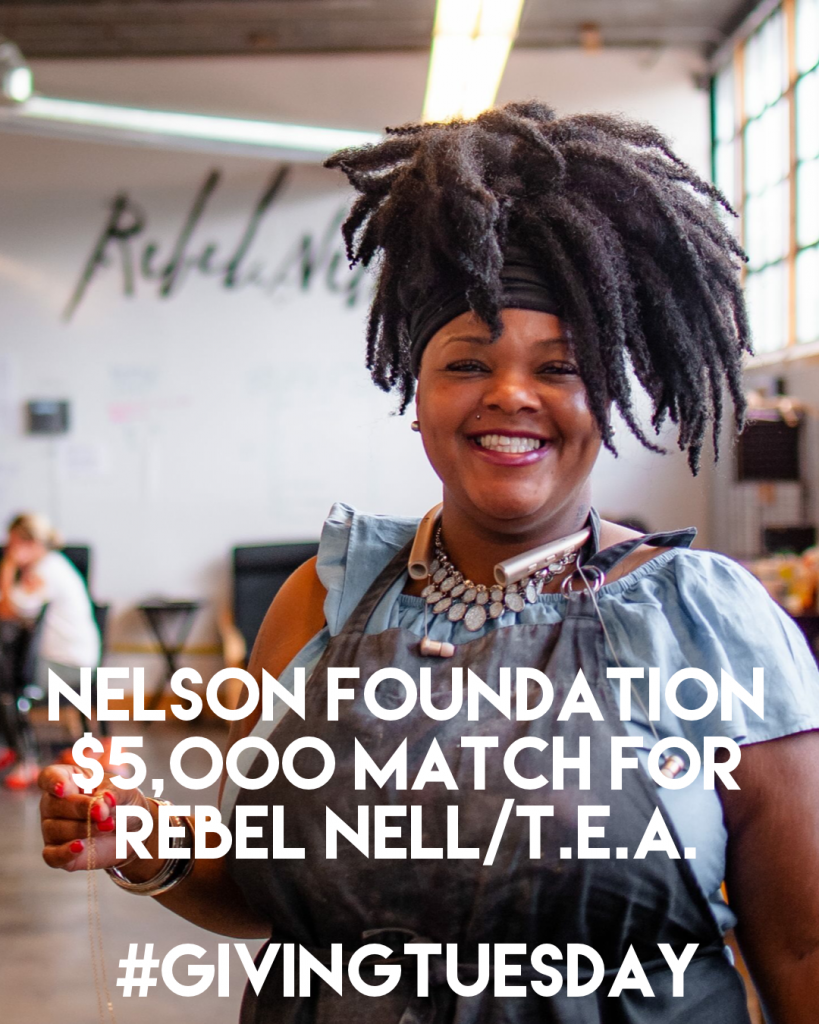
This is Azzie. She’s Rebel Nell's production manager and an alum of their programs.
This is Azzie. She’s Rebel Nell’s production manager and an alum of their programs.

The Nelson Foundation provides financial support to individuals and organizations that use art to create opportunities that better our community.  (Note conspicuous name similarity—this is something my folks and older sister make happen.)  These usually take the form of direct grants and tuition support to underrepresented students in the arts in Michigan.

This Tuesday—November 27, 2018—The Nelson Foundation will be giving up to $5,000 to Rebel Nell/T.E.A. in matching funds. 

You give $1, and the Nelson Foundation matches that.  Everyone together gives $5,000 and the Nelson Foundation doubles that—boom!, $10,000 goes directly to supporting women and families getting free and building up their communities.

Click to give! Pay it forward. Spread the word. 

Thanks!

image1 

Michigan Voters: Please “Plunk” for Sam Bagenstos for MI Supreme Court on Nov 6

“Plunking” means voting for just one person, even when you could vote for several.

On Nov 6, Please plunk for Sam Bagenstos for Michigan Supreme Court

This is easy to remember, because he’s the only candidate who has a hobbit-sounding name.  Sometimes he wears little half-glasses while reading, which really underscores the hobbit thing, although he’s sort of a tall dude.

Voting for Michigan Supreme Court

This year we have six candidates running for two open seats in the Michigan Supreme Court. This is on the “non-partisan” portion of the ballot—that is, even though the nominees have a party affiliation, that affiliation isn’t listed on the ballot.  As a result, in general, only about 50–60% of voters even bother to vote for a Michigan supreme court justice.  When they do, they overwhelmingly pick the incumbent (who have “Justice of Supreme Court” listed under their names on the ballot—generally, the rational voters have is “Well, I can’t think of anything terrible the supreme court did this year, so whoever is on it must be doing a good job.”)

My point is two-fold: 1) It is a small number of well-informed voters, coupled with a bunch of people who just like ticking boxes, who elect our supreme court justices and 2) once you’re on, it’s easy to stay on.

Why am I asking you to vote for Sam?

  1. He’s a solid dude.  I know him a little bit, personally, and know his wife and kids much better (we’re active in the same congregation). Sam isn’t in anyone’s pocket. He is smart and fair and works his ass off.
  2. He’s a civil rights dray horse. He was a top official in DoJ’s Civil Rights Division under Obama.  In the last couple years Sam has argued and won important victories for pregnant workers and disabled children before the Supreme Court of the United States.  He’s fighting for the people of Flint to hold the state accountable for their poisoned city water.

Why am I asking you to “plunk” for Sam?

You can vote for up to two supreme court justices.  You could vote for both Sam and the other Dem nominee, Megan Cavanagh—with your rationale being that this brings us closer to getting at least one progressive justice on the court.  But this is the midwest, and “Democrat” is not a reliable proxy for “progressive.” Megan Cavanagh has actually spent her career restricting civil rights, representing municipalities, police, and businesses against the sorts of clients that Sam has stuck up for.  (FUN FACT: One time Cavanagh argued before the Michigan supreme court, representing an oil company that accidentally dumped 396 gallons of fuel oil into a woman’s basement, destroying her home.)

So, on the one hand, you have Cavanagh who worked to get an oil company out of paying $100,000 in damages to a woman whose home they destroyed. On the other, you have Sam representing the people of Flint after they suffered heavy metals poisoning at the hands of incompetent city admins.

If you plunk for Sam (voting for him and only him), you essentially double the value of your vote.  This is important because, if trends persist (and there’s no reason they wouldn’t), the incumbents are going to devour the vast majority of the votes.  Effectively, only one supreme court seat is open (if even). Voting for both Sam and Cavanagh is essentially saying that you figure it’s a coin-toss between the two, as to which will better bend the arc of the moral universe toward justice.

That simply isn’t true in this case.  Sam is your justice. Please plunk for Sam.  Please spread the word.

usa-american-flag-waving-animated-gif-26


There is Such a Pure Joy of Expression in Richie Jackson’s Skating

You don’t have to love—or like, or even give shit one—about skating to enjoy watching Richie Jackson skate.  You don’t need to know a lexicon of jargon to appreciate it, because most of what he does has no formal name, since it’s arisen from the immediate conditions and his feelings about them.

I guess I maybe dig Richie Jackson so much because he’s kept skateboarding—a thing that, since I was a kid, has been transformed into a sport and a career—as an expressive art form.

“I for sure had a vision, but how close to it I’ve gotten, I don’t know [because] I’ve dissolved it by making it a reality, and it’s different. [laughs] The original vision has ceased to be.  I’ve replaced it with a bunch of pixels.”

Amen, brother. Amen.

Continue reading “There is Such a Pure Joy of Expression in Richie Jackson’s Skating”

On Newstands Now: The Sept/Oct ASIMOV’S with “In the Sharing Place”

The annual “spooky” issue of ASIMOV’S Science Fiction (Sept/Oct 2918) has hit newstands, and includes my apocalyptic sf/horror story “In the Sharing Place.” Enjoy!


4F669A2A-0BC8-487B-B8F8-C7D692D7E4F9

9DBCE5DB-0C8B-4414-A2CC-7685EC63BA38

Maybe it makes me sort of a tool, but this cracks me the hell up…

The #GoogleTranslatesMTG hashtag is basically the only thing on Twitter that hasn’t made me wanna cry in, I dunno, months.

"Talk about something else."
“Talk about something else.”

Shit like this is why I always roll deep in Black, folks:

"Solving a psychological problem is very difficult."
“Solving a psychological problem is very difficult.”

(Legit, though: Tormented Soul is a fun card, in my humble—but I just love the idea that it’s the crow saying “Great features!”  It’s all, like, “Cheer up, bro! You can’t block, but you’re unblockable, and getting nicked for an extra life every round annoys the crap out of Dave-o’s kid!”)

Five Writing Exercises for @ben_brainerd (and Anyone Else Looking for a Prompt) #writing

Hey Ben (and the rest of the world),

Sorry this took so long to put together.  Life happened.  Here goes:

  1. “There is a corpse in the barn!!!”  X finds a corpse in the barn. S/he needs to go tell Y about this, but doesn’t want Z (who is in the same room) to grok the situation.  (Back when I used to teach high school, we’d frame this exercise like so: “You have found a corpse in the barn; alert your sister to this fact.  You may not use the words ‘body,’ ‘dead,’ ‘corpse,’ or ‘barn.’  Go!”)  Who are X, Y, and Z to each other?  Why must X inform Y of this situation?  Why doesn’t X (or Y or both) want Z to know?  What happens if (when?) Z figures it out?
  2. Eschew the Voodoo  We all have voodoo around our creative processes: We only work in Scrivener or with this font in Word or using that pen or writing in a Moleskine or before 8am or whatever.  For your next project eschew your usually voodoo and replace it with a totally foreign “habit.”  Write the story entirely on 3×5 cards, or in the “Stickies” app on your computer, or in emails sent to yourself from your phone, or on a piece of crap 99-cent notebook from the drug store or in Comic Sans or only working before getting out of bed or after brushing your teeth for the night or whatever.  Feel how changing tools changes the feel of writing and the piece itself–but also see how little difference it can make, how your good work is still good scrawled on a Post-It note stuck to your kitchen table, and how lazy hackwork is still just that, even when you’ve used your favorite pen in the prettiest journal anyone ever gave you for Xmas.
  3. Write in Freddish: Write your next story in a style that is a. highly constrained and b. very different from your “default” voice—for example, borrow the voice of an autoclave installation manual, or a EMT handbook, or extremely constrained vocabulary (see, for example, any early-reader children’s book, of Randall Munroe’s Thing Explainer: Complicated Stuff in Simple Words Hardcover). My absolute favorite recent fiction application of this technique has to be Greg van Eekhout’s “Will You Be an Astronaut?  That story fucking crushes my heart every time.
  4. Rewrite What Vexes You:  Take some story that recently annoyed you by not living up to your expectations and rewrite it the right way. (I just found myself doing this the other day via text message with my Mom and sister after we all separately saw, and were annoyed by, Solo—a film that I desperately wanted to love, but could not; it has some good gags, but a thin plot that is massively overburdened by something-for-everyone, “fan service,” and box ticking.  Something that’s for everyone is for no one, and box ticking us inherently boring.  Most annoyingly: You can actually make Solo into a really good movie purely through cuts; it’s a good, lean story buried in flab.)
  5. Write to the Formula:  I usually use the 45/45/10 Formula as a tool for revising—I have something roughed out and now it’s time to make it run smooth—but you can use it to build a story from scratch.  Outline it in three sections (I. is the Setup, II. is the Tangle, and III. is the Resolution).  Flesh out each section, noting that I. and II. need to have about equal amounts of material, while section III. has only about a quarter as much stuff.  Draft from there.

Continue reading “Five Writing Exercises for @ben_brainerd (and Anyone Else Looking for a Prompt) #writing”