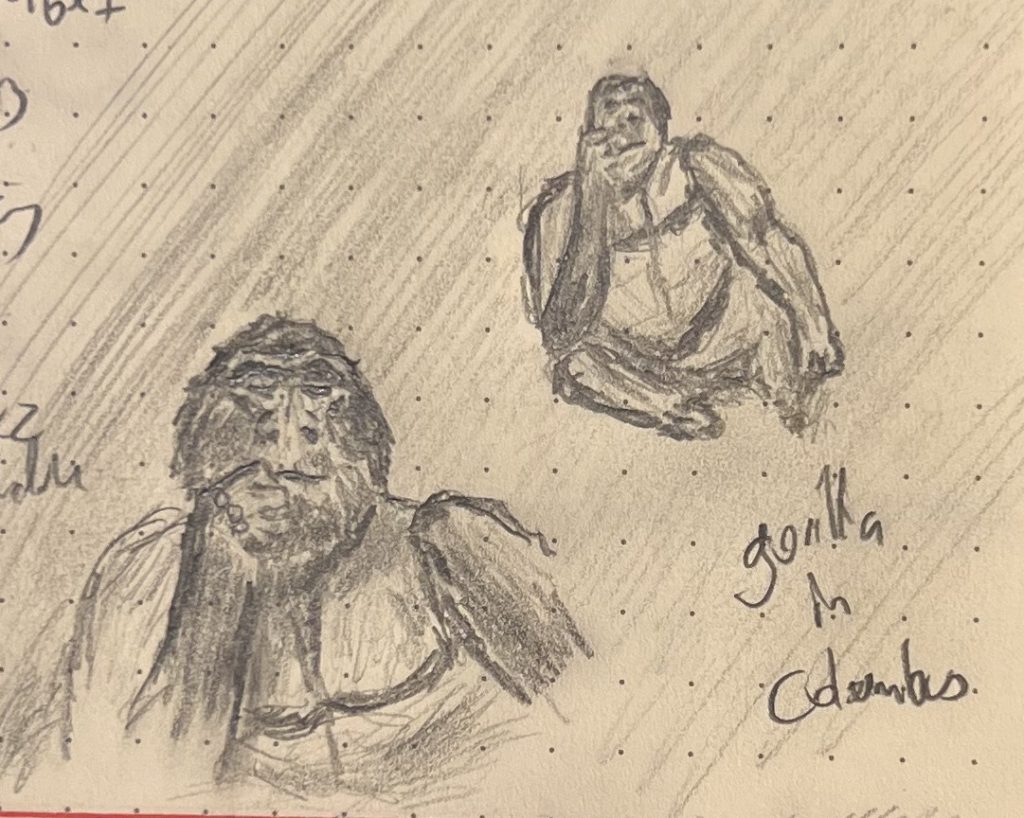
Due to a split decision/ranked-choice vote, this week’s sketch is the thinking man’s gorilla (based on a blurry snapshot from the Columbus Zoo):
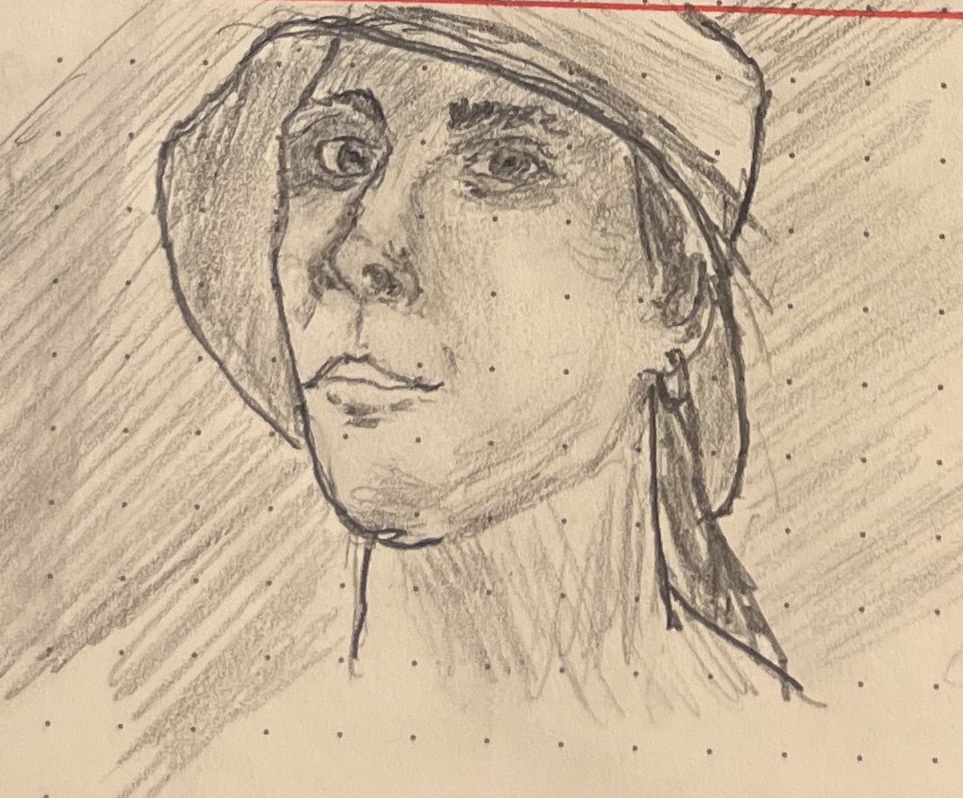
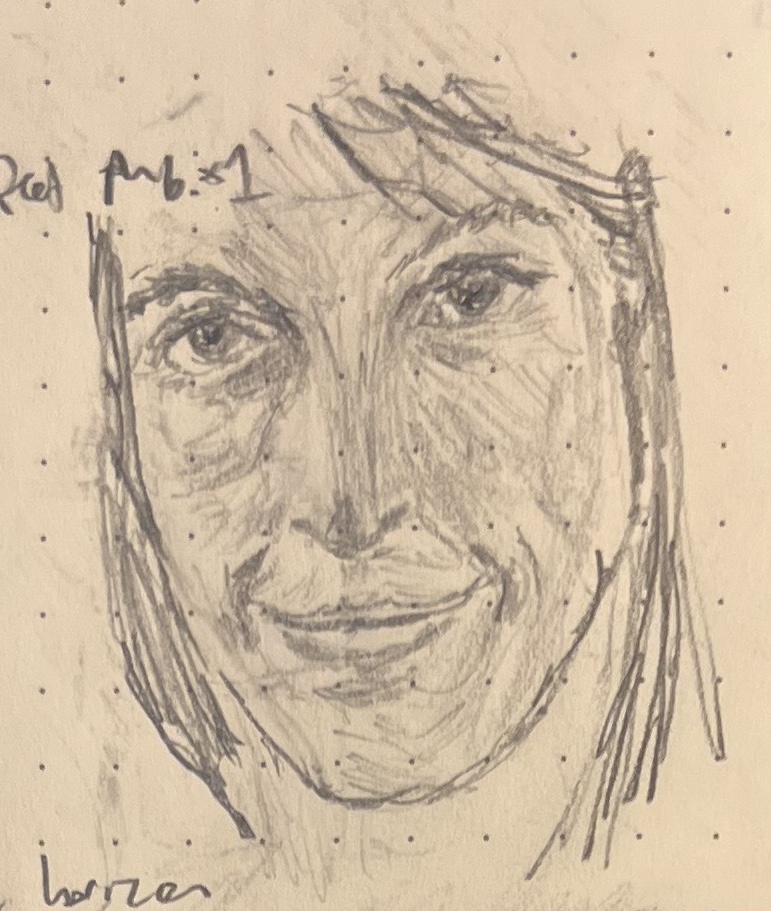
My son favored either the gorilla sketch (above) or the sketch of my wife in a bucket hat (below) Meanwhile, I preferred either the gorilla (above) or this sketch of my wife based on a photo we took this past Halloween (way down below). Thus, despite an abundance of qualified women, we wound up with a gorilla on top. Democracy is an imperfect system.
my wife in a bucket hatmy wife humoring her husband
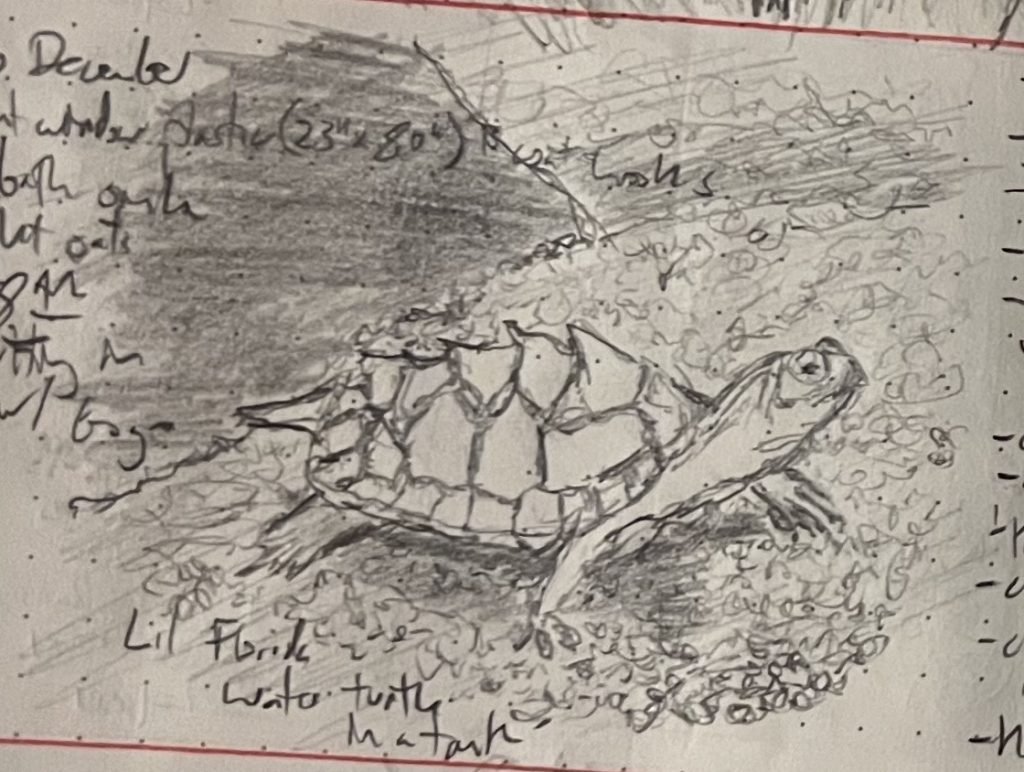
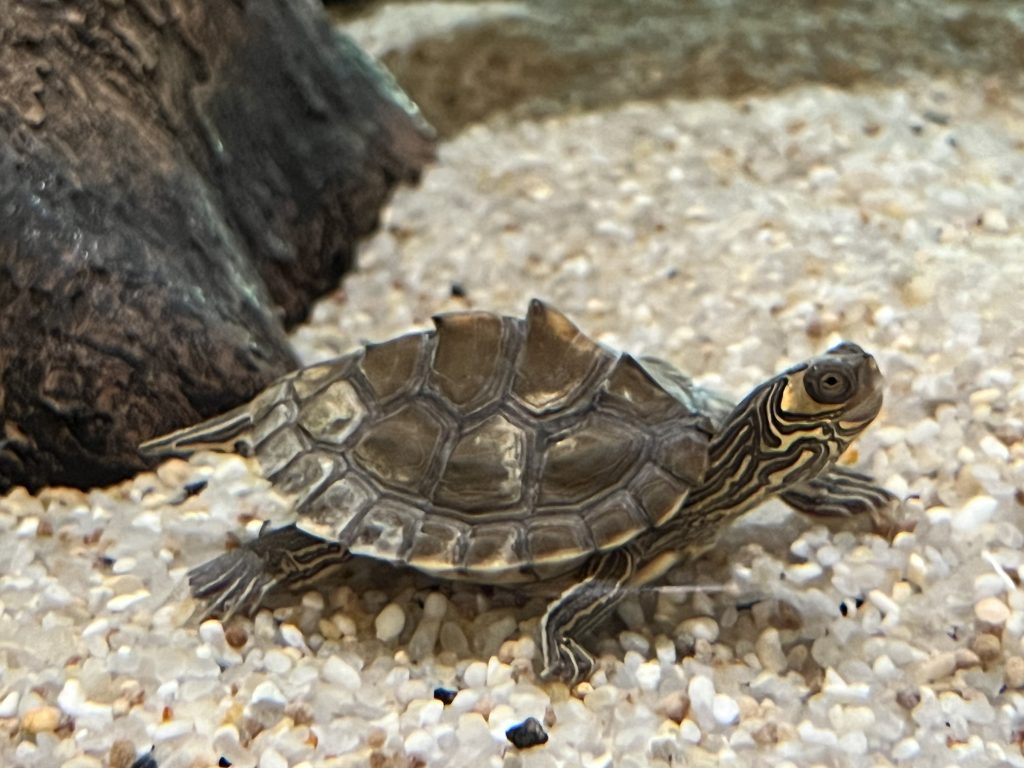
I saw this little guy in a display tank at a ranger station in Apalachicola, Florida. To me it was a “fancy slider” (in Michigan you mostly see painted turtles–which tend to be big–and red-eared sliders, which are this guy’s size, but with a smooth shell). But apparently he’s really a Barbour’s map turtle. Like the sliders and painted turtles I’m used to, he has extremely pretty yellow pipping all along his body (which I didn’t even try to capture). What I was really taken with was that spiky shell, and his tiny dignity.
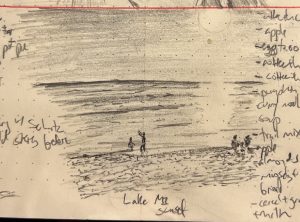
Both kids unanimously voted for this sketch, which is based on a photo I took in the summer of 2020:
My kids are the small figures playing in the surf near the middle of the image, but that isn’t why they chose it; they both really liked the play of the light on the water and the shadows on the beach.
I have to admit, I’m pleased with how the light on the water came out, too.
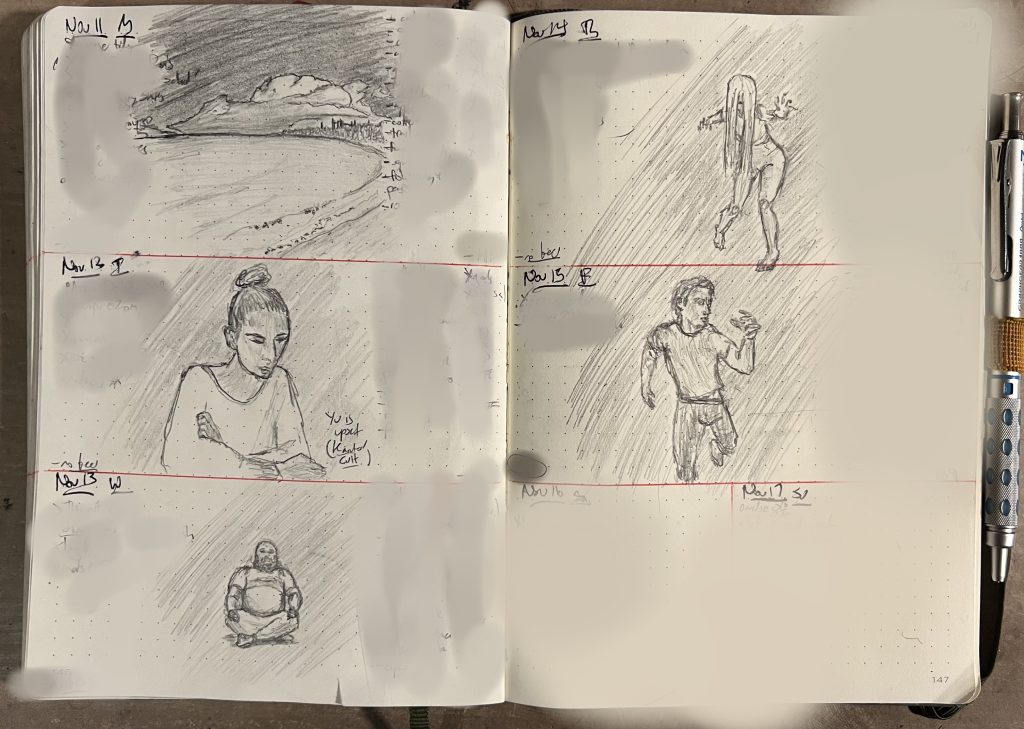
This week my son was entirely undecided; he liked everything. I was also pretty pleased, so here’s the full spread for the week:
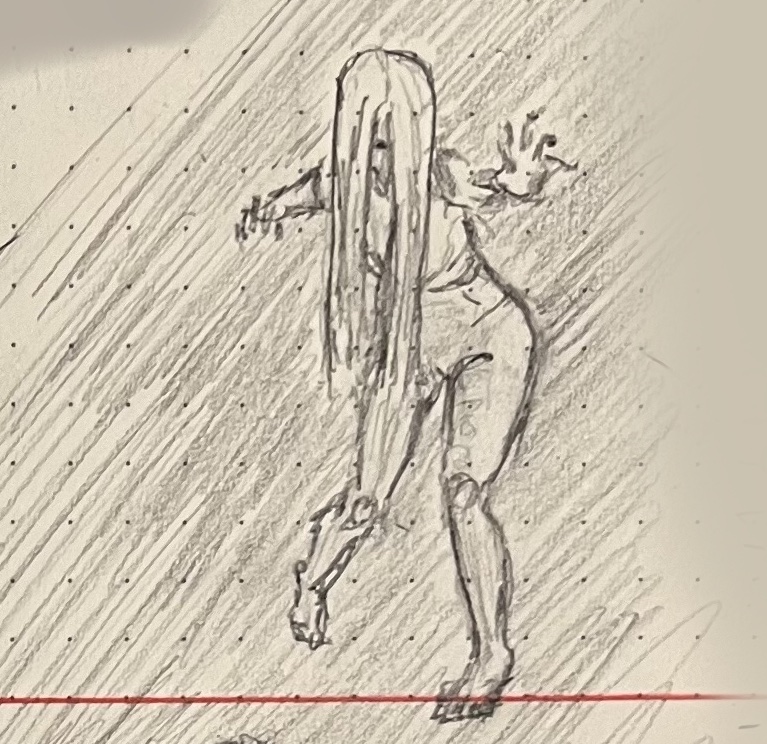
I did the creep and her victim on different days, and wasn’t as pleased with how he came out, which is why he’s cropped out above. Both of those figures are based on reference photos from The Pose Archives, which I adore.
Monday is a composite of a stretch of beach north of Fisherman’s Island State Park (FUN FACT: most of it isn’t an island; it’s the lakeshore, and may now be entirely inaccessible due to climate change) with some cumulus clouds in my neighborhood. I’m not anywhere near where I want to be with clouds yet.
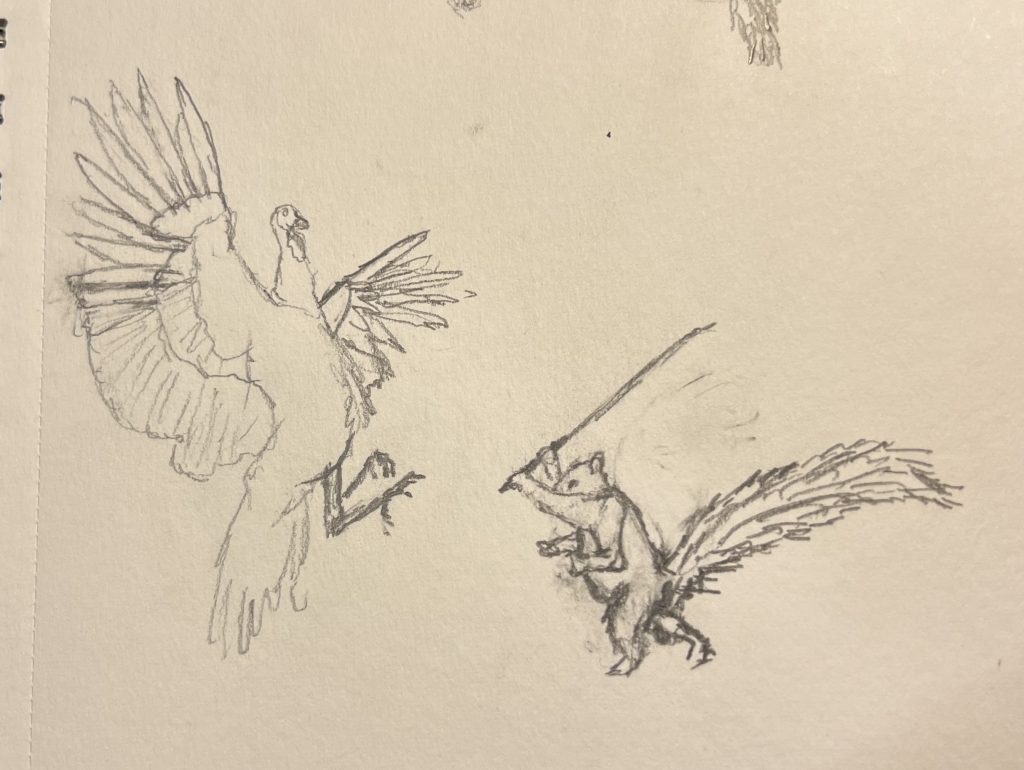
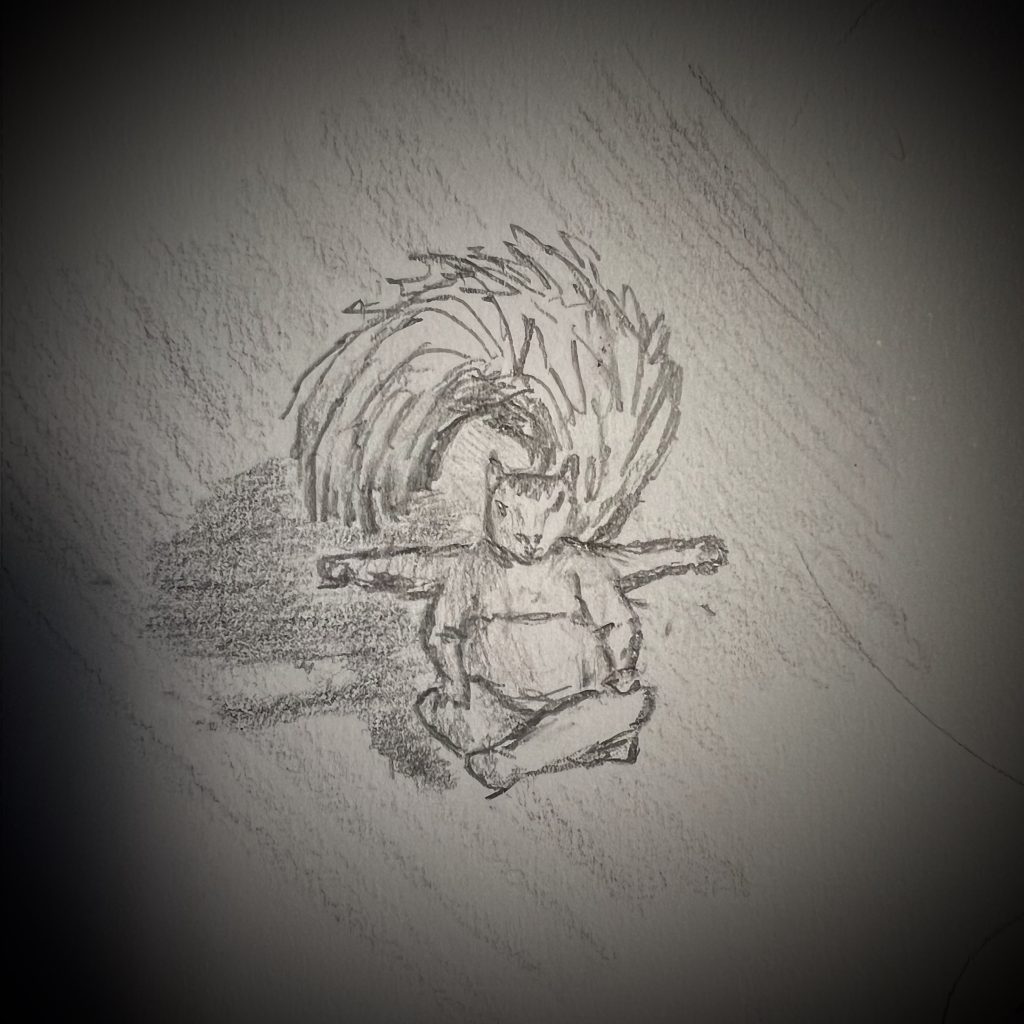
Wednesday is from a stock photo that’s been kicking around my phone for ages; I used him as a model for a six-limbed samurai squirrel back in June:
The squirrel was part of a joke either with my son or with my mom and sisters; I can’t really recall how I got there. A lot of what I do is the result of off-handed jokes gone too far.
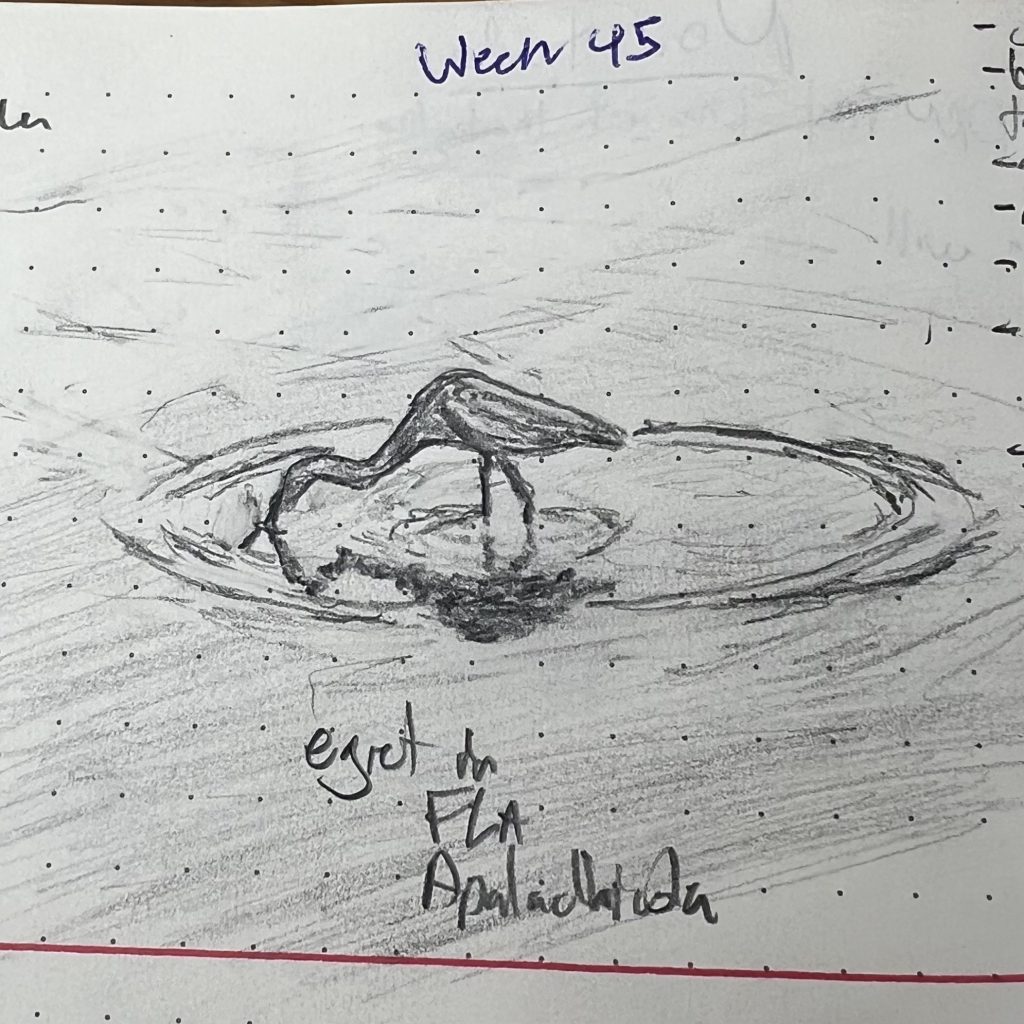
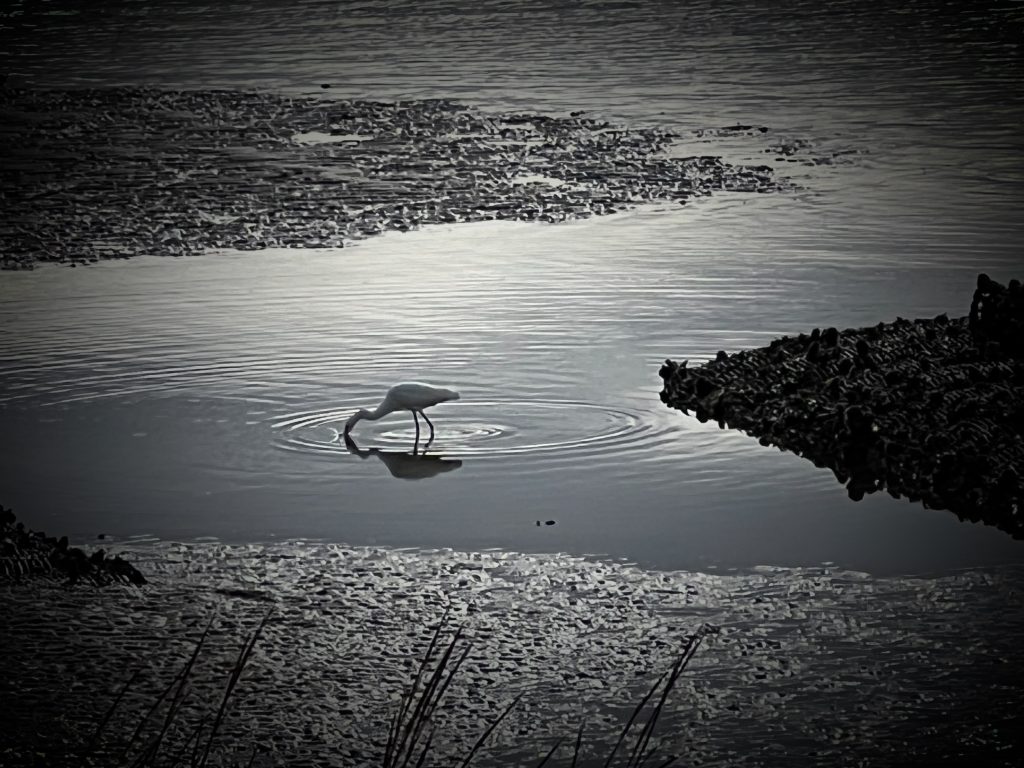
This is based on a snapshot I took last winter, while visiting the Florida panhandle’s “Forgotten Coast” (which I understand is now its totally obliterated coast, at least in some of the parts we were in). Here’s the reference photo:
I won’t be shocked if someone tells me that isn’t an egret; I’m not much for identifying what I see.
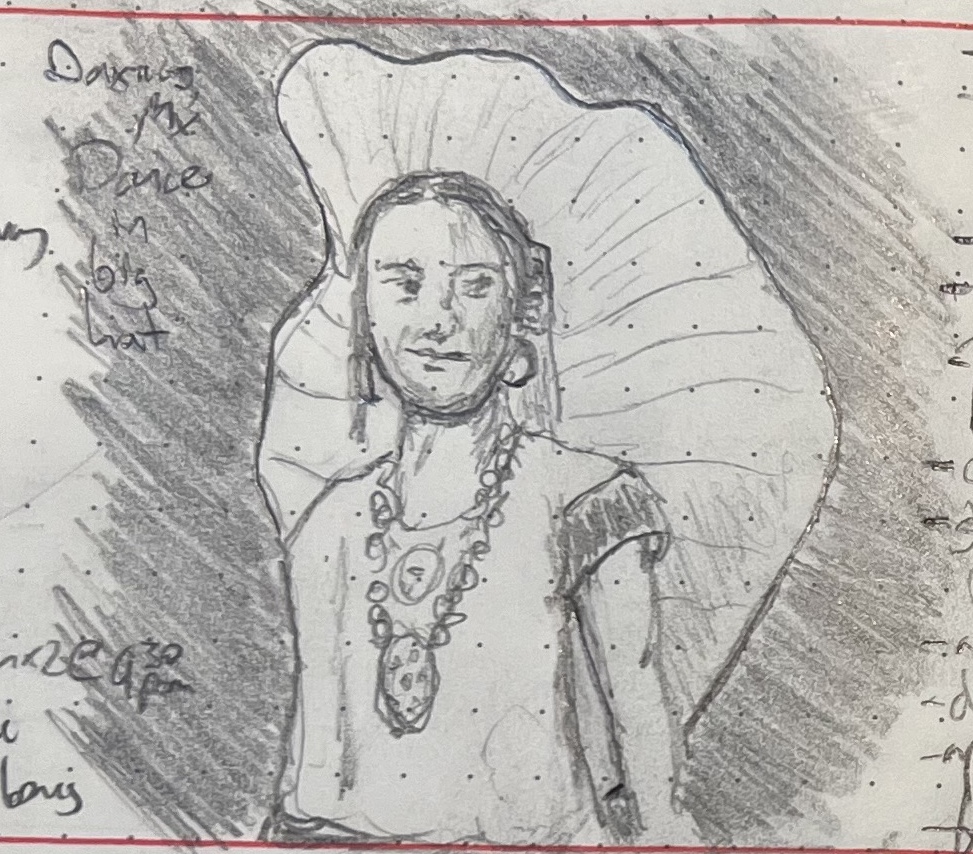
Anyway, the egret wasn’t my son’s vote for this week. He liked this Oaxacan dancer in the big fancy hat:
He was particularly pleased by her clothes. I like her, too.
Where I live in Michigan, there are a lot of wetlands. As a rule, when you build something that creates a lot of impermeable surface (like a warehouse or parking lot), you have to create someplace for the water to go, so it doesn’t strain our storm water systems or deliver a concentrated flow of surface pollutants to the rivers.
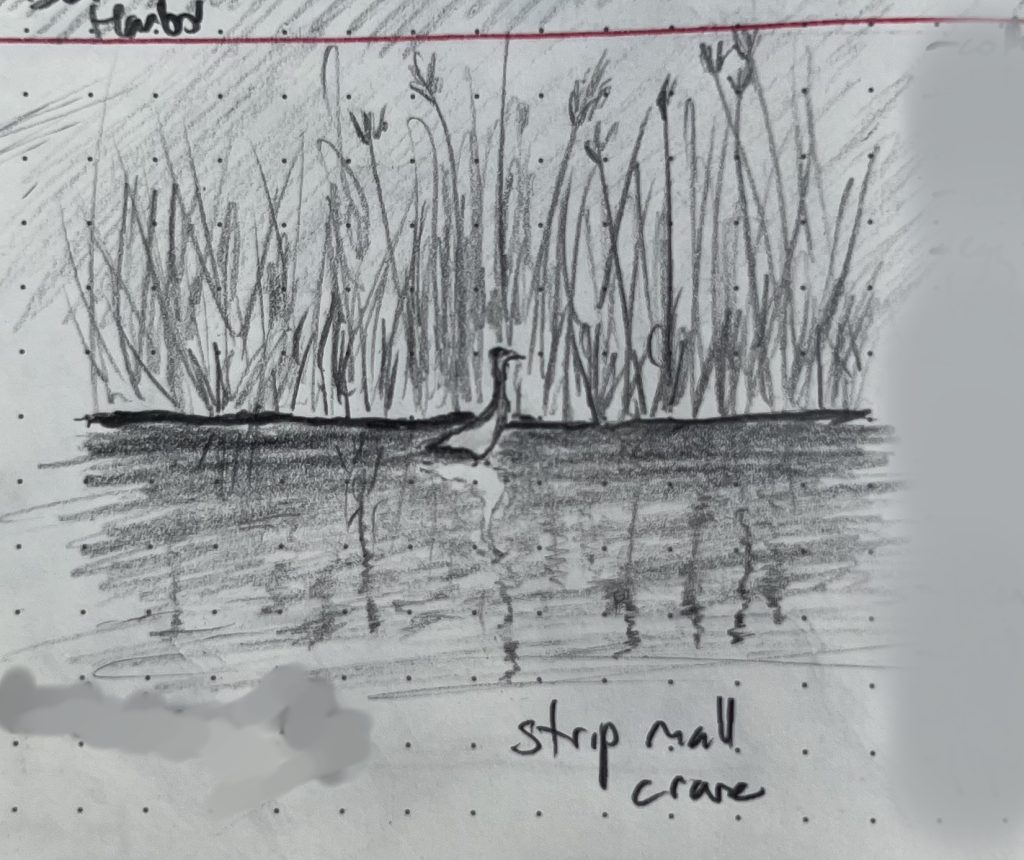
In practice, that means that lots of rust-belt Michigan office buildings and strip malls (i.e., the natural environment where I grew up, riding skateboards and bikes and playing tag and setting off fireworks and playing with slingshots) have little scrubby neglected wetlands next to them. These can become remarkably healthy and resilient little ecosystems all their own. I saw this little guy (who I’m 90% sure was a juvenile sandhill crane) while sitting in the car outside a Target waiting for my wife. If you could zoom out on this sketch a click or two, you’d see an Applebees and a freeway and an abandoned Chuck E Cheese—the many vibrant biomes of Southeast Michigan!
I believe sandhill cranes were endangered in Michigan when I was a kid. They were certainly a rare and exciting sight. Now they’re getting to be almost a pest species in some places. Every spring they take it into their head that a section of paved bike trail in Island Lake Park belongs to them and attack the unwary. A pal of mine got a black eye from one. #PureMichigan
My son was really excited by how the reflections came out on this one, as am I. Water is really, really hard to unsee enough to capture it in graphite.
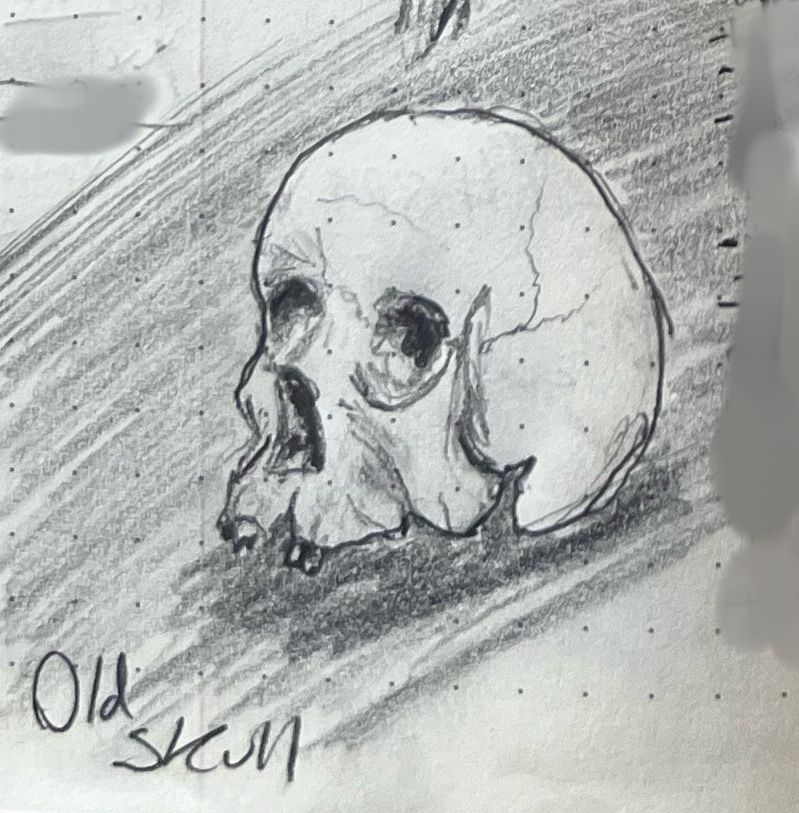
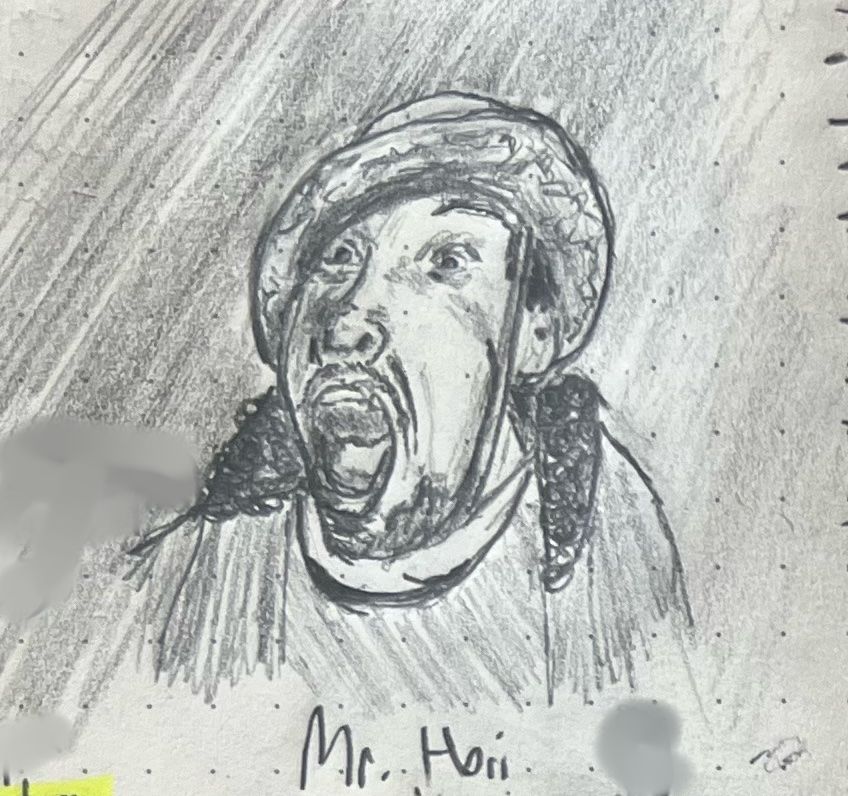
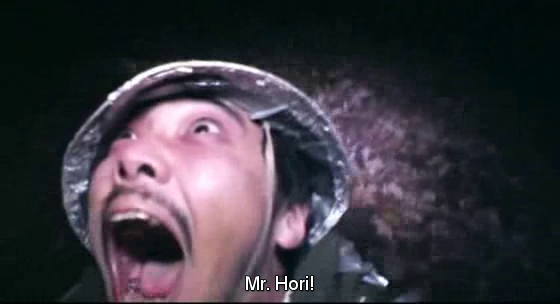
My son really liked the depth on the skull, but his actual vote for this week’s Sketch of the Week was this one of Mr. Hori from the film Noroi: The Curse, noting “the expression … is incredible”:
I personally was unhappy with how I elongated the face; Mr. Hori’s face is fundamentally round, but my hand kept wanting to regularize him against Munch’s “Scream,” I guess 🤷♀️.
I do feel like I get at least close to the extremity of Mr. Hori’s terror in that scene. (The actor, Satoru Jitsunashi, is pretty amazing in that role; he totally makes the movie for me.) Here’s the reference image (more or less; I was working from several stills I grabbed from the movie, because his whole face wasn’t ever in frame at once):
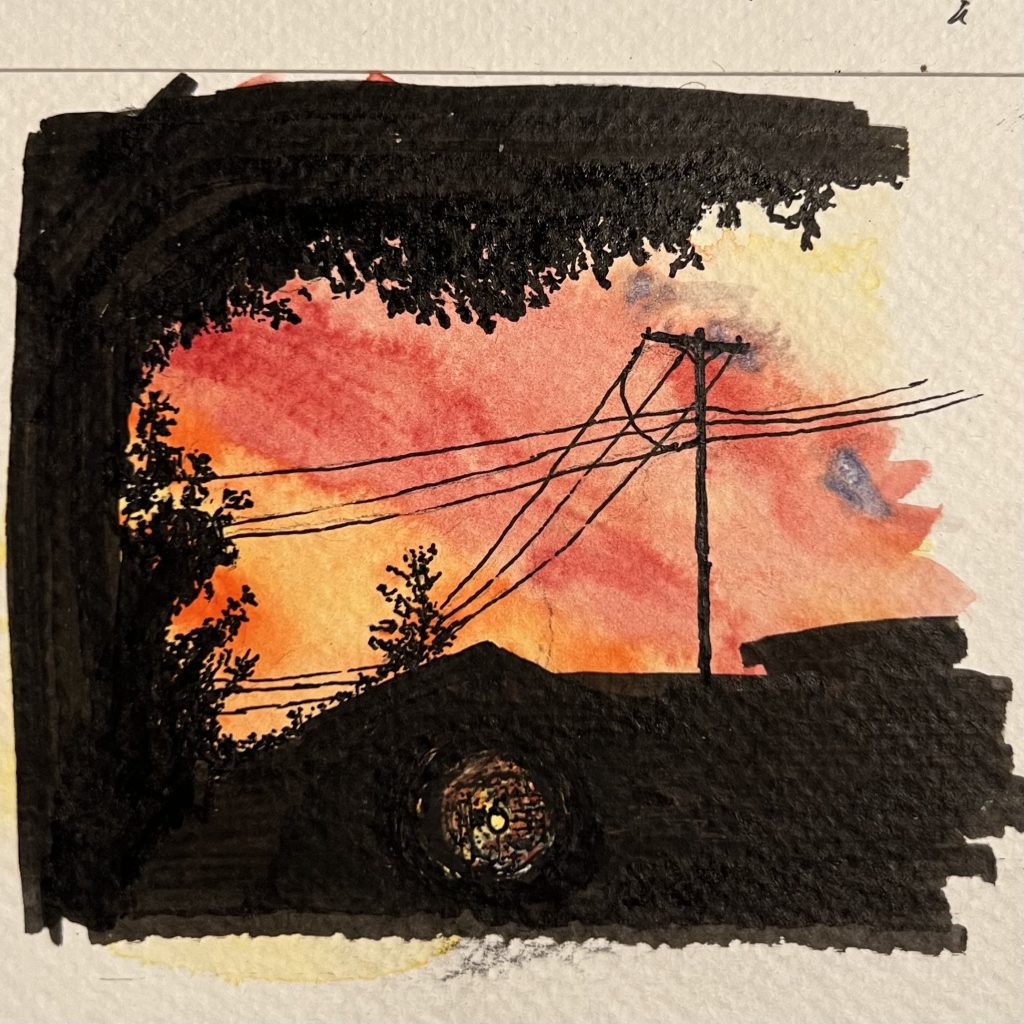
This week’s sketch is watercolors and India ink, of a house up the street after the sun has dipped below the treeline, but is still above the horizon:
Back when I was a teen I was taught two ways to use India ink: dip pen and bamboo calligraphy brush. You can do a lot with either, but Jesus are they fiddly. Also, the old bottle of India ink I have is not waterproof, which is great for certain effects, but often maddening overall (esp. against watercolor).
So this was done with Faber-Castell Pitt pens, which are amaaaaazing. Yeah, a dip pen can give you a much finer line, and an ink brush can do really interesting dry-brush and textural things that you can’t coax out of a Pitt pen. But in terms of bang-for-buck (esp. when the “buck” translates to hair-pulling frustration), the Pitt pen is hard to beat:
The India ink is dark and flat and deep, water soluble/flowable when first applied, but then dries absolutely waterproof. They have a ton of different nibs. For this sketch I used a 0.3 fine liner and a soft-brush (the later nicely emulates doing wet-brush work with a Japanese calligraphy brush, giving you all the expressiveness and none of the sorrow). The color of the sky was me experimenting with wet-on-wet watercolor.
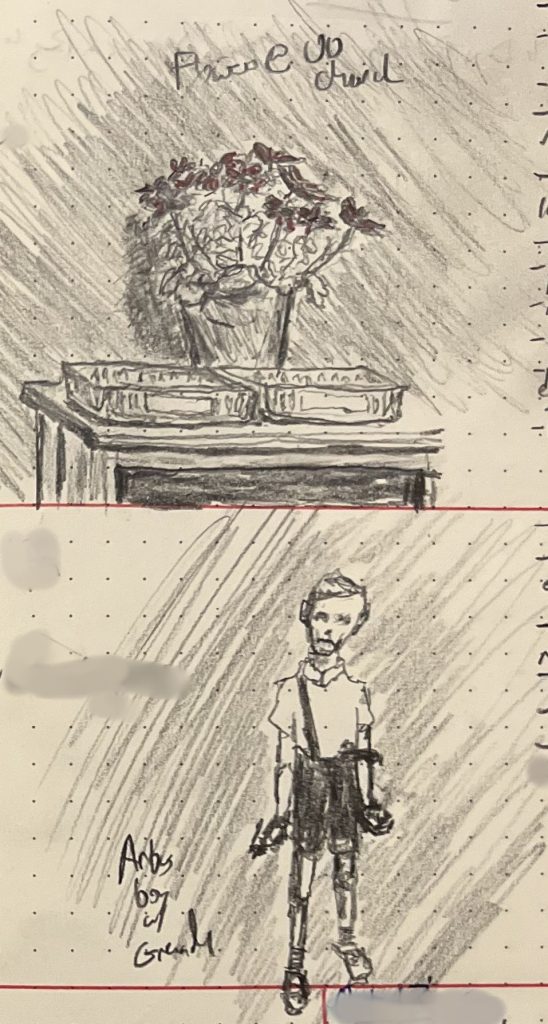
My son voted for the upper sketch, noting “holy heck I love the shadows on the flowers.” The model for this was a little table near the entrance of the Unitarian church where my congregation held Kol Nidrei service on Oct 11. I’m on our Safety Committee, and so had a shift watching the front door. Thankfully, it was an extremely boring shift, hence the sketch.
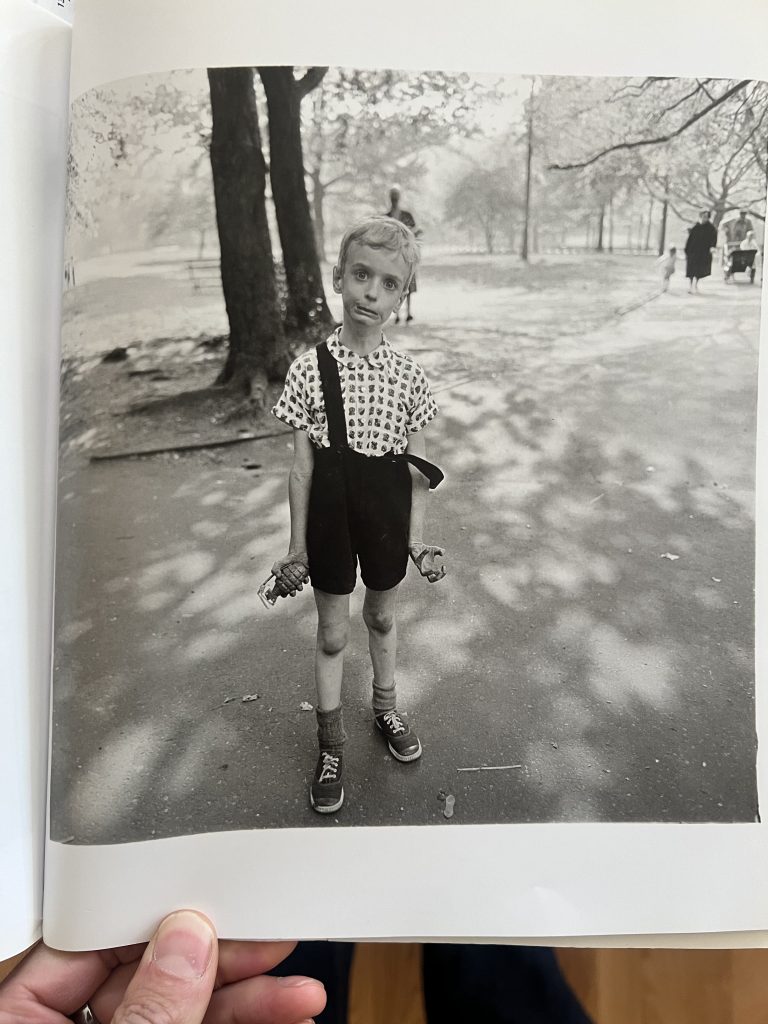
The lower sketch is based on Diane Arbus’s “Child with Toy Hand Grenade in Central Park, N.Y.C. 1962.” The sketch maybe looks pretty odd if you aren’t familiar with the reference. (Otto noted, “He’s adorable but I confess the angle of the head is kinda confusing me.” Then, after seeing the original, added “Pfff okay he just looks like that” and “Is that a grenade!?”)
Here’s my photo of a reproduction of Arbus’s original photo (which, stated like that, begins to sorta feel like I’m making a cheap Duchamp joke):