PROFESSIONAL WRITING TIP: Put the last sentence first

Here’s a bone-simple way most folks can instantly improve their writing:

Take a look at the last sentence; should it actually be the first sentence?

(HINT: The answer is most often “Yes! #duh! 🤦‍♀️”)

I make my living writing commercial copy (yes, still, despite the rise of AI). At one point earlier in my career I was often asked to “fix up” stuff a client had drafted. One day it dawned on me that, most if the time, the final sentence of a client-written paragraph/section/page should actually be the first sentence. In fact, I quickly discovered that in many cases I could basically just move the final sentence to the beginning, fix punctuation, bill my minimum, and everyone would be delighted.  

It doesn’t matter what type of writing it is—a work email, an article, a speech, a blog post, a product description, a sales page, an essay, even many stories or poems—just put the last sentence first and you’re writing will immediately be clearer and more compelling.


But, why?

What I think is happening here is that most casual writers draft entirely chronologically, “thinking with their fingers” (that is, clarifying their thoughts as they write). As a result, they arrive at the true heart of what they want to say—something I privately think of as “the nugget”—last since, having uncovered that nugget they’d been digging for, they feel a sense of closure and relief and stop writing. They look back at the last few sentences, say “There! Nailed it! This is done!” and walk away. If they revise at all, it isn’t true revision, just proofreading.

The thing is, reading is the opposite of writing (in much the same way that a motor and a generator are opposites: apply current to a motor’s wires, you generate motion at the shaft; apply motion to the shaft, you generate current at the wires). Writers arrive at the nugget last when writing—it’s the product of their process. But readers need to receive that nugget first, because they’ve shown up for the product; they don’t care about the process. (Think about it: people don’t start drinking beer because they took a brewery tour; they take a brewery tour because they already love beer.) First you give them the product, then you have some space to to them why they should care.

Incidentally, there’s a deeper lesson here, which should probably be the first sentence of this post:

Amateurs write chronologically; professionals write the intro last.

Yes, I’m asking for your financial support, but I’m also trying to figure out of I set up this Patreon x Mailchimp integration properly

This is a short ask. In addition to these meaningful distractions, I also write disturbing fiction. If you want to support that, you can do so on Patreon:

https://www.patreon.com/DavidErikNelson

Patrons get both the satisfaction of knowing that they, in some small way, are implicated in the things I do, and also fun bonuses (e.g., stories not available elsewhere, a short film, music, interactive fiction experiments, etc.)

I’m also trying to figure out of my Patreon x Mailchimp integration thingy is working properly (ideally it will automagically add new patrons to an existing email group so I can reliably send them stuff). So, if you become a patron at any level, you’ll get the additional satisfaction of knowing you’ve either confirmed that I’m at least as smart as an 8th grader, or sending me into fits of fury aimed squarely at every major platform that seems to think that UX “just happens.”

Michael Jackson on Fire Diorama

Combines the hypnotic analgesia of an “oddly satisfying”-style process video with a weird hallucinogenic tribal jaunt through the semiotic-drift of memory and Europe’s long palimpsestic history of animism and Patriarchal monothiem. 

Also, the pleasure of an Irishman doing his best loving tribute to MJ and sort of almost a brief folk-horror film crammed in the middle.

★★★★★ Recommended; would watch again.

EBOOK SALE! 99-cents!

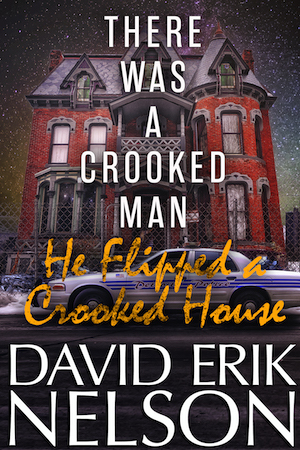
Wanna check out Detroit’s most extra-dimensionally cosmically cursed house? For a limited time it’ll only cost you a buck.

There Was a Crooked Man, He Flipped a Crooked House (a short horror novel by David Erik Nelson)

Stop! Don’t unlock the door, don’t go inside, and whatever you do, don’t look at anything in the library — because this house keeps itself occupied. Fans of the Twilight Zone, cosmic horror, and Detroit will love this “absorbing horror” (Rich Horton, Locus magazine, Recommended Story). “A Real Page Turner” (5-star review and recommended read, Rocket Stack Rank)

“re: Thesis defense issue…”

I loved this story, “RE: Thesis defense issue – kalirush 🐍” —and only later learned that it was a riff on an old McSweeney’s piece that, yeah, is fun but suffers from the baked-in McSweeney’s problem (i.e., that it “approaches humor with a lab coat and tweezers.”)

Anyway, this amateur fan-fic riff is better, because it is actually funny, not just theoretically funny and basically funny shaped.

[the image above is an XKCD comic]

The Groundbreaking “Computer Speech” Record from Bell Labs (1963)

Hear the groundbreaking “Computer Speech” record from Bell Telephone Laboratories, which features synthesized speech created by one of the earliest computer speech synthesis systems. Directed by D.H. VanLenten, this record represents a significant milestone in the development of speech synthesis technology. … You’ll also discover how punched cards were used to provide the computer with detailed instructions on how to manipulate the various formants to produce different sounds [and] explore the fascinating technique called formant synthesis, which involves simulating the resonances of the human vocal tract, and the IBM 704 computer used to generate the speech sounds. 

Incidentally, this record predates Kubrick’s 2001: A Space Odyssey by four years, and came out at least a year  before he began considering the project in earnest. We know that his work in 2001 was influenced by educational materials from the time; hard to believe this wasn’t one of them. 

Anyway, just for the record: this “talking computer” was exactly as intelligent as ChatGPT or any current AI, and considerably less so than a parrot—and inspired the same blue-sky certainty in the media. Hell, here’s an article about computers talking and reliably taking natural-language instruction within the next decade!!! (It was written in 1959.):

Screenshot of article from December 2, 1959 titled "Talking Computers Foreseen in Decade." The first paragraph reads: "Ten years from now it will be possible literally to speak to an electronic computer and have it answer right back.…"

Observers will note that was a somewhat optimistic estimate (the first commercial product that approximated this functionality was released in the 2010s) .

famous ∧ children’s author ∧ British ⇒ antisemite

From Lewis Carroll’s Symbolic Logic (1896):

A picture of the “examples” (presumably of syllogisms) on page 109 of Lewis Carroll’s “Symbolic Logic” (1896). The examples read as follows:

#19 A prudent man shuns hyaenas;
No banker is imprudent.
	No banker fails to shun hyaenas.

#20 All wasps are unfriendly;
No puppies are unfriendly.
	Puppies are not wasps.

#21 No Jews are honest;
Some Gentiles are rich.
	Some rich people are dishonest.

POSIT: IF you are a famous children’s author AND you are British THEN you are an antisemite.

(cf. Roald Dahl, J.K. Rowling, this asshat, probably Rudyard Kipling, etc.)

As an aside, the fact that Carroll (who came from a family of high-church Anglicans and took holy orders) wrote #21 tends to give credence to #20: All W.A.S.Ps are unfriendly.