I’ve finally sorted out my micropayment/subscription situation. Here are a couple easy ways to support my kinda weirdness:
KO-FI: Think of this as a “virtual tip jar.” If we were to bump into each other at the cafe, and you’d wanna buy me a coffee or beer and chat—well, this is a way to do that. My personal guarantee to you: Basically every penny I get this way gets converted first into coffee/beer, and then to words.
PATREON: If you’d like to support my brand of madness on a recurring basis, Patreon makes that easy. Even at the lowest tiers, supporters get access to previously unpublished fiction. That currently includes my novella And Lo She Dwelt in the Great Sadness—which will likely prove diverting to folks frustrated by our current political situation. New stories will be added in coming months.
… but it also makes me so fucking sad to see humans working all day in an indigo coal mine in order to make people who don’t move much all day look like they’ve worked hard all their lives.
—about some folks who really can’t leave the house:
I mention this now because I just learned that Audible is temporarily bumping artists’ royalties—which is nice, as I used their service to produce the audiobook of There Was a Crooked Man, He Flipped a Crooked House (voiced by the inimitable David Sadzin).
If you’ve never tried Audible before, it’s actually pretty sweet—I used it for years when I used to commute. These days, your monthly membership gets you a full-length audiobook and two Audible Originals each month. The first month is free with this link (here’s a UK-specific link, for those who need one). The thing that astounds me: Even though I haven’t been a member in more than 13-years, I can still access all the stuff I got through Audible back in the day—i.e., you really do have lifetime access.
This poem—penned by a UU minister—has been circulating among my Jewish congregation, and I’m inclined to endorse the advice: Take a page from the Jewish playbook, folks. We know a thing or two about surviving long (quasi-)confinement and social distance.
Pandemic
What if you thought of it
as the Jews consider the Sabbath—
the most sacred of times?
Cease from travel.
Cease from buying and selling.
Give up, just for now,
on trying to make the world
different than it is.
Sing. Pray. Touch only those
to whom you commit your life.
Center down.

And when your body has become still,
reach out with your heart.
Know that we are connected
in ways that are terrifying and beautiful.
(You could hardly deny it now.)
Know that our lives
are in one another’s hands.
(Surely, that has come clear.)
Do not reach out your hands.
Reach out your heart.
Reach out your words.
Reach out all the tendrils
of compassion that move, invisibly,
where we cannot touch.

Promise this world your love—
for better or for worse,
in sickness and in health,
so long as we all shall live.
Is the (semi-)official website for Michigan House Republicans (for example, their official Facebook page links to “MiHouseRepublicans.com” which currently redirects to “GOPhouse.org”)
Is there something really obvious going on here, like my local DNS being poisoned? Or does the MI House GOP just have a really crappy web hosting situation? Or deeply untrustworthy staff? Or a deeper commitment to the free market and entrepreneurship than I’d previously imagined?
Who do I even call to ask about this? ’cause I’ve gotta believe that the MI House GOP has a better fundraising model than this.
This is the age of war. This is the age of entire this is the age of strife, this is the century upon which this current civilizations rotting Jew infested country comes to a collapse. You were born in the wrong century for complacency. That’s all for now.
Patrik Jordan Mathews, on or before December 13, 2019
While residing in Georgia, Mathews stated that he “only exists for the White Revolution now.” Mathews further stated that he wanted to remain a “ghost” and oversee safe houses for Base members who need to disappear. Mathews stated that once there are a few “ghosts,” they could begin doing “jobs,” by which Mathews meant targeted violence or attacks.
Based on other statements in the legal motion, these targets were likely to be Jewish- or African-Americans. I’ve mentioned Mathews’ had been hiding out in Michigan, yeah? And I live in Michigan? And my family and I, we’re the kinds of Americans he came here to kill?
The U.S. tax system is unnecessarily stressful. There are tons of reasons for this—a major one being that companies who provide tax-prep services lobby heavily to keep it that way.
Fortunately, the government offers you some free tax software to make your life much, much easier. Unfortunately, the expend almost zero effort letting anyone know these exist (see the heavy lobbying mentioned in the previous graff).
Here are two free tax prep options for 2019/2020:
If you make under $36k (or are active military making under $69k), the government forces Intiuit (the makers of TurboTax) to help you out: IRS Free File Program by TurboTax.
(This is a version of something I drafted for my local faith community, where I’m active in safety/security. Faith communities offer lots of programs for the very young, very old, and very vulnerable—and we tend to crowd lots of folks into one room; disease transmission is more of a concern than it might be for a workplace full of healthy young adults who can afford and access health care services.)
Folks are worried about Coronavirus (i.e., “COVID-19”)—and this isn’t unfounded (see the “REASONABLE COVID-19 CONCERNS” sub-section for details).
While there are good reasons for concern, there are also very basic steps we can all take to reduce both the risk of infection and the severity of any disruption to our lives should an outbreak hit nearby. Please feel free to share any portion (or all) of the following info with your people. Thanks!
REASONABLE COVID-19 CONCERNS
As of this morning (March 2), there have been two reported Coronavirus (i.e., “COVID-19”) deaths in Washington state. Given
how it’s transmitted (airborne droplets from coughs and sneezes)
and our best guesses at it’s transmission rate (or “R0”; current estimate is that COVID-19 has an R0 of “2”, which means each infected person will infect ~2 others),
this all tends to imply that the disease has been spreading in WA for ~6-8 weeks, and there are hundreds of cases there now (I heard an estimate in the thousands on NPR this morning, but didn’t catch the source, and so take it with a grain of salt).
On the one hand, this is obviously concerning: COVID-19 is ~20x more deadly than the seasonal flu (which kills tens of thousands annually). On the other hand, a 2% mortality rate implies a 98% (or higher) survival rate, and an R0 of 2 isn’t great, but it also isn’t a Stephen King story: COVID-19 is more contagious than seasonal flu (which has an R0 of ~1.3, I think) but much less so than measles (R0 ~15) or whooping cough (R0 ~5). (Incidentally, all of those are also primarily transmitted through airborne droplets).
Usually, diseases like COVID-19 are most dangerous to the very young and very old. Based on limited studies in China, it appears that even the very, very young have no trouble fending off COVID-19. That’s great! But that means the mortality rate for COVID-19 falls hardest on the elderly and those with existing health problems.
REASONABLE COVID-19 MEASURES
ENCOURAGE HAND WASHING! I know it seems silly to say, but that’s the Number One way we can protect ourselves and our community members (especially the infirm and our elders). Make sure to review this with any kids you keep around; they chronically short-change hand washing. The young aren’t at very high risk of dying from COVID-19—but are excellent candidates for spreading it. (Also, as someone who regularly uses public men’s room, I’ll level with you: Maybe also review this with adults you know.)
Soap and water beats hand-sanitizer every time!
Wash hands with soap for at least 20 seconds (i.e., sing “Happy Birthday to Me” twice while washing hands).
Make sure to scrub between fingers, down the backs of the hands, and focus on the finger tips.
Dry vigorously with paper towel—the friction does a lot of the work of removing pathogens.
Wash hands upon returning home from school/work, before and after meals, after you cough or sneeze, and any time you’ve been touching something folks likely coughed on (e.g., shared computers/tablets, ATMs, public handrails, etc.)
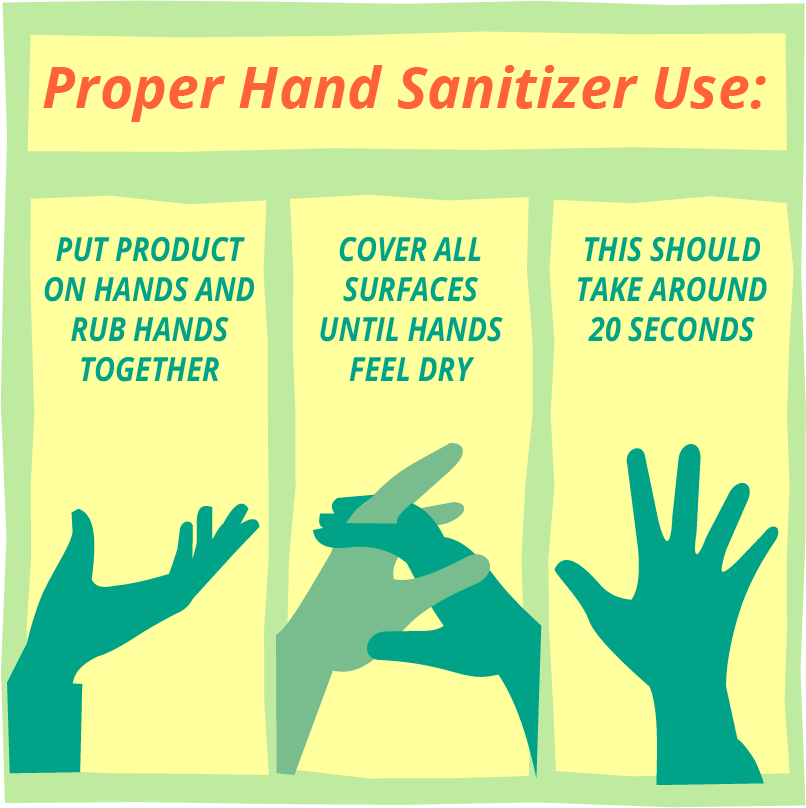
Failing all else, hand sanitizer is better than nothing. Proper use us just like soap & water: Cover hands, scrub for 20 seconds, focus on getting between fingers/down backs/and rubbing fingertips.
Cough into the elbow crook: At school my kids were taught that this was called the “vampire cough”; I love that!
Plan for school closures: It’s gonna happen, just like snow days. Be ready—and be ready for your day care to be closed, too. Make advance plans with work to telecommute, have backup helpers in place, and so on. Make sure your Netflix and Disney+ subscriptions are paid up. Invest in a game system.
Take care of yourself: Disease strikes the stressed, tired, and weary. Drink plenty of water, get plenty of exercise (go on a walk before the ice returns!), and get plenty of sleep.