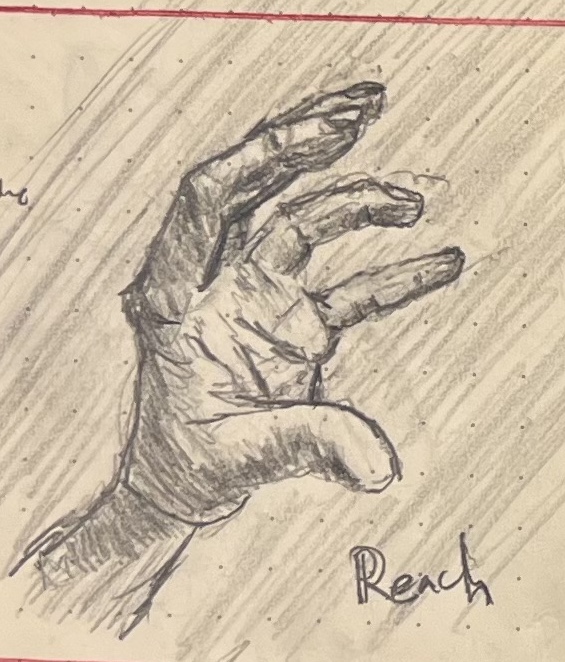
Folks often complain about drawing hands—hands are hard! And they are 100% right: Hands are hard to draw. The one unalloyed good that has come from the advent of generative AI is that it’s objectively confirmed that hands are really hard to get right: we used supercomputers to capture, encode, digest, and average all human art ever, and even it consistently fucks up the hands. That is some poignant shit right there.
But hands are sort of awesome models. I’ve probably drawn more left hands than anything else in my life, because I’m right handed, which means there is one model I always have with me that can adopt as wide a range of poses as the entire human body. If you want to sketch and improve at sketching, your hand is an amazing model.
Anyway, even with decades of drawing hands, they’re still hard. A lot went wrong with this sketch as I worked it, but it ended up in the right place: it captures, to my satisfaction, something ineffable I was feeling about the human condition, and it does so in three square inches of pressed wood pulp and graphite, in a way that you can either grasp or ignore at a single glance.
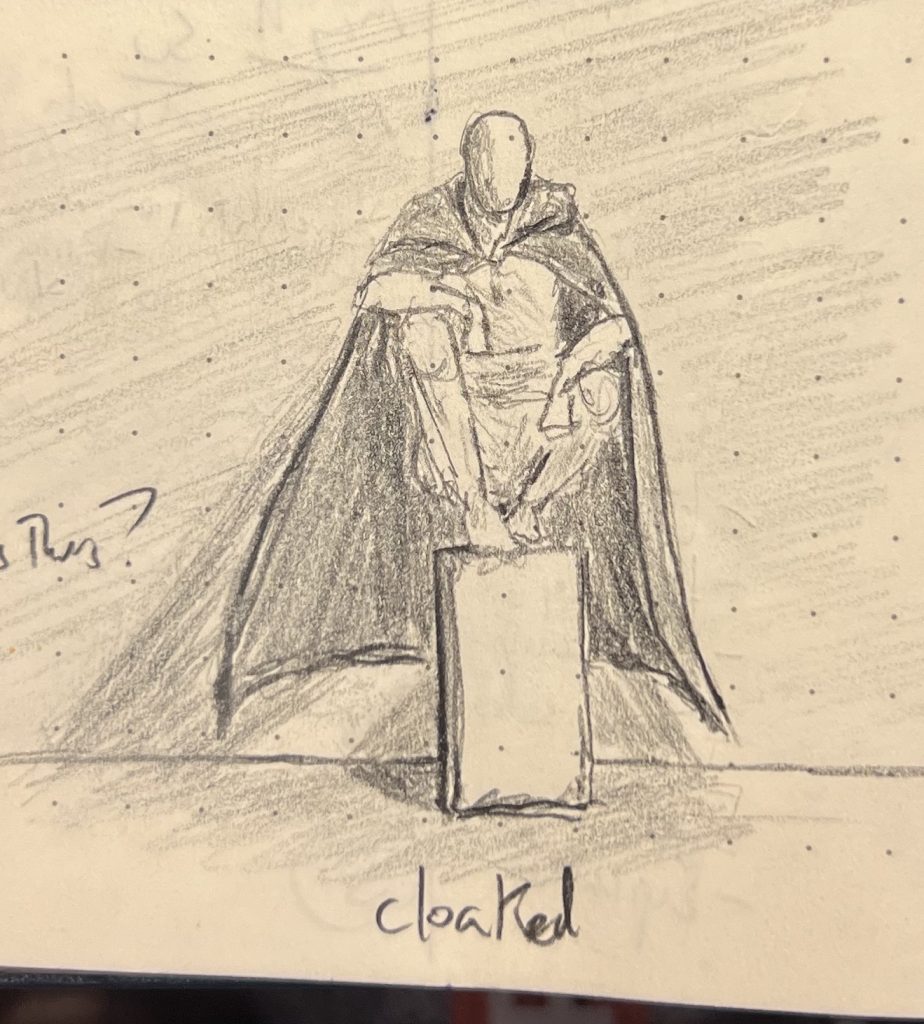
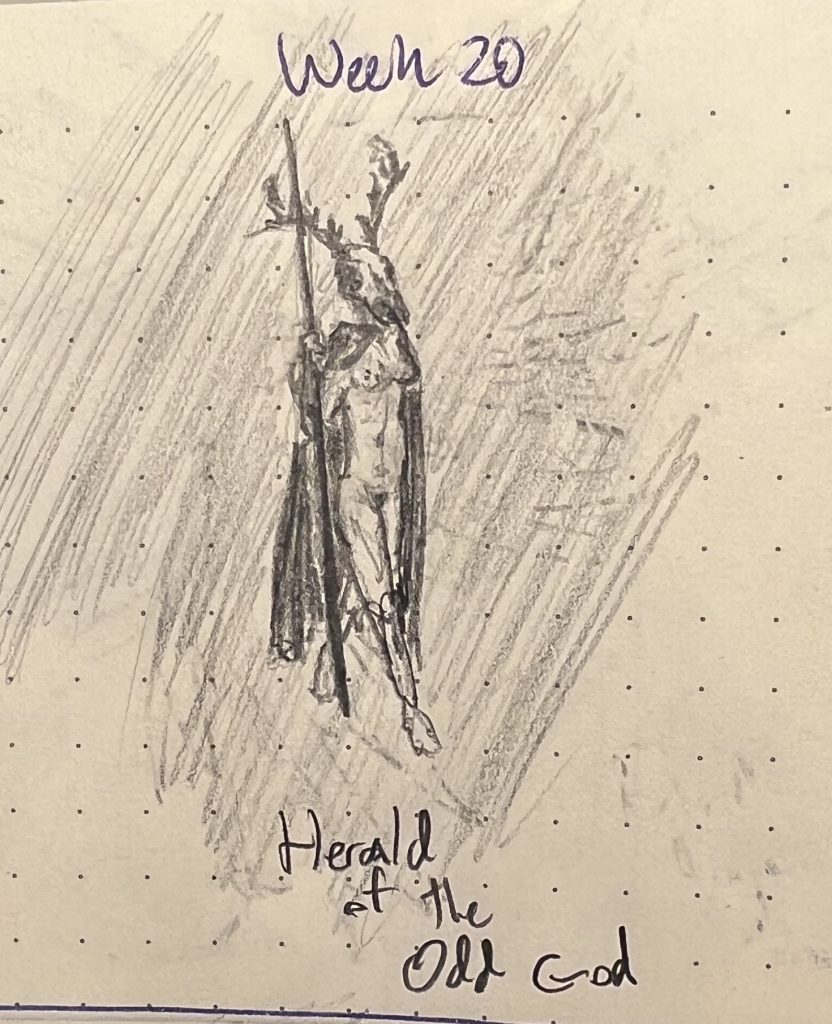
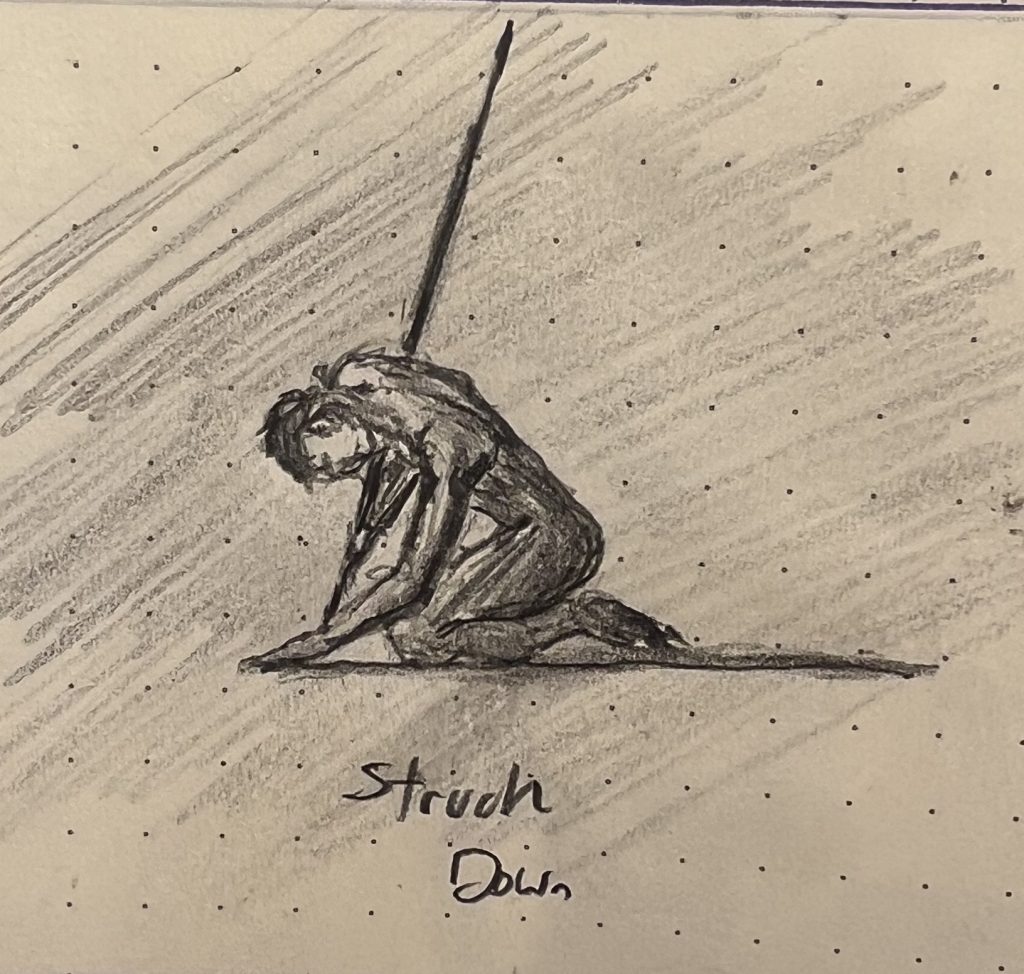
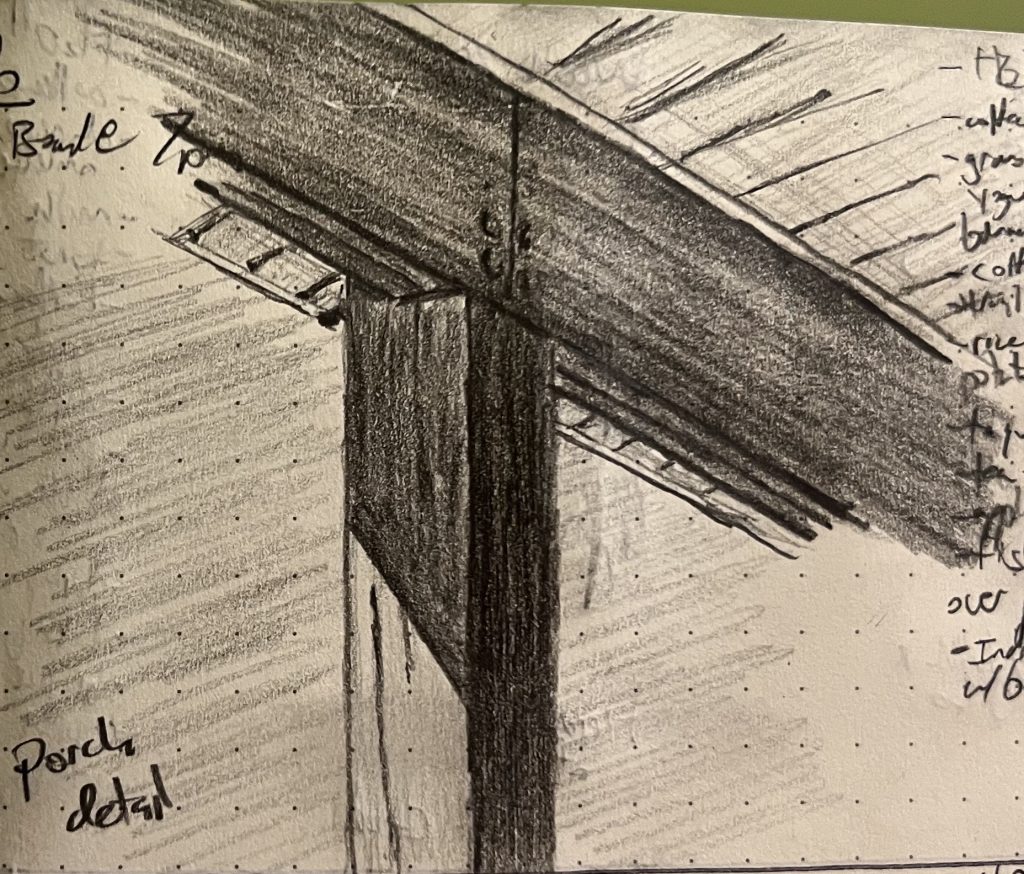
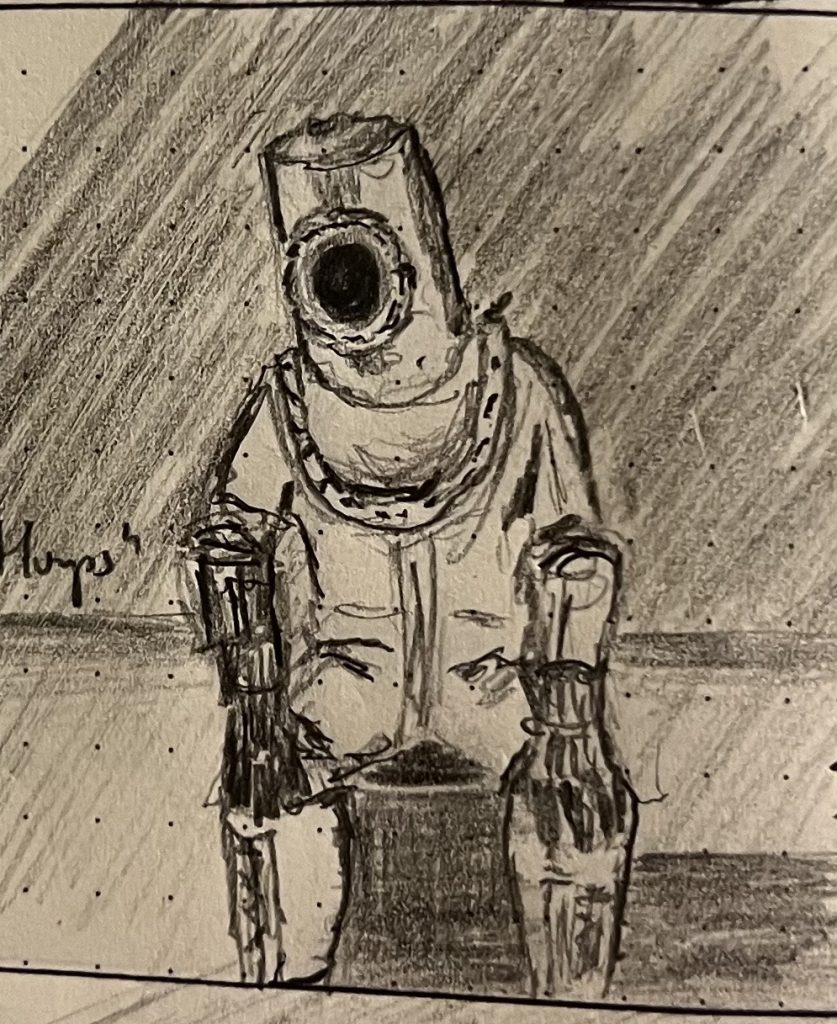
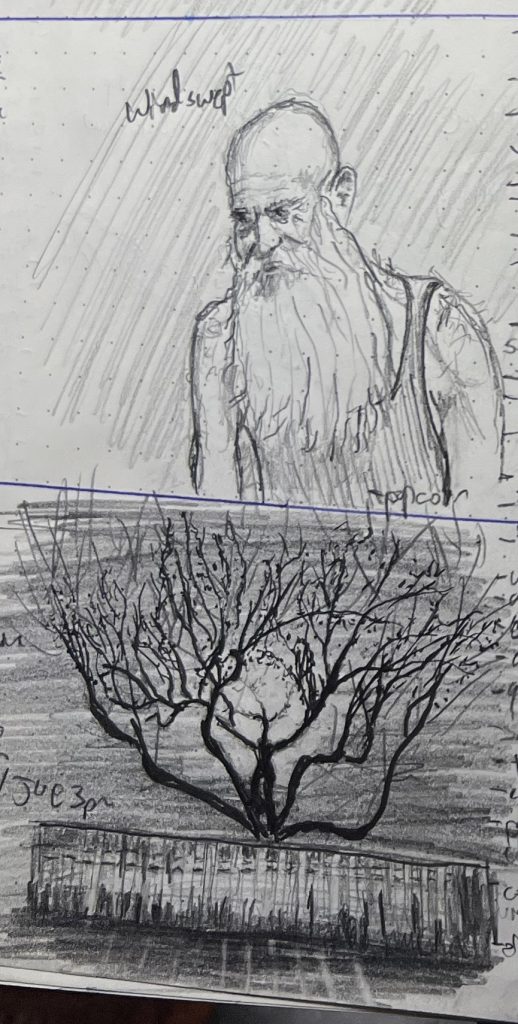
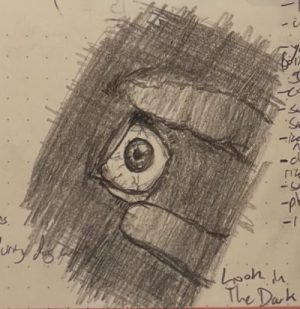
Another week where Sketch of the Week was disputed; my son felt strongly that the lower sketch of the sunrise through a just-budding cherry tree, was the stronger work technically, in that it captured something about the way light behaves in that situation that he found delicious. I preferred the windswept old man, because of the way he teeters between sinister and good-humored in the same why the open eye from Week 14 vacillates between terrified and enraged.
As an aside, and totally unrelated to why this is an important story (and especially so right now), this piece both explains and perfectly epitomizes why I love the stories I love, and what’s missing from those I don’t love, for whatever that is worth.
Burning Chrome was a favorite of mine in the mid-1990s, when I first read the title story in an Oxford sci-fi anthology I found for a couple bucks at a used bookstore.
Before that decade (and century, and millennium) was done, I’d read every one of these stories more than once, fascinated with the future Gibson painted, one I could see just around the corner. Some of these stories (like “Johnny Mnemonic” and “Burning Chrome” and “Dogfight”) I read over and over and over again. The best of these (esp. those last two) are really solid, tight, classic noir tales (albeit ones modeled after Jim Thompson’s The Grifters more than Dashiel Hammett’s gumshoes). The rest are, at best, stylistic sketching exercises; they more often have punchlines than plots. Gibson wrote all but three of these stories before Neuromancer, his debut and breakout novel (published in 1984.) Prior to 1982, Gibson doesn’t appear to have precisely known what a plot is. I’m not sure he’d argue with me on that; he’s said himself that although he’d been writing “stories” since the 1970s, the first one that was actually a proper story was ”Burning Chrome” (published in 1982, and basically a prototype for Neuromancer).
Cyberpunk is a future that looks an awful lot like the past, especially now (although even then, Gibson was firmly rooted in the past, sometimes formally—as with “The Gernsback Continuum”, other times more subtly, as with the noir plots he gravitates toward, and which become the heist/resistance themes that seem to form the skeleton of most cyberpunk stories still).
I’m old now, and Gibson, it turns out, is to me what Hugo Gernsback/1950’s “Populuxe“/Frank Frazetta/“Googie”/Eero Saarinen were to him. I think it’s appropriate that these are primarily visual artists and movements: Gibson has always been more of a visual artist and stylist than a writer, despite how culturally and politically prescient his writing has been. I’m given to wonder if that is why he’s proven so upsettingly accurate in his predictions (which I don’t think he thought of as predictions at all): the “Deep Pilot” might express itself in words, but runs its pattern matching on a purely aesthetic basis. We may be talking apes today, but at heart we will always be the monkeys that first daubed paintings of the world we hoped—or feared—we’d soon see on French cave walls.
“The future is already here — it’s just not very evenly distributed.”
Before this year, I had no clue The Power or Naomi Alderman existed—despite the acclaim the book met when it was published in 2016, and the fact that its apparently been made into an Amazon mini-series starring Toni Collette, who I absolutely love. A colleague in a crit group read a story I was working on, and recommended I read this. She was absolutely right.
When I say this is the bravest and most horrifying book I’ve read in ages, I’m not exaggerating. I actually had to stop about 10 minutes from the end because I was in a Thai restaurant in Orlando and was on the verge of bursting into tears, and didn’t want everyone staring at me. This book is easily better, and darker, than Atwood’s Handmaid’s Tale (both a book and artist I hold in hella high regard).
One clarification: when I told my wife that this book was the bravest and most horrifying thing I’d read in years, she totally misunderstood what I found horrifying in the book. She assumed I was upset by the rapes. There are several very graphic and traumatic rapes of men by women in this novel, as well as broader sexual subjugation of men.
Frankly, none of that really bothered me. I’ve read fictional depictions and non-fictional accounts of the rapes of men and boys that I’ve found more upsetting. Talk to anyone who’s worked for child protective services and you’ll hear an earful. Humans are, on balance, awfully creative when it comes to being awful.
What got me about this book is that, evidently and despite it all, there was some small part of me that had continued to really and deeply believe that “everything would be better if women were in charge.” Alderman meticulously dismembered and violated that foolish, optimistic child that was still hiding inside me.
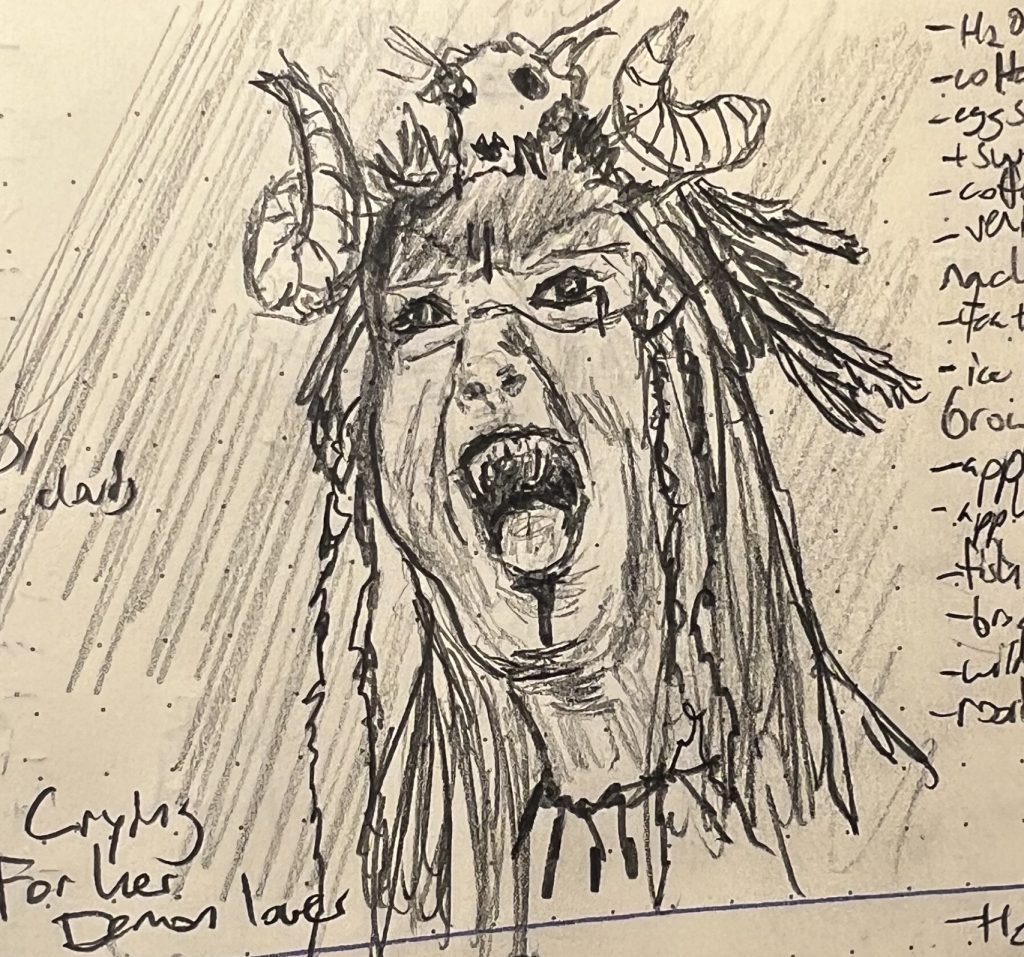
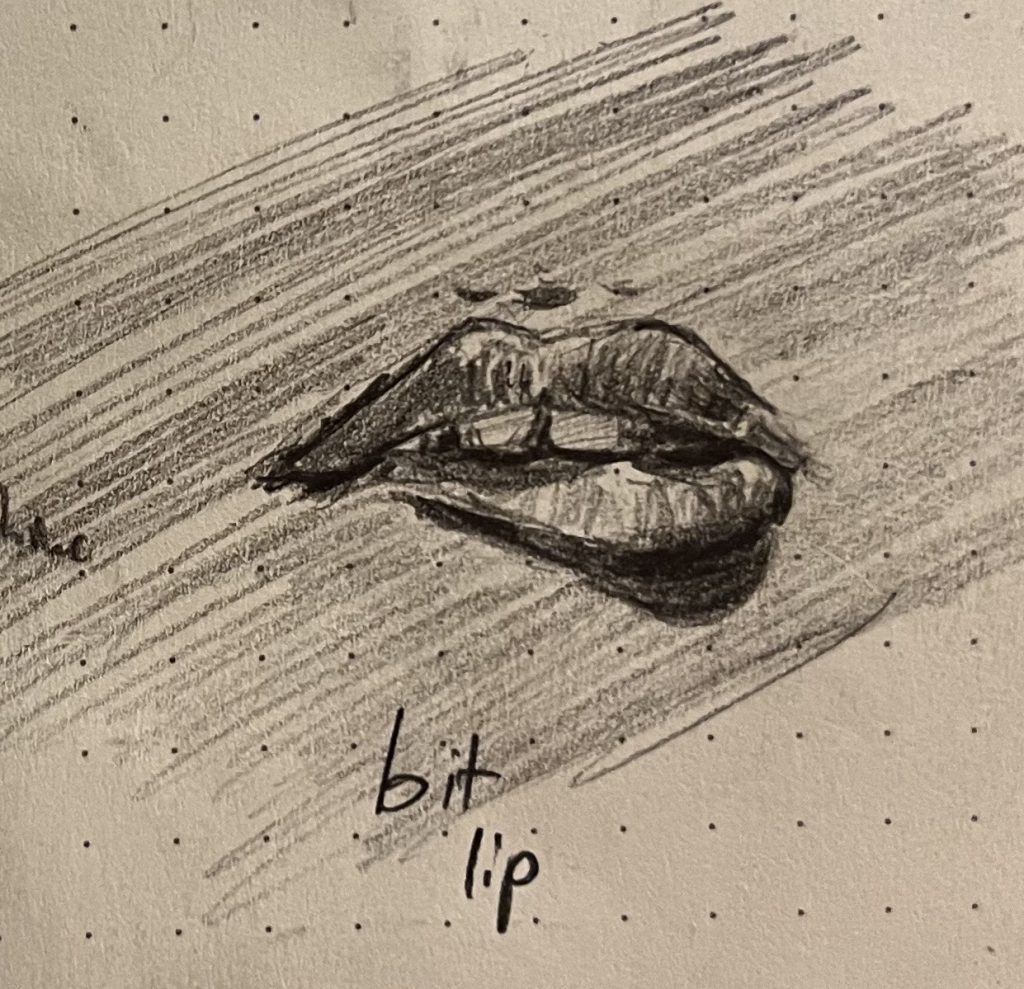
Last week I started thinking about how facial features are inherently disturbing when they are looming out of the gloom or otherwise decontextualized. Hence these sketches.
I was especially pleased with the eye, and how from moment to moment you can’t quite land on whether it is terrified or enraged. I’m inclined to think “both,” that there is a situation in the dark where you are peeling open your eye—or someone is doing it for you—and you yourself cannot reliably determine if you feel terrified or enraged, or both and in what proportions. If I were to title that sketch as a standalone piece of art, it would be “Reading the Newspaper at the End of the Day in 2025.”
All of this was inspired by this sculpture by Hirotoshi Ito:
Feel free to google him. There’s more Ito where that come from.
Sorry again for the long break; I was sick, and then I was at a conference in Florida, and then I was on vacation in Michigan’s UP, and now I’m back.
My son was emphatic that this was the sketch of the week, because he liked the composition and the implied narrative and the fact that there was dialogue:
I’m not so sure. From a technical standpoint, I think this sketch of a single stone on a Lake Superior beach just outside Porcupine Mountain Wilderness Area is the better sketch:
I have the grit on the sand all wrong (I got sloppy, and the technique was no good to begin with) but I feel like I got the depth of the shadow right for maybe the first time ever.
Anyway, it’s not really my call which is “best”; that’s for you. I get what I get out of them in the drawing, and in sharing them with my son.
I didn’t post a sketch last week because 1) I was absurdly sick with influenza A and 2) wasn’t really happy with anything I drew that week. I’m less sick this week, and more satisfied with my work. My son voted for this sketch:
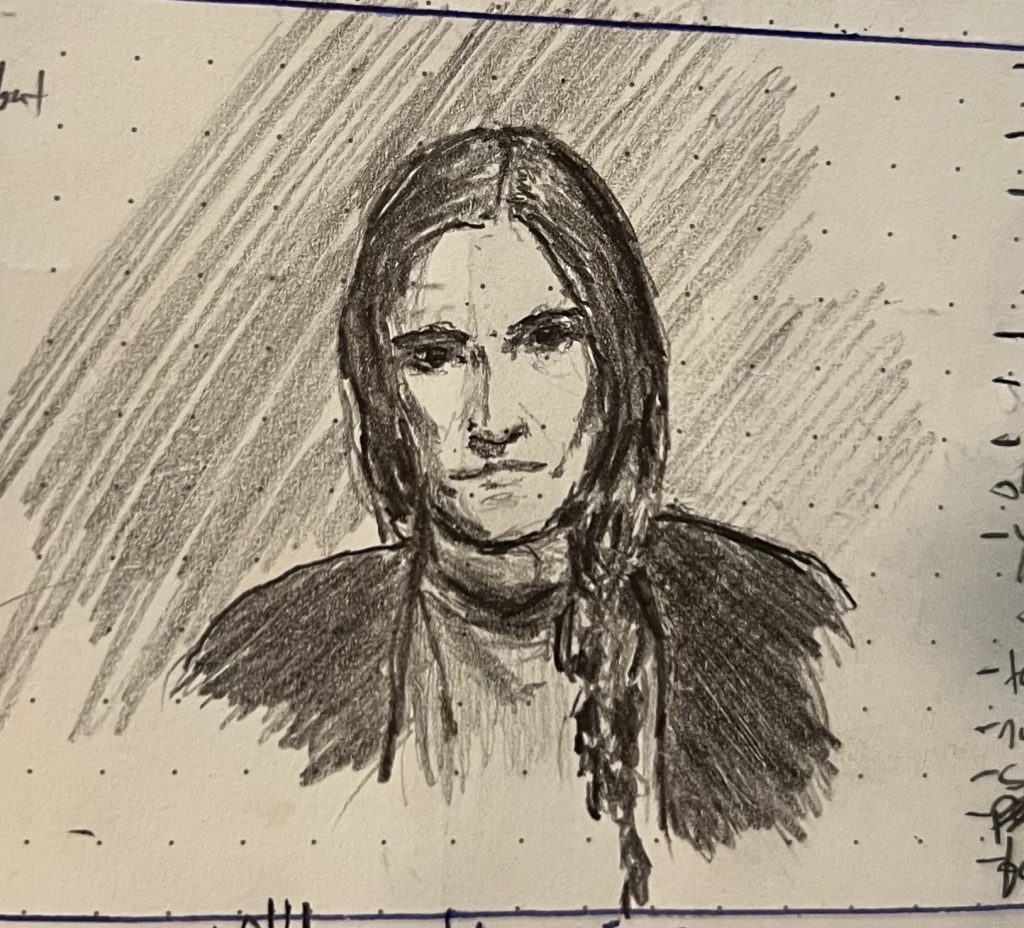
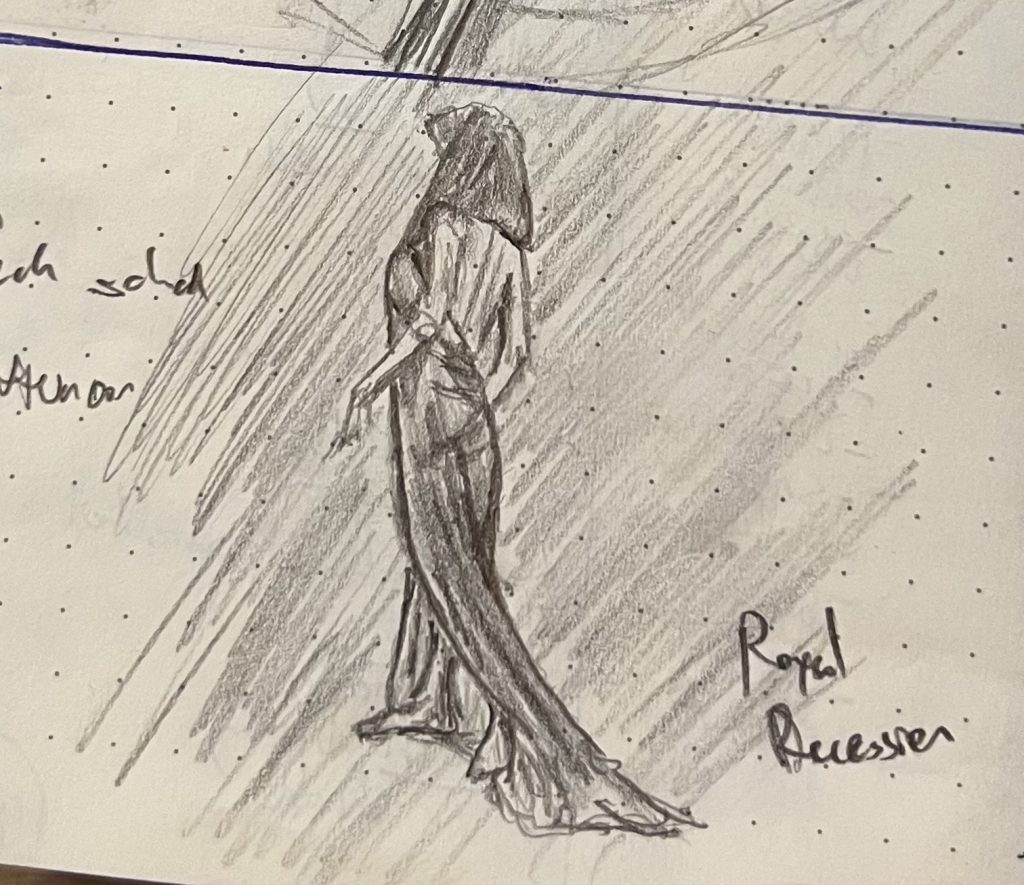
The reference image here is a sample from a reference image pack I found online. I originally took a run at it specifically because I figured it would be basically impossible for me to capture: the cloth’s draping was so complex, and my eyes really had trouble following it. I couldn’t conceive of how I’d communicate a figure I could hardly see.
In the end, this was a super revealing exercise for me: having all those familiar landmarks (eyes, ears, shoulders, hips) gone forced me to simply do the thing I’m always trying to do, and failing at: to look at the subject and draw what I’m seeing, and the feeling of seeing it, not my ideas of what a woman (or whatever) looks like, and what it takes to show one to someone on paper.
I’d thought it would be maddeningly frustrating, but it ended up being super relaxing. 🤷♀️
My son insisted that every sketch from last week had a claim on Sketch of the Week. While I wouldn’t go as far as him, I’m not gonna lie: I was really pleased with this batch, esp. Monday (“Warrior”), Thursday (“Shadow Dancer”), and Friday (“The Terror of Jim Carrey”)
Monday: “Warrior”—This is based on a photo I found on Pinterest, a platform that I’m embarrassed to admit I’m really liking, as it’s proving to be a really good source of reference images. I love the strength of that pose! There’s a lot I failed to capture here—the original model is quite muscular, while mine is almost gaunt; the original pose has this nearly bone crushing hauteur, and mine is almost contemplative—but I was really pleased with the strength in her stance, and I captured that. She feels unmovable, like a dolmen. This is definitely the best all around drawing from the week, according to my son, who really liked the values and shadow shading.
Tuesday: “Swordsman”—Another Pinterest find. My son really loved the dynamism of the pose and the economic capturing of the back muscles. I went after it because I found the pose both interesting, but challenging to make legible.
Wednesday: “The Ahmeek Stamp Mill Ruins”—This is a real place near where my son goes to university. The reference was a photo I took when we were visiting him a couple weeks back, and the ruins were buried in about four feet of snow. He really loved the subject matter, and thought I captured it well. I disagree, but it’s such a mind-bendingly weird place, I’m pleased I did as well as I did. I’m planning to take another stab at it in a larger format, and hopefully with watercolor.
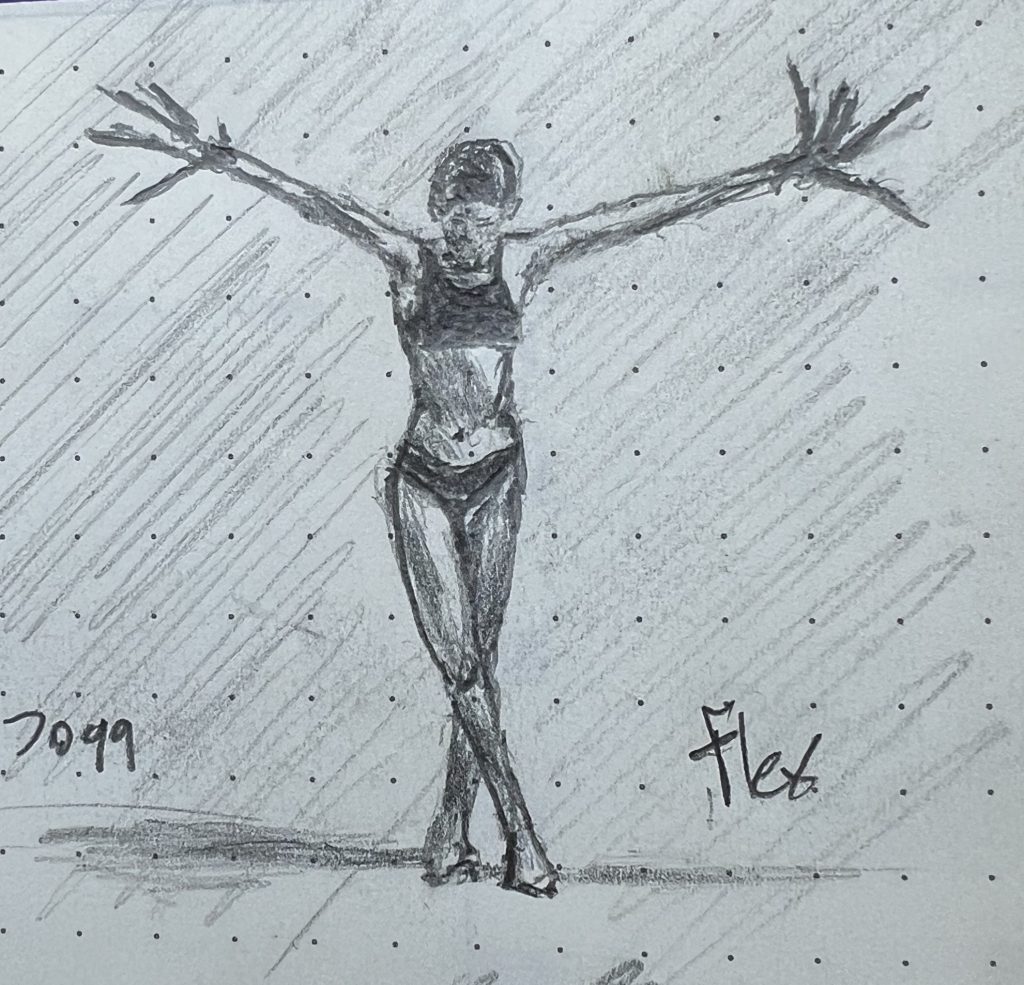
Thursday: “Shadow Dancer”—A benefit of Pinterest is that it’s sent me in new directions looking for reference photos. It had not dawned on my before to look for dancers, but Pinterest is full of photos of them from all sorts of sources, and dancers strike some incredible and gnarly poses; such great monster and eldritch being fodder! This one is more abstract and less eldritch, but I loved what her shadow was doing on the wall.
Friday: “The Terror of Jim Carrey”—I modeled this off of a relatively famous set of pics of Jim Carrey. It’s not a good drawing of Jim Carrey, and it isn’t even really a good drawing of the actual gesture he’s making, which is a sort of mugging cartoonish surprise. But jesus!, what I got on the page was arresting; it captures legitimate terror for me in a way I’m having trouble articulating. I find that tiny scribble so goddamned disturbing, I’m fascinated.