“They like me! They really, really like me!”

My short cosmic-horror-IKEA-home-inspction-reality-show-Jews-CrypotJews-JewsOfColor-siblings story, “The Nölmyna,” made it into Reactor’s 2025 “Best of…” antho (grab your free copy, no strings attached). I always like these, because I’m more of a Kindle/paper reader than a phone/tablet/laptop reader, but I especially like this year’s edition because I’m in it, with my name on the cover and everything.

Enjoy!

To be clear: I am in no way suggesting that IKEA may pose an existential threat to the fabric of reality

My latest horror story, “The Nölmyna,” is now officially published and free to read on Reactor: https://reactormag.com/the-nolmyra-david-erik-nelson/

A few months back I hung out with Ann VanderMeer, who edited this story for Reactor, at a conference in Florida. We ended up talking about Grady Hendrix, and I mentioned that this story sort of arose out of my frustration with Hendrix’s first book, Horrorstör. It wasn’t that there was anything wrong with that book—which I really liked—just that it wasn’t the story I would have written about IKEA. This one is. 

I’ve spoken before about how much of my writing (and, I believe, much of art in general) arises from frustration that some artist Isn’t Doing It Right, Dammit!™. That’s certainly the case here: I wrote “The Nölmyna,” in part, because Hendrix hadn’t Done It Right, Dammit!™, and so I’d better just jump in and take care of that.

But it wasn’t until this morning that it dawned on me how deeply unreasonable it was for me to pick up Horrorstör and expect it to be the story I expected, because I have deeply weird feelings about IKEA that are simply not the norm:

Almost 20 years ago I was diagnosed with panic disorder with agoraphobia. This is well managed now, but I continue to struggle with certain public spaces, especially those like IKEA: cavernous places that have poor sight lines, lots of people, no windows, and obtuse wayfinding. I can function in these places, but I experience dissociation and depersonalization, intrusive thoughts, a free-floating dread, and pretty much would rather be anyone or anyplace else. If you’ve ever been too stoned on too much edibles, you’re in the ballpark. 

IKEA is the seat of cosmic horror for me. This morning it dawned on me that maybe other people don’t experience this. Like, when I say “I hate IKEA,” what I mean is “When I’m in IKEA, I often feel like it would be better to stop breathing and being alive anymore.” I’m beginning to suspect when other people say “I hate IKEA,” they just mean “it’s crowded and weirdly stuffy” or “that furniture only holds up half the time” or “my partner and I always get in arguments there about lamps.”

Anyway, the publisher’s legal team very nicely asked me not to call the store “IKEA” in this story. But it’s IKEA. This story is about the true nature of IKEA and the distinct possibility that, through no fault of their own, they are creating the conditions for the absorptive annihilation of All of Everything by an Eminent and Imminent Immanence.  You’ve been warned.

This might be an extremely important short story to read right now

“In My Country” by Thomas Ha in Clarkesworld magazine.

As an aside, and totally unrelated to why this is an important story (and especially so right now), this piece both explains and perfectly epitomizes why I love the stories I love, and what’s missing from those I don’t love, for whatever that is worth.

Agustina Bazterrica’s TENDER IS THE FLESH: ★★★★★ would dine again!

(I do a fair bit of reading, which I track over on Goodreads. Trying to move some of that value over here, prior to the inevitable enshitification.)

Cover art for the English translation of Agustina Bazterrica's novel TENDER IS THE FLESH

This book is a little like heavy metal poisoning. Its impact is pernicious, deep, and likely permanent. You’ll be powerfully tempted to pigeon-hole this as an allegory (about world-wide overconsumption of meat, about climate change, about patriarchy, about the deadly tendency to humor wealthy idiots)—but, jeez, don’t. That’s just a defense mechanism, your brain’s white blood cells trying to contain and thus destroy an interloper. Don’t cop out like that. Just let the story fully in, let it blossom and consume you.

It’s really a helluva book. In many ways, this is the exact opposite of Ketchum’s The Girl Next Door, in that it blessedly lets no one off the hook.


For those interested in other art Dave compares favorably to heavy-metal poisoning, consider Merhinge’s film Begotten.

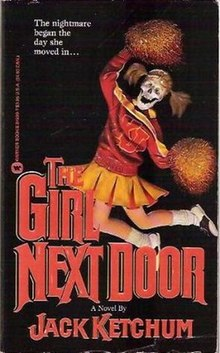
I should not have read Jack Ketchum’s THE GIRL NEXT DOOR (a zero-stars review)

(I do a fair bit of reading, which I track over on Goodreads. Trying to move some of that value over here, prior to the inevitable enshitification.)

This book was notorious when I was a kid for being so extreme and gruesome. Straight talk: it’s not that gruesome. Yes, there are graphic depictions of torture and sexual violence that are basically in the ballpark of stuff happening in conflict zones right now. That this really happens to real people is gruesome and outrageous; that some guy typed it up in 1989 feels trite.

Anyway, what really is truly extreme and gruesome in this book is its absolute moral cowardice. Ketchum sets up an interesting premise–not the sex torture of the orphaned girl next door, but the narrator’s (David’s) complicity, how he lets awfulness roll forward despite liking this girl, despite being a “good guy” and “All-American Kid” (echoes of King’s “Apt Pupil” there).

That premise is interesting, because it matches the vast majority of us: we’re good people, and we let bad things happen all over the world all the time.

The problem is that Ketchum pulls the punch. Inexplicably, he attempts to transform David into a hero in the final act–despite the fact that there’s no set-up for it, and Ketchum seems entirely incapable of pulling it off. That might be fine; it could still be a solid three-star book if David tried to play the hero, then faceplanted (as he does in the novel, as he must, because the situation is so hopeless), and Megan (the victim of these outrages and everyone’s leer, readers included) had poured her fury and rage out on him.

Instead Ketchum paints this kid–this coward, this bystander, this rapist-by-proxy and torture fanboy–as the hero, and forces Meg to be his forgiving damsel.

And it just makes me want to fucking vomit. It’s a mediocre book that’s only shocking if you’ve never read a newspaper’s international headlines. It’s an advertisement for never holding anyone accountable for anything–save for the victims; “What was she doing alone with those boys? What did she expect, dressing like that” and so on and so forth ad nauseam, ad infinitum, world without end, amen 🤮

Recommended Reading/Listening: PseudoPod 886: “A Wonder of Nature, In Need of Killing” by VG Campen

PseudoPod 886: “A Wonder of Nature, In Need of Killing” by VG Campen

I loved this story, especially given the wonderful voice acting by narrator Sevatividam. Very strong vibes of “illegitimate lovechild of True Grit and H.P. Lovecraft.” Recommended for those who enjoy voicey first-person narrators, down-holler riverside oxy-and-meth country Americana, turtle soup, and county fairs.

You can listen to this story wherever you get podcasts, or at the following link, which also features the full text for those who prefer reading over being read to:

PseudoPod 886: “A Wonder of Nature, In Need of Killing” by VG Campen

(art credit: “Kalmarian swamp turtle” by Halycon450 released under Creative Commons Attribution-NonCommercial-ShareAlike 3.0 License)

RECOMMENDED READ “Mister Ice Cold” by Gahan Wilson

RECOMMENDED READ Mister Ice Cold” by Gahan Wilson

I first read this when I was 12—already an avid reader of OMNI, the 100% perfect magazine for my adolescent Mysteries of the Unknown pre-X-Files brain—and it changed my world:

The chant-like repetition!

The onomatopoeia!

The unheimlich at its core, the disconcerting flesh it shows peeking through the drowsy mundane skin of the midwestern suburbs (where I myself lived)–stumbling across this story was like like bitting into an orange that turns out to be full of blood-moist teeth and a Chinese fortune.

The goddamned art!!! 

Art from "Mister Ice Cold" by Gahan Wilson (originally published in Omni magazine #139, April, 1990) caption reads: Mister Ice Cold never opens the bottom right door in the back of his truck.

The second person?!

In many ways it was exactly the sort of story I’d always want to write forever after.  “In the Sharing Place” is warped by the enormous gravity of this story–and especially its art–forever looming large just below the horizon of my brain. 

(Incidentally, if you wanna read “In the Sharing Place” right now, $3 Patreon Patrons get instant access to the story, audiobook, and 40-minute analog horror film versions.)

And, predictably, it was Ellen Datlow (esteemed editor of the Best Horror of the Year anthologies) who commissioned “Mister Ice Cold” and put it in OMNI—and thus into the hands of a 12-year-old kid outside Detroit who really should have been practicing his Torah portion, not up late reading a slick from the drugstore.

Recommended Read/Listen: “20 Simple Steps to Ventriloquism” by Jon Padgett

PseudoPod 433: “20 Simple Steps to Ventriloquism”

I absolutely guarantee the last couple twists are ones you ain’t gonna see coming, dummy. 

[photo credit: “Photo booth portrait of two clowns and a ventriloquist dummy” by oakenroad is licensed under CC BY 2.0. ]