
The other day, over breakfast, my first-grader asked how long it would take a vampire bat to drain a pig. I, of course, had no idea. Fortunately, we live in an Age of Wonders:
A quick trip to Wikipedia informed me that “A typical female vampire bat weighs 40 grams and can consume over 20 grams (1 fluid ounce) of blood in a 20-minute feed.” From prior experience buying live hogs and arranging for their slaughter and processing (don’t ask), I knew that there were something like 10 or 12 pounds of blood in a pig. A quick Google confirmed that it averaged around 9.5 pounds of extractable blood, which is conveniently roughly 9.5 pints, or 152 fluid ounces.
So, if she could feed nonstop (which she can’t), then a vampire bat could exsanguinate a very calm pig in roughly 50 hours. Alternately, a single bat could feed off a single pig for 152 days (at one fluid once per day) before the little fella was bone dry. *But*, I told him, we need to keep in mind that 1 fl. oz. is a very small amount of blood, and that the body regenerates blood regularly. People regularly give a pint, and it doesn’t seem to take more than a week for them to bounce back. Sorry, buddy, but I don’t think the little bat would *ever* drain the pig.
*Booom!* Question answered!
Kinda.
Because not knowing that blood replenishment rate was bugging me, so I started Googling again, and *holy crap!*, it takes a lot longer than I thought to make back that pint you gave the Red Cross! I’m not sure how fast pigs replace blood, but humans do so at around three fluid ounces per week–which is a bit under half an ounce per day an average. So, if the bat hit the same average pig for a fluid ounce each night, the pig would make half of that back the next day (in theory), meaning that to actually exsanguinate a live pig, the vampire bat would have to invest most of a year.
*But* how much blood can a pig loose before he keels over? Or before the body’s built-in replenishment system goes off the rails? I haven’t the *foggiest*–although life experience tells me that a human can lose *more than half her blood volume* and still be perfectly functional (albeit kinda logy, and certainly pale). So how long could a healthy pig go if it was being plagued nightly by a vampire bat? Clearly more than half a year. Maybe three quarters? At what time does that bat use its sharp lil teeth to carve “SOME PIG” into the wall of the barn?
Anyway, in the end, this seemed like an *excellent* teachable moment:
Remember, kids, given a persistent spirit and enough time, even the humblest vampire bat can completely drain the mightiest swine.
Why there is no children’s book with this as its central motif is, frankly, a stumper to me.
At any rate, the day after that momentary diversion on our way to the grave, I came across this, and it just sorta seemed like I *had* to share it. So I am.
(thx to these friendly Twitterati for checking my blood math: @hypomodern, @logista, @vaguery, and @dgoings!!!)
Penn & Teller do an excellent deconstructed cups-and-balls routine, teach you to write
Penn & Teller Explain Ball & Cups on Jonathan Ross 2010.07.09 (Part 2) – YouTube
This presentation of the cups and balls (a trick that is downright “*ancient*) isn’t just an incredibly graceful and concise primer on magic, but also on that triple-point of storytelling, narrative, and persuasion. It highlights the shared, emergent linchpin that’s vital to entertaining someone, explaining something to them, and getting them to see things the way you want them seen.
How wanna be a good writer? And I don’t mean “a good novelist” or “a good copywriter” or “a good essayist”–I mean good at all three, good at the stuff that’s way down below all of these visible structures, down in the roots? Then you could do much, much worse than watching this video over and over and over again.
See Project Orion! To Mars in an A-Bomb-Powered Sleigh!
For those who’ve never heard of Project Orion, Wikipedia is as good a place to start as any:
Project Orion was a study of a spacecraft intended to be directly propelled by a series of explosions of atomic bombs behind the craft (nuclear pulse propulsion). Early versions of this vehicle were proposed to have taken off from the ground with significant associated nuclear fallout; later versions were presented for use only in space.
–which, yea, sounds pretty patently nuts. But keep reading, and it begins to look *really* attractive:
The Orion concept offered high thrust and high specific impulse, or propellant efficiency, at the same time. The unprecedented extreme power requirements for doing so would be met by nuclear explosions, of such power relative to the vehicle’s mass as to be survived only by using external detonations without attempting to contain them in internal structures. As a qualitative comparison, traditional chemical rockets—such as the Saturn V that took the Apollo program to the Moon—produce high thrust with low specific impulse, whereas electric ion engines produce a small amount of thrust very efficiently. Orion would have offered performance greater than the most advanced conventional or nuclear rocket engines then under consideration. Supporters of Project Orion felt that it had potential for cheap interplanetary travel, but it lost political approval over concerns with fallout from its propulsion.
They actually made demo prototypes of this bomb-drive, in order to convince government backers that it was *less* nuts than it sounded, and it does indeed looks pretty rad:
Project Orion: “To Mars by A-Bomb” RARE Footage – YouTube
Here’s the full declassified footage those clips are culled from:
Project Orion [nuclear propulsion] (1958) – YouTube
Anyway, if this lil sidebar in the history of the atomic bomb tickled your fancy, then you can do worse then losing a few hours sifting through Alex Wellerstein’s Restricted Data blog. Start here: The “Secret” song | Restricted Data
Holy Crap! Is This Ever Wonderful and CREEEEEPY!
Władysław Starewicz (sometimes Russified as “Vladislav Starevich,” with his surname just generally butchered as “Starevitch,” “Starewich,” and “Starewitch”–damn Polish trick alphabet! He later changed it altogether to make it easier on Francophones, calling himself “Ladislas Starevich”) became famous as a Polish-Russian-French animator, a line he sort inadvertently fell into. His first career was as Director of the Museum of Natural History in Kovno, Lithuania. In making documentaries on animal behavior for the museum, he found himself stymied when the nocturnal stag beetles he wanted to film fighting would go to sleep under the bright lights required by earlier motion-picture cameras. So, he faked up the stag-beetle fight in stop motion, and after that he was off to the races. After fleeing several wars and uprising, he wound up settled in France, where he would do most of his greatest work.
Starewicz’s 1933 film, The Mascot (aka “Duffy the Mascot”, “Puppet Love,” or “The Devil’s Ball” [?!?]) , is widely regarded not just as Starewicz’s best work, nor as one of the best stop-motion films ever made, nor even as one of the best animations ever made, but as among the greatest short films ever made (the most notable film aficionado to take that position is Terry Gilliam, predictably). Thanks to the Internet, you can judge that on your own. Without a doubt, it is one of the most endearingly creepy films I’ve ever seen:
I got the tip on this from this Slate article, showcasing another film made by Starewicz, The Cameraman’s Revenge:
I *love* that Starewicz imbeds the middle of his movie into the end of his movie. Also, that it’s such a Russian-style “happy ending.”
If all this has you feeling inspired, you can do worse than dropping a buck or two on an iPhone app (which my son and I continue to occasionally monkey with).
How the Textbooks Get Made (or “The Writer’s Life for Me”)
I continue to write a monthly column for the Ann Arbor Chronicle. In the latest I take a break from talking about guns and “gun control,” and instead talking about my actual work-life as a freelance writer/editor:
The Ann Arbor Chronicle | In it for the Money: Not Safe for Work
Illustrative example: I recently put together a classroom reference on Internet pornography (not kidding). The book consists of a couple dozen point-counterpoint pairs on topics like “Access to online porn does/doesn’t encourage rape” or “Teen/preteen sexting should/shouldn’t be prosecuted as child pornography” – fun stuff like that.
I hunt down these articles, then revise and massage them so that they’re high-school accessible, because that’s the market for this book – high school libraries. That’s my job:
I write reference works on pornography aimed at high schoolers.
I’ve also done books like this on drugs and teen sex. I don’t even know what to say about my life, except that if you had told 12-year-old me that this was how it was going to end up, that kid would high-five you all over the place.
The only time a lay person hears about what goes into a textbook is when some jerkwater school board in North Carolina mandates that they aren’t buying anything with this untested evolution crap in it, or whatever.
I’ve done this about a dozen times (not counting projects I ultimately passed on because the money or timing were wrong). And I gotta tell you, the editorial guidelines have never remotely approached that kind of political micromanagement. More than politics, “expedience” and “balance” are the rule.
. . .
I hunt down these articles, then revise and massage them so that they’re high-school accessible, because that’s the market for this book – high school libraries. That’s my job:
I write reference works on pornography aimed at high schoolers.
I’ve also done books like this on drugs and teen sex. I don’t even know what to say about my life, except that if you had told 12-year-old me that this was how it was going to end up, that kid would high-five you all over the place.
The only time a lay person hears about what goes into a textbook is when some jerkwater school board in North Carolina mandates that they aren’t buying anything with this untested evolution crap in it, or whatever.
I’ve done this about a dozen times (not counting projects I ultimately passed on because the money or timing were wrong). And I gotta tell you, the editorial guidelines have never remotely approached that kind of political micromanagement. More than politics, “expedience” and “balance” are the rule.
. . .
Travelwide: An Ultralight Point-and-Shoot Large-Format Camera for Under $100
Wanderlust Cameras (aka Justin Lundquist and Ben Syverson–both are awesome photographers with some pretty tight 3D design and fabrication chops, and Lundquist is also my brother-in-law) are just wrapping up the Kickstarter campaign for their newest project: The Travelwide 4×5 Large-formate Point-and-Shoot.
“Large-format” cameras take pictures using *negatives* that are 4-by-5 *inches* or larger–which is pretty frickin’ huge, when you think about a traditional 35mm image (which is a bit bigger than a postage stamp) or the CCD sensors in a digital camera (which tend to be less than .5-inch square). A larger negative (or sensor) means higher image resolution and finer color gradation. Large-format is the way much professional photography is done, and is big with hobbyists–but it’s expensive (used large-format rigs start at a several hundred dollars and quickly climb into the thousands) and heavy (these are big hunks of steel).
Lundquist and Syverson have designed a super-light, precise, basically indestructible large-format camera body that accepts existing lenses (which can be bought used for pennies on the dollar). Since Lundquist and Syverson made their name producing the best pinhole “lens” available for Micro 4/3 mirrorless digital cameras (you can buy one here, or learn more about it from this article I wrote for issue 9 of The Magazine), they’ve also included a removable pinhole aperture for their Travelwide. Here’s a sample pinhole pic taken using that setup:

And here’s a little more background on their design and development process for this camera.
I’m not sure if the price will pop up once the Kickstarter campaign is through, but for the next 10 days you can lock in a $100 pre-order for this camera –which gets you what is, without a doubt, the most precise large-format pinhole camera on the market today, with the added bonus that you can easily swap in a pro lens, or mount after-market range-finders, flashes, tripods, and other accessories on the thing. Final bonus: The thing is 100% Made in the USA.
Light enough to drag around backcountry Brazil, tight enough to use for a pro-shoot, cheap enough to experiment out in the grit and the rain without constantly worrying that you’re gonna wreck the damn thing.
Chill with Me at the Up in the Aether Steampunk Convention!
Hey All,
Just a quick note that I’ll be a panelist/guest at the Up in the Aether steampunk convention: May 24–26 at the Detroit/Dearborn Double Tree hotel (5801 Southfield Expressway, Detroit, MI, 48228). Super fun last year, with some great panels/demos/classes and vendors. Promises to be even bigger this year, with even more panels and workshops (including a full-bore lit track, plus lots of DIY of all sorts), *and* the location is right by the Henry Ford Museum (whose collection is bound to thrill any folks with steampunkish leanings).
Anyway, I’ll be at Up in the Aether all three days, sitting on a variety of panels talking about steampunk, history, writing, horror, and the nitty-gritty of publication. I’ll also be running a couple DIY workshops, one on building old-school kites, and the other on flash-boilers and building a simple flash-boiler powered steam putt-putt boat.
See you there! If you wanna connect and hi-five (or whatever) please feel free to ping me via email or twitter @SquiDaveo. Thanks!
DIY Standing Desks
On the off chance you missed the memo: Your chair is killing you!!1!

The tl;dr goes something like this: Human bodies are really ill-served by sitting in a chair for periods longer than ~30 minutes; it tangles up your digestion, causes problems all up and down the spine, and if you are typing at a keyboard is also pretty hard on your blood circulation. Also, “resting” this much strains the heart, as we’re evolved to use the big muscles in our legs to help circulate our blood, thus relieving stress on the heart. We evolved to move around a lot–mostly walking from place to place–not sitting super still while moving our fingers super fast. If you prefer this sort of thing as a totally excessive infographic, the canonical one is to the right.
Anyway, over at the Workantile–which is populated by folks whose jobs are to sit very still while their fingers move very fast–we talk about the health ramifications of our sedentary jobs *a lot*. One of the easiest solutions–in addition to mandating regular perambulations–is to add a standing desk to your office. Our space includes a couple of high cafe tables, as well as one of these bad boys:
This is one of the best store-bought standing desks I’ve seen, because:
- It has an adjustable monitor mount: Many folks choose standing desks because looking down at their hands all day is screwing up their necks and backs–looking straight ahead is much more comfortable
- It’s convertible: The whole thing can raise and lower so that you can take periodic sitting breaks; shifting from sitting to standing (and being able to sit in multiple different postures) is ideal
- It’s flexible: This fella clamps to a wide variety of existing desks, and is really quick and easy to set up
I’m 99 percent sure this particular model (which a member donated) is an “WorkFit-S Single HD Sit-Stand Worstation
For those on a budget, their are *tons* of ways to rig up a workable (if, let’s face it, ugly as hell) standing desk. This is a project that’s totally responsive to Roosevelt’s Law of Task Planning (aka Akins Law #34: Do what you can, where you are, with what you have.) Here’s mine:

(The sheet is just there to aid visibility; otherwise it’s hard to see the damn thing against all the clutter hung in my cave)
Yes, this thing–the Fool’s Swing–is ridiculous. I originally hung it up as a platform to test different standing-desk heights in order to determine what I wanted to build (it’s next to my sit-down desk–in ancient, dented Steelcase monster I bought for a dollar–so I can readily shift between sitting and standing). But I discovered that the swing–which took all of five minutes and no dollars to construct–was a good solution for me. Part of the reason this works is that my neck and spine are in great shape–looking down all day doesn’t bother me (also, I touch type, and frequently look away from the screen and just stare into space in front of my as I write); I use a standing desk because working a sit-down job wrecked up my digestion pretty badly (a hereditary thing, as it turns out). The other advantage here is that the swing pushes away from me. I have a tendency to put too much weight on my wrists and lean into them, and the swing doesn’t let me do that. My wife constantly predicts that this arrangement is going to end in a computer-dumping disaster, but it’s been a year and some change, and I’ve never even had a close call. Seeing as how it is basically the same structure as swings I’ve hung–which have put up with much greater weight and abuse without collapsing–I’m not that worried.
Another member of our workspace has this rig, which I love:
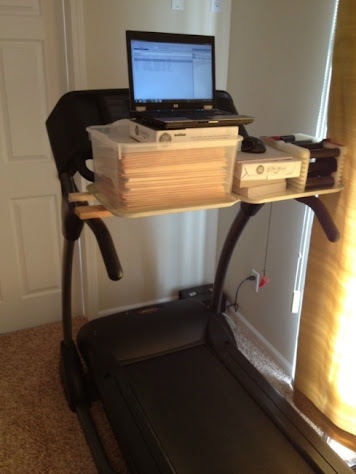
Totally ad hoc, but it allows him to pace while working, which is brilliant. Again, zero-cost, and under 30 minutes to build.
Another option is just to boost your desk as a whole. One thing I envy here is that he has an entire raised workspace; when I’m revising (which I do on paper) at home, I generally have to sit at my desk; on book projects, this can mean full days seated, which gets pretty miserable by mid-morning. Although this method requires a lighter desk to begin with (my Steelcase would crush those milk crates), it’s another no cost/quick build solution:

Finally, here’s a link to the canonical $22 Standing Desk from Stock IKEA parts. No one I know has built one, every standing-desker I know has been inspired by it.
FYI, if you’re going to shift to standing and you have a hard floor (mine is vinyl tile on concrete), invest in an “anti-fatigue” gel mat. I got a “Martha Stewart” branded one for $20 at the hardware. Your feet and lower back will thank you. (These are also great in the work room and, if you cook a lot, in front of the sink.)
The Coworking Society: My Day Not-Job
First off, sorry for the week of radio silence; I was traveling for Spring Break with my wife and kids. I’d assumed I’d have a chance or two to update the Snip, Burn, Solder Blog while on the road, but instead ended up investing my writing pomodori in a new short story (not to spill the beans on it, but there’s Chicago’s elevated train, pickpockets, and naked folk in the story. I think we can all agree these will have been words well spent). All apologies, no excuses.
Secondly, this interview (conducted by the remarkably patient Mark Maynard) is now up: Inside Ann Arbor’s Workantile coworking community. It’s an +8,000 word (!!!) interview with me and the other two “owners” of the “Coworking Society,” and absolutely and profoundly unprofitable LLC whose sole purpose is to support the Workantile, a community of freelance and independent workers who share goodwill and a *lovely* 3000-square-foot workspace in downtown Ann Arbor, MI.
Here’s an interview snippet:
MARK: Is there a culture of collaboration at Workantile? Do you have examples, for instance, of projects involving multiple members, which wouldn’t have otherwise come about? Or are people more inclined to just work on their own projects? Assuming it’s the former, are there things that you’ve done to help facilitate the exchange of ideas between members, etc?
BILL: Again I want to unpack the assumptions here a bit. If you mean: are there work collaborations between members? Not much. We all pretty much have too much work already. There are ideas for new things, and at least a few of them have gone somewhere. But we all understand that whenever we launch a new Next Google, our dance cards are immediately filled with appointments with investors or for a boot stamping on our faces–forever. So that outcome tends to be a self-trimming branch as far as Workantile is concerned.
. . .
DAVE: Just to take a sec and disagree with my distinguished colleague: I’ve seen and participated in a fair amount of “billable work collaboration/hook-up” in the Workantile–but I don’t think this is unusual in any community. I know folks who are deep into their communities of faith; those are their goto communities, and if they’re looking for a lawyer or writer or graphic designer or builder, those are the people they ask. This is the same at Workantile, except for without the God business. When I needed a tech reviewer for the electronic projects in my very enjoyable book of geeky crafting, I ended up hooking up a Workantile member (the one that designed and built our original computer-controlled door system, in fact). When another member needed someone to write content for web sites he develops or do some of the coding for those sites, he asked around Workantile. The writing group I’m in now–and, with whose support, I’ve done my best work–was introduced to me by a Workantile member. Our email group regularly has threads that start with: “Hey; I need a contract looked at; what lawyers do you guys trust? My sewer pipe is collapsing; what plumbers do you trust? I wanna buy ethically raised pork; who knows a pig guy?” I think maybe what Bill wants to foreground is that this sort of commerce isn’t our *purpose*, just a by-product–but what *I* want to foreground is that commerce is the human business, and whenever humans are in a group fungible exchanges are brewing. Dogs sniff butts, we recommend organic CSAs, but it’s all the same.
BILL: Again I want to unpack the assumptions here a bit. If you mean: are there work collaborations between members? Not much. We all pretty much have too much work already. There are ideas for new things, and at least a few of them have gone somewhere. But we all understand that whenever we launch a new Next Google, our dance cards are immediately filled with appointments with investors or for a boot stamping on our faces–forever. So that outcome tends to be a self-trimming branch as far as Workantile is concerned.
. . .
DAVE: Just to take a sec and disagree with my distinguished colleague: I’ve seen and participated in a fair amount of “billable work collaboration/hook-up” in the Workantile–but I don’t think this is unusual in any community. I know folks who are deep into their communities of faith; those are their goto communities, and if they’re looking for a lawyer or writer or graphic designer or builder, those are the people they ask. This is the same at Workantile, except for without the God business. When I needed a tech reviewer for the electronic projects in my very enjoyable book of geeky crafting, I ended up hooking up a Workantile member (the one that designed and built our original computer-controlled door system, in fact). When another member needed someone to write content for web sites he develops or do some of the coding for those sites, he asked around Workantile. The writing group I’m in now–and, with whose support, I’ve done my best work–was introduced to me by a Workantile member. Our email group regularly has threads that start with: “Hey; I need a contract looked at; what lawyers do you guys trust? My sewer pipe is collapsing; what plumbers do you trust? I wanna buy ethically raised pork; who knows a pig guy?” I think maybe what Bill wants to foreground is that this sort of commerce isn’t our *purpose*, just a by-product–but what *I* want to foreground is that commerce is the human business, and whenever humans are in a group fungible exchanges are brewing. Dogs sniff butts, we recommend organic CSAs, but it’s all the same.
So, if you’ve been wondering what “coworking” and “coworking spaces” are all about, or the ways folks do “Work 2.0” (or whatever damned thing WIRED is trying to call it now), then there are worse places to start than this interview.
Steam-Powered Aeroplane Footage!
On page 251 of Snip, Burn, Solder, Shred I make brief mention of flash boilers used in steam-powered airplanes, basically just to poo-poo them as dangerously whack–which, as it turns out, was pretty closed-minded of me. Here’s one in action:
I don’t usually advise clicking through to the pit of vitriol and distraction that is YouTube, but the original poster’s comments are pretty informative. A snippet:
A Travel Air 2000 biplane made the world’s first piloted flight under steam power over Oakland, California, on 12 April 1933.
The strangest feature of the flight was its relative silence; spectators on the ground could hear the pilot when he called to them from mid-air.
The strangest feature of the flight was its relative silence; spectators on the ground could hear the pilot when he called to them from mid-air.
It goes on with some neat technical details; as it turns out, the flash-boiler design Besler used was arguably an optimal solution at the time for small planes like his. There’s a pretty fascinating contemporary article on Besler’s steam-powered flight in the June 1934 issue of Steam Car Developments and Steam Aviation. Besler’s steam engine was reversible at the flip of a switch, making it possible to slow the plane after landing without risk of doing an endo and flipping the bird. I.e., In a slightly different timeline, steam-powered planes would have been a perfect fit for aircraft carriers.