A CNC router is a machine that uses a computer to control a spinning bit (“CNC” stands for “computer numerical control”) in order to precisely carve materials (usually wood or metal, although you can basically carve anything that’s rigid-ish: I’ve seen folks route fiberglass, acrylic, styrofoam, ice, and even hunks of melon). Any shape you can map with a computer can be carved by the appropriate CNC router.
In my humble, CNC routers are just lovely to watch, in and of themselves. If robots had to invented ballet, it would look like this. That the process is being used to produce a Möbius strip lends the whole think a little extra cognitive luster. I especially like that they elected to retain–and even accentuate–the milling artifacts of the CNC process; lends just the right touch of wabi-sabi, the degree to which a “perfect” automated process still leaves signs of its having passed this way.
mobiprize | rvtr
Author: dave-o
OS X Lion DiskMaker for Greater Good!
I’m finally getting around to upgrading my unibody MacBook to OS X 10.7 Lion (mostly because Apple is forcing my hand: I have to join iCloud before the end of this month, or face the consequences).
Since Lion is the first download-only OS upgrade from Apple, I’ve been strongly advised by my computer programming cohort that I really ought to make a bootable recovery OS X disk (actually a USB drive–the damn OS installer is +4Gb!) prior to running the install (just in case–and because making the boot disk *before* installing is *much* easier than trying to do it afterward, as OS X erases the installer disk image when it cleans up post-intallation).
Lots of great instructions cover doing this (here are the ones I followed: How to make a bootable Lion install disc or drive | Macworld); it isn’t really arduous, but it’s far from intuitive, so you’ll want the walk through.
I only discovered *after* purchasing a 8Gb ScanDisk Cruzer thumb drive to use as my bootable recovery disk–and wrestling with it for several hours as my Mac repeatedly failed to be able to finish writing the disk image to the drive–that, for reasons unknown, Cruzer thumb drives are notoriously janky in this application.
Thoroughly frustrated and hopelessly googline, I stumbled across the freeware Lion DiskMaker. It’s really just a shiny wrapper around a few AppleScripts, but it totally automates the process of creating one of these bootable thumb drives *and* can do so even with the Terrible, Horrible, No Good, Very Bad Cruzer thumb drives.
So, consider this lil bundle of magic *Recommended*:
Serial Serveur — Lion DiskMaker (US)
On Getting Schooled
Sorry that the posting has been light here for the last week; I’ve been struggling with a Basement Plumbing Disaster, which I’ll fully report next weekishly. For now, I’d like to point you to my latest column for the Ann Arbor Chronicle. This piece feels especially salient this week as I’m spending Wed-Fri doing a teen workshop at the Henry Ford Museum on DIY, making, and innovation, more-or-less coordinated with my participation in this year’s Detroit Maker Faire.
This column is the first in a series on education, and broadly covers how we measure outcomes in our schools, and why being overly focused on test scores and “career readiness” might be a pretty hollow goal. I also talk about my boy’s first year at kindergarten, Super Mario Brothers, the Jewish People, KRS-One, and decision fatigue. Consider this the loose framing of Dave Nelson’s Totally Impractical Education Plan.
The Ann Arbor Chronicle | In it for the Money: Getting Schooled
Last Friday my son finished his kindergarten year at Bryant Elementary – an excellent public primary school in Ann Arbor, Mich., conveniently located near our municipal airport and impressive town dump [1]. He learned a shocking amount this year – e.g., he’s now functionally literate and has a solid grip on mathematical concepts I vividly remember my middle school class puzzling over – and I really appreciate everything his teachers and school administrators have done.
But, frankly, it’s hard to be super shocked by these academic achievements. I’m a former English teacher, my wife has taught for at least a decade, and the only consistent forms of entertainment in our house are books – it would be a little weird if he didn’t know how to read yet.
No, what impresses me about my son’s education at Bryant is this: Midway through his school year my blond, Jewish five-year-old told me he wants to be like the Reverend Dr. Martin Luther King, Jr. . . .
But, frankly, it’s hard to be super shocked by these academic achievements. I’m a former English teacher, my wife has taught for at least a decade, and the only consistent forms of entertainment in our house are books – it would be a little weird if he didn’t know how to read yet.
No, what impresses me about my son’s education at Bryant is this: Midway through his school year my blond, Jewish five-year-old told me he wants to be like the Reverend Dr. Martin Luther King, Jr. . . .
FATHER’S DAY STEAL: Save 40% on No Starch Press books with the coupon code DADROCKS! @nostarch
Just a quick note. My publisher, No Starch Press, is having an across-the-board sale for Father’s Day. You’ll save 40% on *everything* if you use the coupon code “DADROCKS” ADDED BONUS: Most of their hardcopy books include the DRM-free digital version for FREE (usually in PDF, ePub, and Kindle format–so that’s basically another $10 to $30 of value right there).
My book is obviously a pretty good fit for dads, but since most blog readers likely already have a copy, I also suggest these titles:
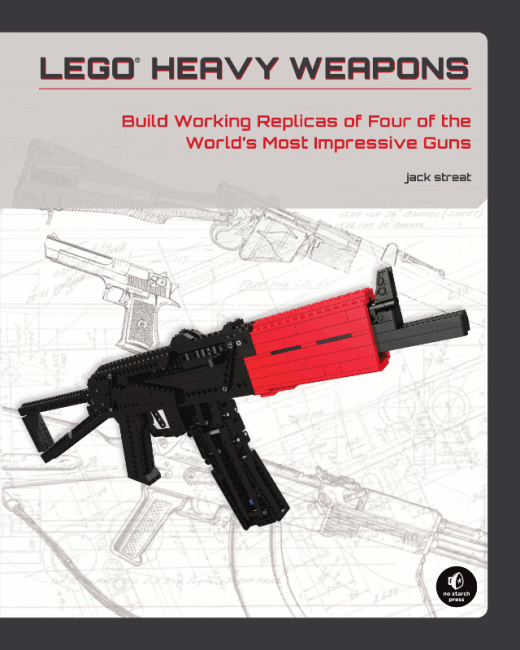
FOR GUN-NUT LEGO DADS

FOR PEACE LOVING LEGO DADS


GENERIC NERDERY

FYI, I’ve reviewed a few of these titles in detail here.
(Sorry that the “Generic Nerdery” is sorta thin. I’ve seen pages for a few really exciting programming books No Starch has coming out aimed at kids, but those are still in pre-order, so I’ll leave them for later.)
Breeding and Harnessing Piezo-electric Viruses for Greater Good!
A Virus That Helps Charge Your Cellphone – NYTimes.com
Scientists at the Energy Department’s Lawrence Berkeley National Laboratory say they have created a virus that generates electricity . The research is described as a first step toward using genetically engineered viruses to build devices that convert the body’s motion into electricity. . . .
The article is actually surprisingly detailed, and even includes a short (and possibly somewhat cryptic) video:
WHAT I’VE LEARNED FROM THE ISS ALPHA MISSION (a brief essay by Dave Nelson) @fritzswanson
About a decade ago Fritz and I were *really* geeked about the International Space Station–which, as you’ll recall from my last post, fundamentally fails to impress my mom. Back then the ISS had just finished the first round of continuous human habitation (it’s now in round 31–a fact that complete blows my mind. Our space station is fully operational, and has been for more than a decade!) Sometime in late 2001 or early 2002 NASA quietly released the captain’s log kept by Bill Shepherd, who was Commander for the Alpha mission (i.e., that first team of long-term space stationers). The full complement for that mission was three guys, including Shep.
These logs–which are more than a little janky, with weird gremlin characters, extensive redactions, and large chunks set in Comic Sans–fascinated Fritz and me. During this period I was working at a school, teaching 1/4 of the time and doing office-drone stuff for the other 3/4, and lots of those office-drone hours ended up being spent pouring over these logs and imagining the awful wonder of living on a damn orbital space station.
While cleaning out my office this weekend (preparatory to the nice plumber with the jackhammer coming to totally wreck up the joint) I found the following essay. Now, at this point, I can’t recall precisely *why* I wrote this. Clearly, in part, it was sort of a gag about high school composition assignments (I was a neophyte English teacher for that 1/4 of my workday, after all). But more than that, it’s just a really honest expression of how much I loved those Captain’s Logs–real, honest-to-God *Captain’s Logs!!!*–which were the first really tangible evidence that I *was* living in a future that bore some resemblance to that OMNI magazine, matinee movies, and Scholastic books promised me when I was a boy.

WHAT I’VE LEARNED FROM THE ISS ALPHA MISSION
a brief essay by Dave Nelson
I’ve learned that astronauts like action and war movies (“Apocalypse Now” and all four “Lethal Weapon” films)–not suspenseful dramas (e.g., “The Sixth Sense,” which they only brought along because they mistakenly believed it was a sequel to the Fifth Element)/
If you lose anything, it’ll turn up in the air filter sooner or later.
Shep loves tools–his perfect day involves using both tools and schematics in unison. Russian cosmonauts love sorting things.
Most of the time on a space station is spent building more space station.
Astronauts love laptops (they apparently have 9 running, and are complaining that they don’t have enough table-space to accommodate the two more the’d like to get going). They are receiving email up there, using Outlook (considering the whole computer-virus situation with that mail program, I’d be nervous if I were them.)
Ham radio is still the most reliable form of communication with the earth.
Despite a dearth of tools and parts, Russians can fix or rig anything.
Even in space, folks celebrate Christmas.
Astronaut Don Pettit Plays Didgeridoo in SPAAAAAAACE!
And here’s another really lovely orbital water experiment with Don Pettit:
Aside: My mom is here to watch my newish baby while a friendly giant crushes my basement floor in order to swap out a collapsed sewer line. Mom glanced at this video and exclaimed, “He’s on the moon?!?” When I explained that, no, he was on the International Space Station, Mom was visibly let down. Guy standing on an inert hunk of rock and playing the digeridoo? *OMG!* Guy sitting in the crowning technological achievement of our species and playing a didgeridoo? *Menh.*
In a nutshell, this is everything that’s wrong with the Baby Boom Generation, folks.
(via here and here)
Continue reading “Astronaut Don Pettit Plays Didgeridoo in SPAAAAAAACE!”
M.C. Escher’s “Relativity” litho as a Star Wars LEGO diorama

I’m not just posting this because geeks and LEGO and Star Wars and nostalgia-singularity and *neat!* {*squeeee*} FREAKOUT! Yes, all that’s in the mix (plus, like most of you, I’m a depressingly unselfconscious Escher fanboy from small times), but I’m posting this because, simply as art in and of itself, this sculpture is lovely and worth meditating on. It is here to tell us something interesting about ourselves and our myths. For example, the artist’s blithely stated intention to *dismantle* this.
Take a second to click through and look at the detailed images. Please. Trust me:
Star Wars Relativity V2: A LEGO– creation by Paul Vermeesch : MOCpages.com
Shameless Self-Promotion: Are You Prepared for Father’s Day?
A gentle nudge: If you’re looking for a Dad’s Day gift for a fella with school-age children, you can do worse than my book SNIP, BURN, SOLDER, SHRED: Seriously Geeky Stuff to Make with Your Kids. Fully certified dads have said stuff like:
This is the stuff that magic and dreams are made of in childhood, at least for those kids who have the idea that magic can be handmade. Snip, Burn, Solder, Shred is a seriously cool book.
and
This book is full of great innovative ideas to engage you and your kids for quite some time. What I loved most was that this book provided step-by-step directions that left nothing to chance. Instead it spelled everything out making it simple, even though your kids will simply think that you are cool! I mean how many dads can say that they built their own electric guitar? I don’t know many that is for sure!
and
Seriously: order this soon.
(That last one’s from Rob Malda, founder of Slashdot.org, and really nice cat.)
If you really want to stick it to The Man, you can always order directly from the publisher. You’ll get the ebooks (including a Kindle version) *FREE*, and if you use the coupon code SHRED you’ll save 35 percent.
Order soonishly from whoever and the book is sure to arrive in time for Father’s Day.
Alternately, if your dad or hubby is into clockwork sex robots, maybe try this steampunk novella on Kindle–or the supercool, handmade print chapbook.
So, that’s my pitch. Thank you, and goodnight!
Bilal Ghalib Rocks Veggies in his Wok using MakeyMakey
I’ve worked with Bilal Ghalib in the past (we hosted one of his “Pocket Factory” 3-D printing crash-course workshops at Workantile), so it was a delight to see him pop up out of the blue with something new and rad:
Yup: He’s using the MakeyMakey USB keyboard interface (a Kickstarter project I geeked about a few weeks back; it’s now funded at 1,700% [!!!] with 6 days to go!) to play with his food. Nice!
This is precisely the reason I jumped on the MakeyMakey funding bandwagon: Obtuse interfaces for musical instruments inspire all sorts of crazy new ways to rock out, and I *love* that. Here’s another great MakeyMakey ad hoc instrument:
FYI, I’m just now starting in on my second DIY book with No Starch Press. This time around it’s going to be all musical instruments, mostly electronic; expect lots of janky little synths with nary an equal-tempered keyboard in sight, and inappropriate uses of conventional technologies. Also at least one ukulele.