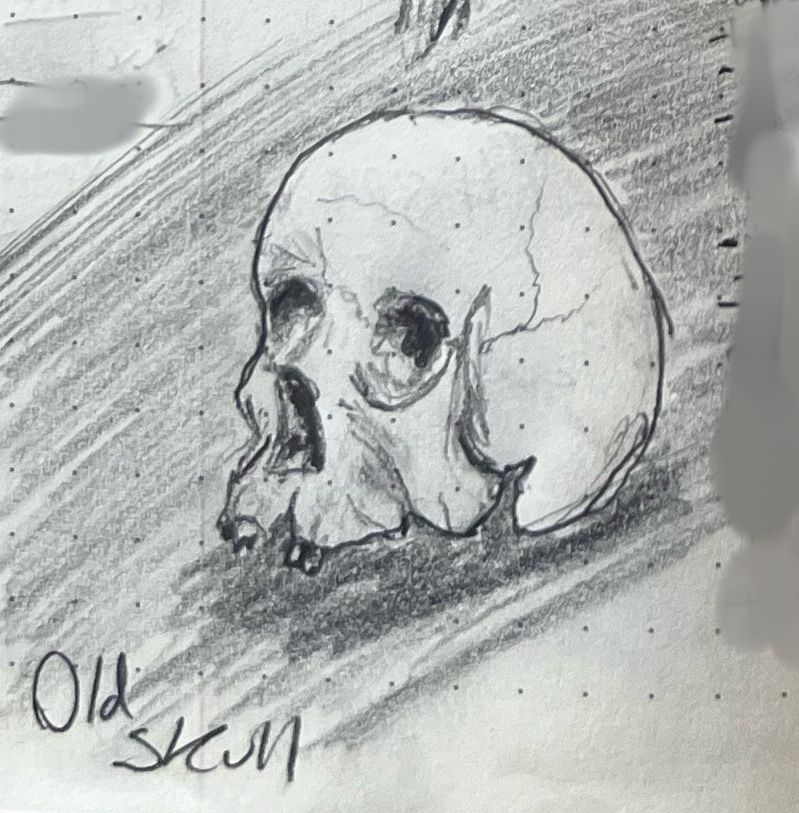
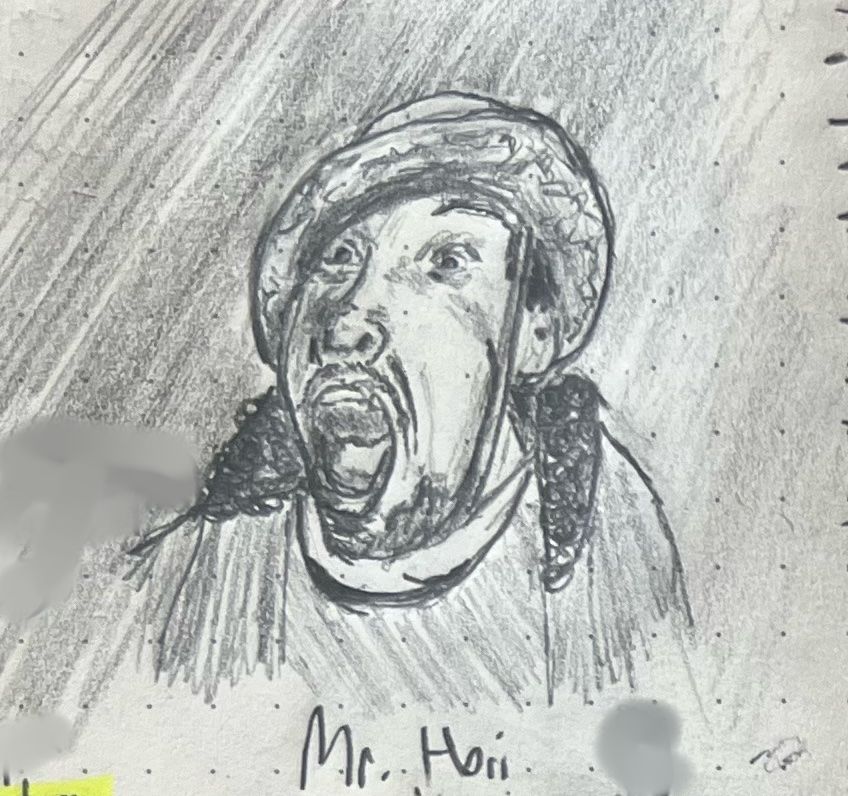
My son really liked the depth on the skull, but his actual vote for this week’s Sketch of the Week was this one of Mr. Hori from the film Noroi: The Curse, noting “the expression … is incredible”:
I personally was unhappy with how I elongated the face; Mr. Hori’s face is fundamentally round, but my hand kept wanting to regularize him against Munch’s “Scream,” I guess 🤷♀️.
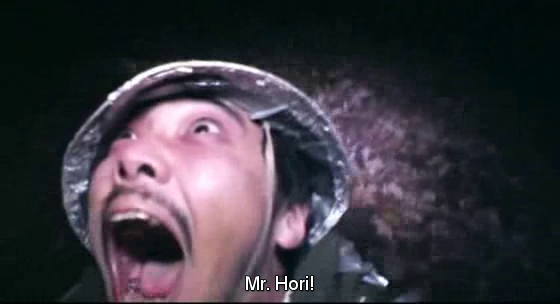
I do feel like I get at least close to the extremity of Mr. Hori’s terror in that scene. (The actor, Satoru Jitsunashi, is pretty amazing in that role; he totally makes the movie for me.) Here’s the reference image (more or less; I was working from several stills I grabbed from the movie, because his whole face wasn’t ever in frame at once):
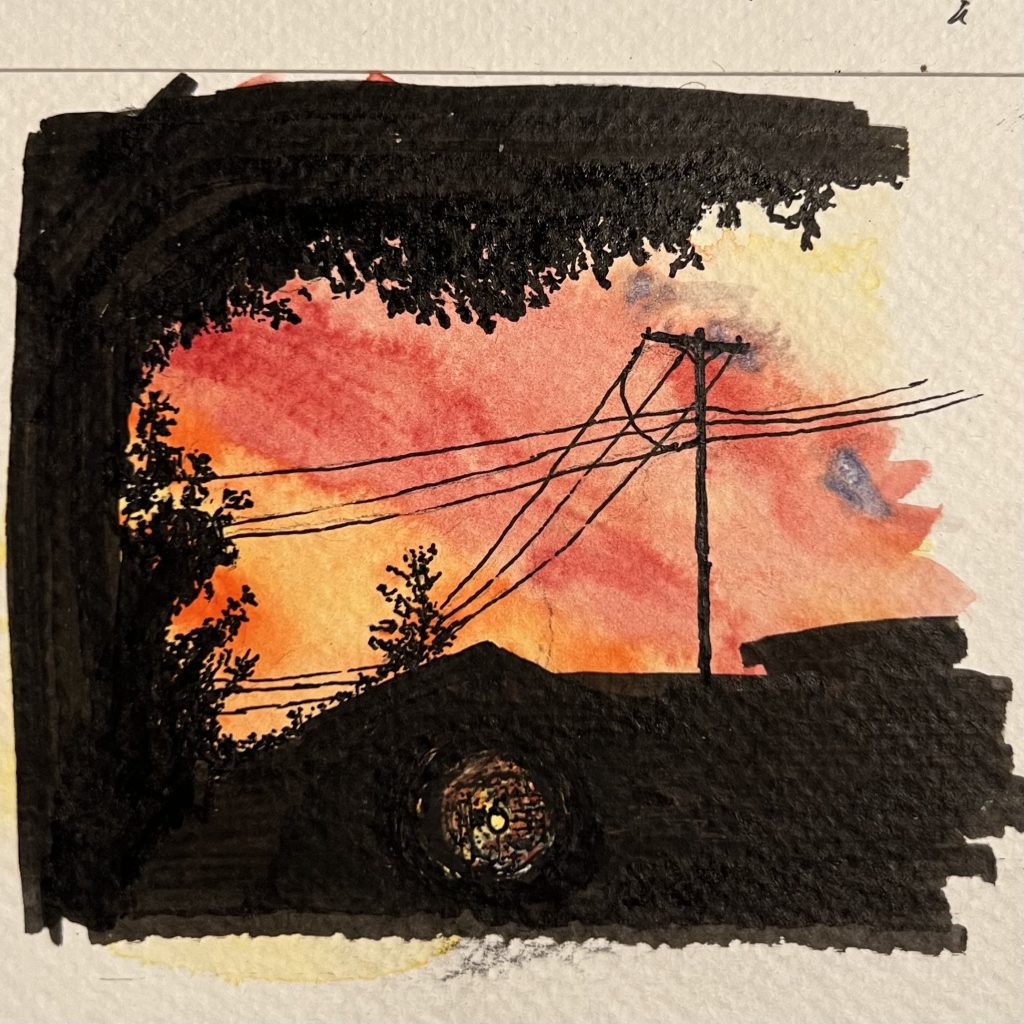
This week’s sketch is watercolors and India ink, of a house up the street after the sun has dipped below the treeline, but is still above the horizon:
Back when I was a teen I was taught two ways to use India ink: dip pen and bamboo calligraphy brush. You can do a lot with either, but Jesus are they fiddly. Also, the old bottle of India ink I have is not waterproof, which is great for certain effects, but often maddening overall (esp. against watercolor).
So this was done with Faber-Castell Pitt pens, which are amaaaaazing. Yeah, a dip pen can give you a much finer line, and an ink brush can do really interesting dry-brush and textural things that you can’t coax out of a Pitt pen. But in terms of bang-for-buck (esp. when the “buck” translates to hair-pulling frustration), the Pitt pen is hard to beat:
The India ink is dark and flat and deep, water soluble/flowable when first applied, but then dries absolutely waterproof. They have a ton of different nibs. For this sketch I used a 0.3 fine liner and a soft-brush (the later nicely emulates doing wet-brush work with a Japanese calligraphy brush, giving you all the expressiveness and none of the sorrow). The color of the sky was me experimenting with wet-on-wet watercolor.
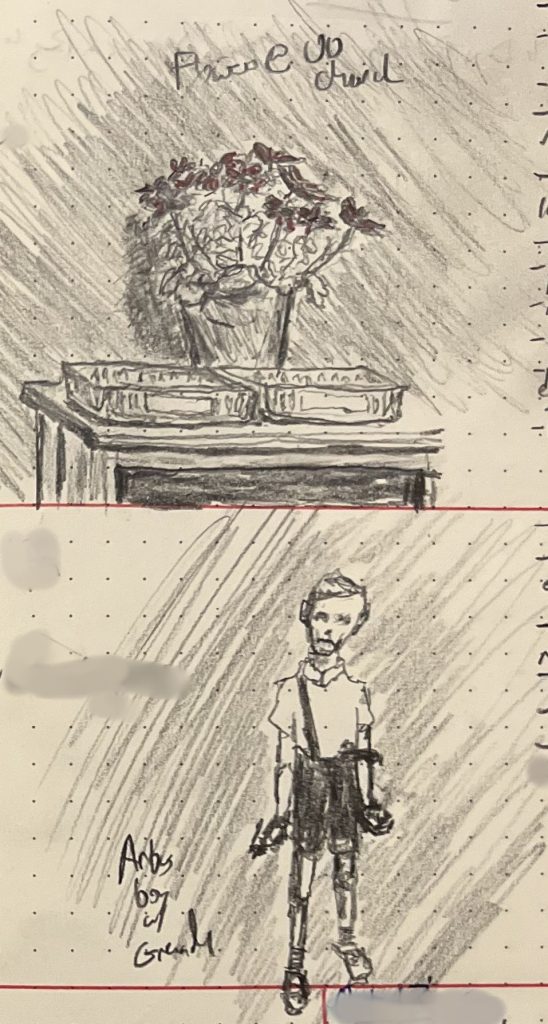
My son voted for the upper sketch, noting “holy heck I love the shadows on the flowers.” The model for this was a little table near the entrance of the Unitarian church where my congregation held Kol Nidrei service on Oct 11. I’m on our Safety Committee, and so had a shift watching the front door. Thankfully, it was an extremely boring shift, hence the sketch.
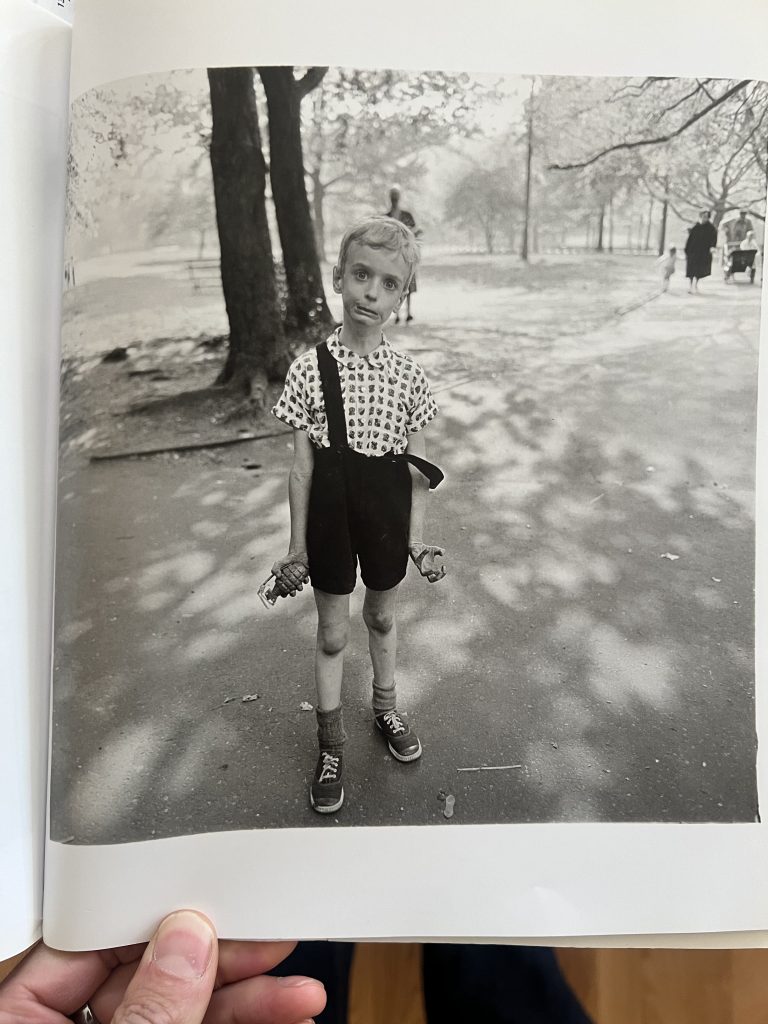
The lower sketch is based on Diane Arbus’s “Child with Toy Hand Grenade in Central Park, N.Y.C. 1962.” The sketch maybe looks pretty odd if you aren’t familiar with the reference. (Otto noted, “He’s adorable but I confess the angle of the head is kinda confusing me.” Then, after seeing the original, added “Pfff okay he just looks like that” and “Is that a grenade!?”)
Here’s my photo of a reproduction of Arbus’s original photo (which, stated like that, begins to sorta feel like I’m making a cheap Duchamp joke):
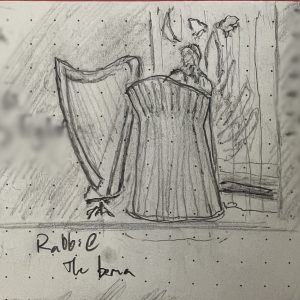
Just a quick, loose sketch I did of our rabbi at the bimah while she was leading Rosh Hashanah services. (Our particular rabbi trained as a cantor before being ordained, and happens to play harp; harp isn’t a standard part of Jewish services.)
My son voted this sketch of the week because “I really like the curves on the harp. All the geometry in that one is very beautiful.” (I spent most of last week working on faces, which I’m terrible at; weak as it is, this is the best sketch of the lot 🤷♀️)
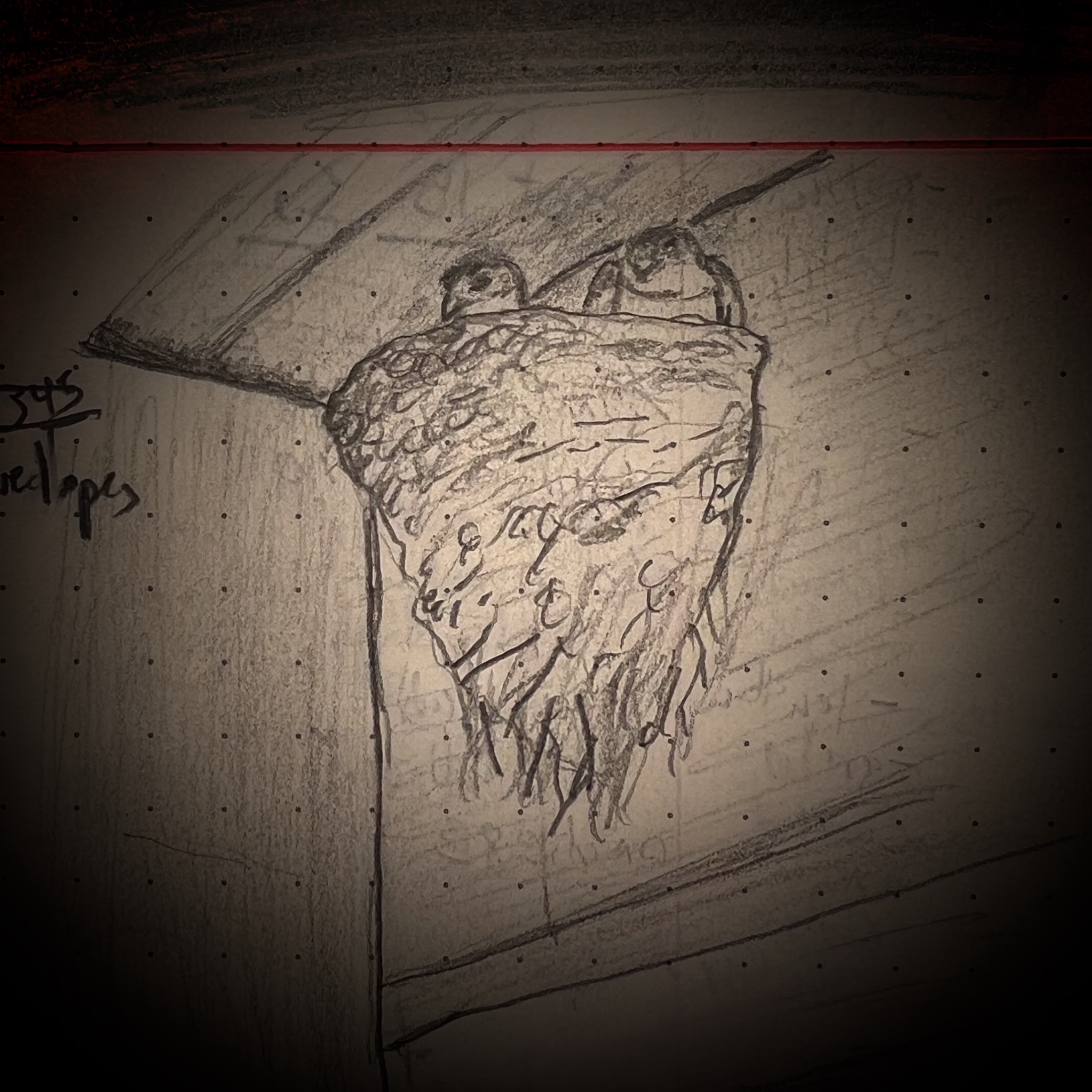
My son nominated this sketch, noting: “That one in the back looks like it has strong opinions.” I can’t quite recall where I saw these little guys, just that it was in a Michigan State Park this past summer, as part of a canoe trip that went moderately off the rails (massive duckweed, inclement weather, thousands of dead fish blocking the river, etc.) This park was maybe our third choice, in terms of places we were supposed to be that night.
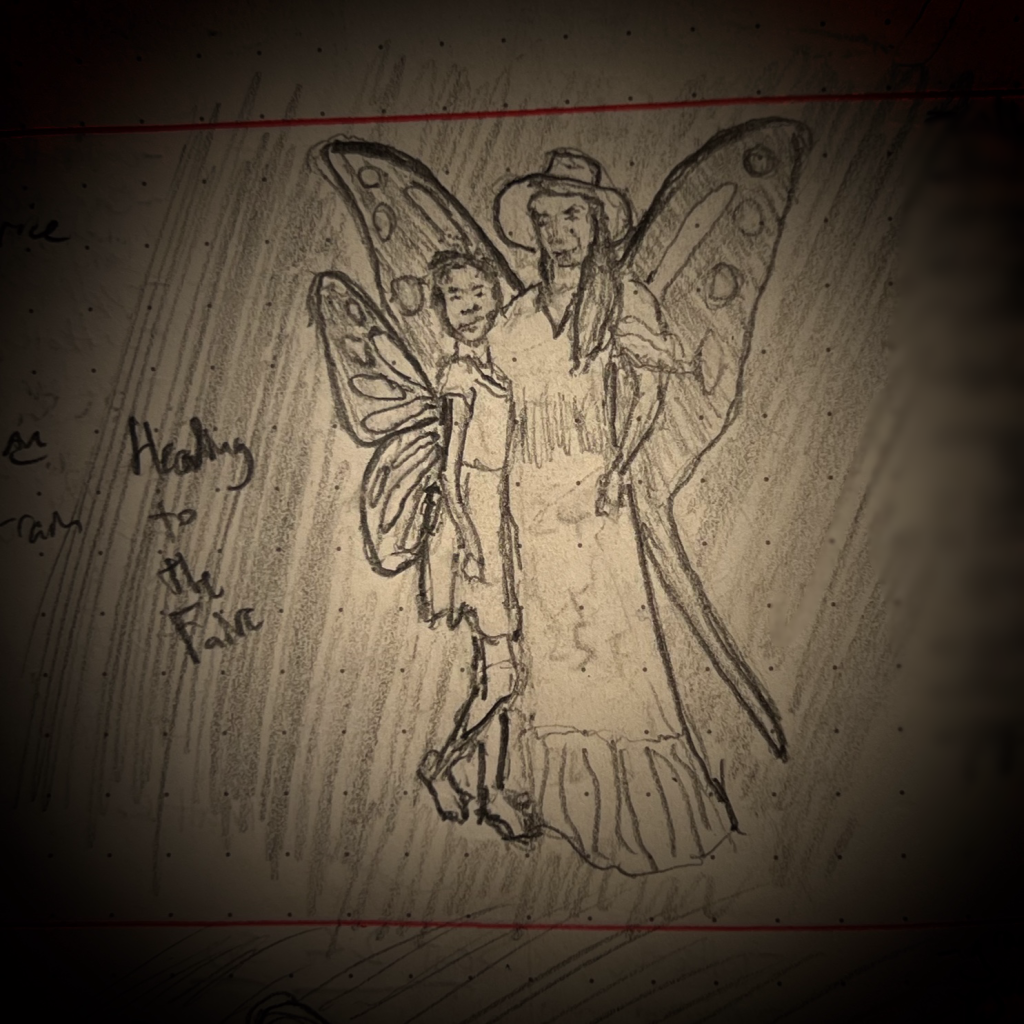
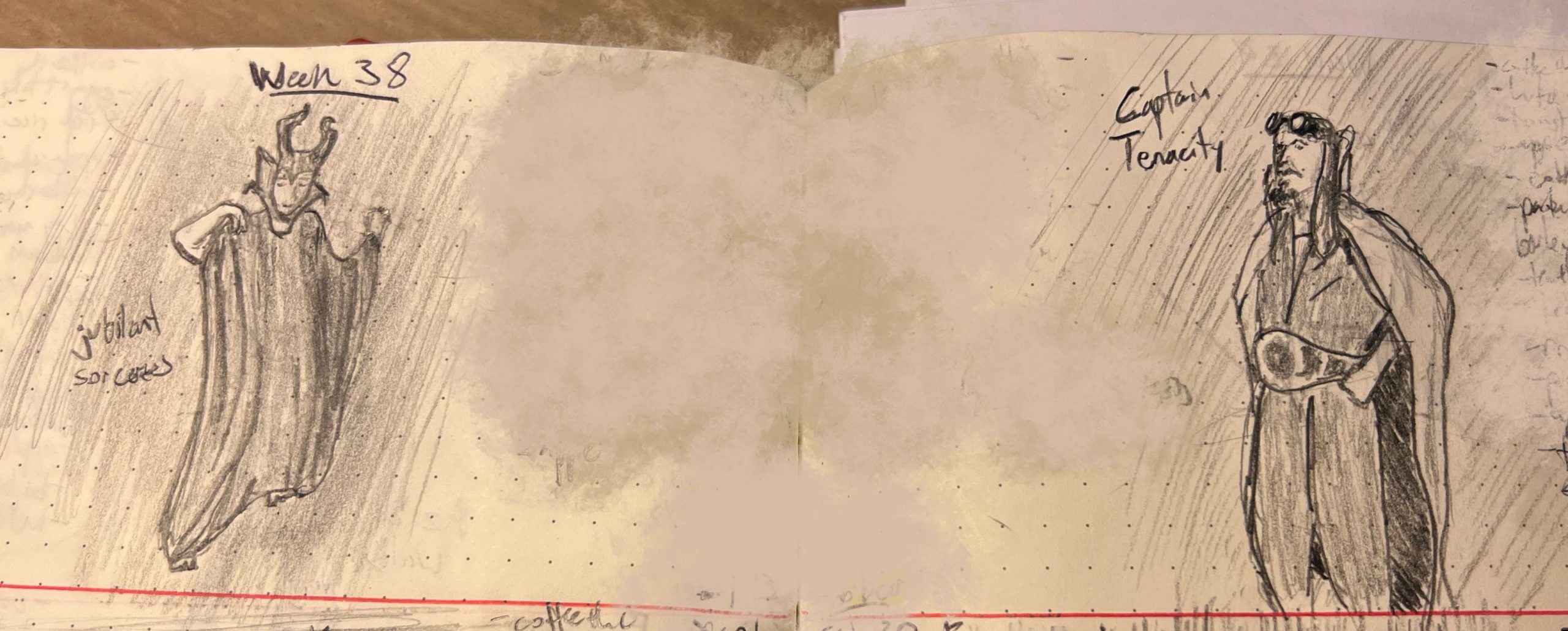
For the record, I was almost positive he was either gonna chose the Jubilant Sorceress or Captain Tenacity:
Mostly I like how the two images interact (they were in adjacent slots on the spread). The reference for the sorceress is my wife in a Halloween costume she got for cheap at a thrift shop a few years back, while the captain is me about 20 years ago. Serendipitously, the ratio between their sizes is roughly our real-life size difference.
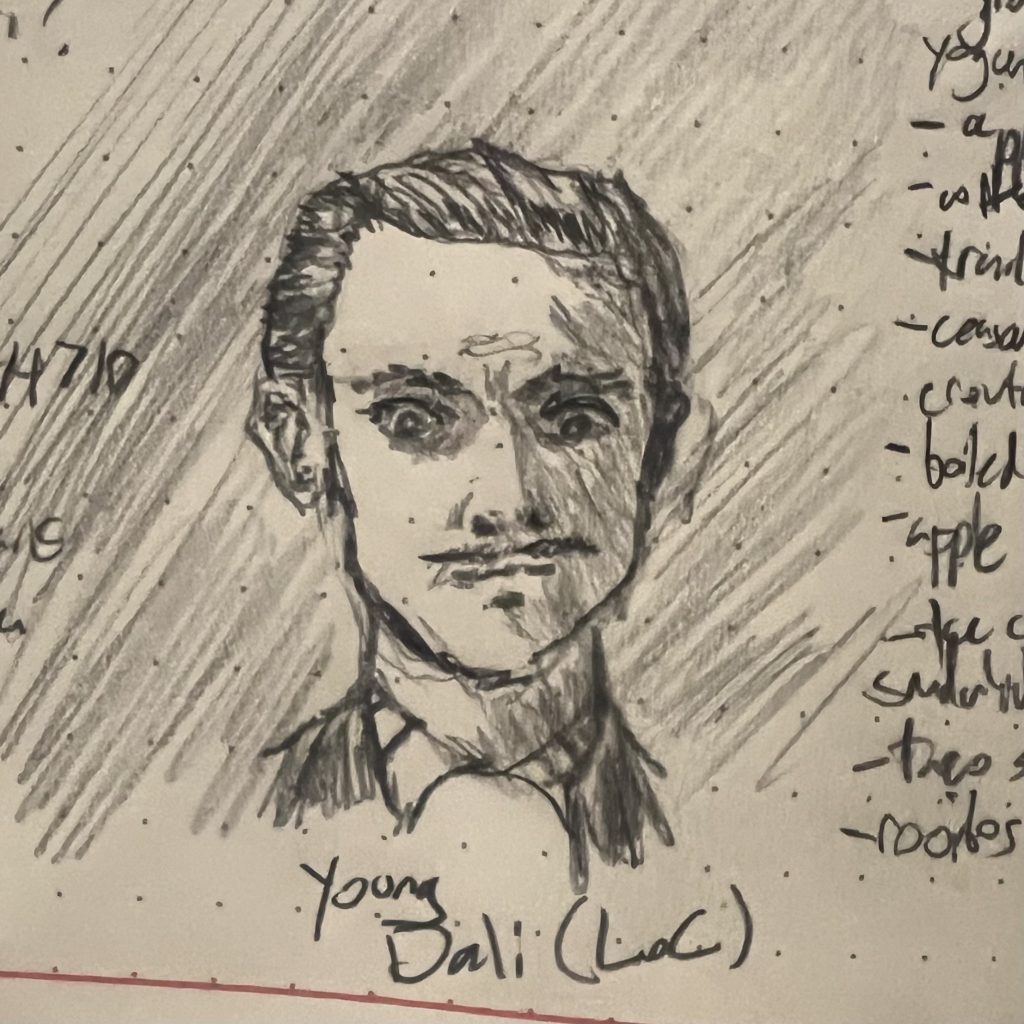
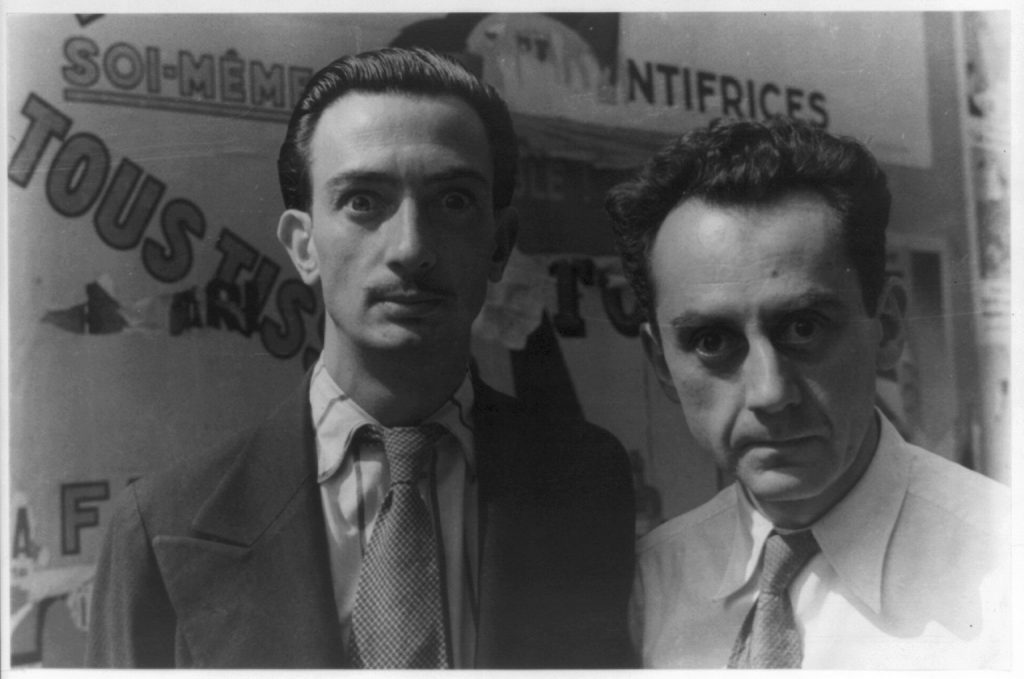
My best sketch from Week #37-2024 is this one of a young Salvador Dali:
My reference for the sketch was this picture of Dali and Man Ray I stumbled across on the Library of Congress website:
Until I saw this photograph, it never dawned on me that Man Ray might be Jewish (which he was), nor that he was American-born (I thought he was French, because he was most famous for the work he did while living in France), nor that he thought of himself as a painter (I knew him for his photography). 🤦♀️
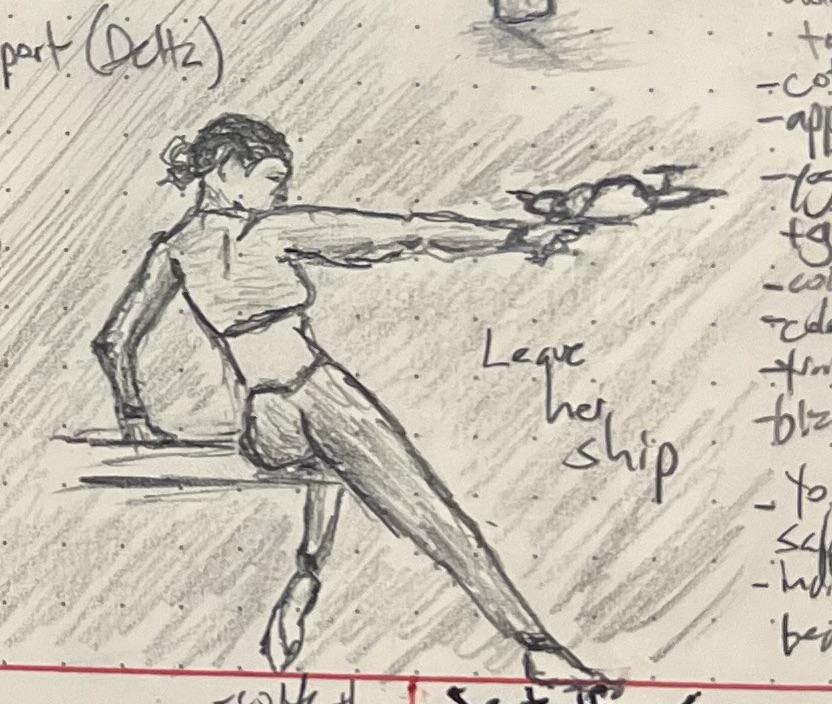
For the record, the Young Dali sketch narrowly beat out this space captain from Friday, September 13. She is taking no shit, folks:
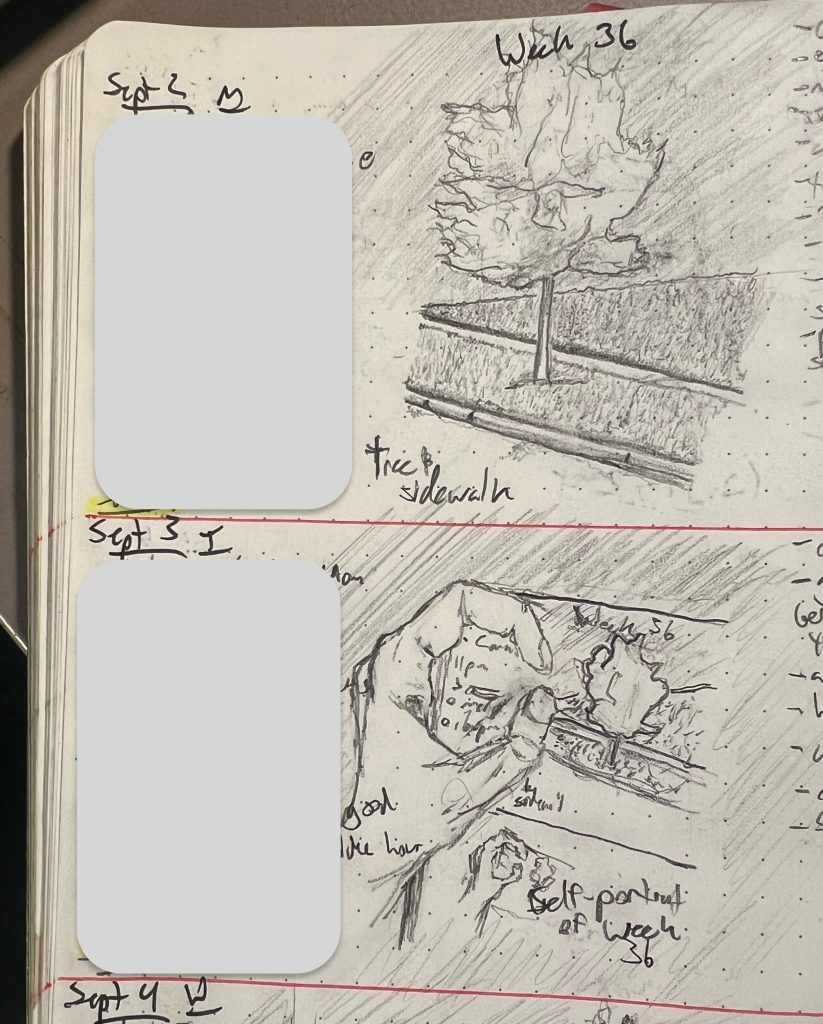
My son suggested I share this one, which he characterizes as “handception” . The sketch I’m highlighting is the lower one, but it doesn’t make sense without the context of the larger page, so here you go:
In order to be good at a craft, we need to accept and embrace the fact that we are an intelligent conduit for that craft. We are nothing more, and certainly nothing less.
Hanks says basically that in a gajillion little different ways here, and each is worth hearing.
OK, those scare quotes are unfair; this is indeed art, even if the creator is phoning in bits where he or she could certainly have applied a small amount and greatly improved their work.
Yes, “Pooky Park” is credited like so:
This is an AI-generated 1950s TV commercial for a family theme park called Pooky Park, where customers are chased by giant, somewhat terrifying puppets. Script: ChatGPT Photos: Midjourney Video: PikaLabs, Runway
That leaves the impression that someone typed “Make a 1950s TV commercial for a family theme park called Pooky Park, where customers are chased by giant, somewhat terrifying puppets” into ArtGT, hit the GO! button, and it pooped out this short, festive romp whole.
But that’s not how any of these tools work. For example, I can tell you from experience that Runway only gives you three or so seconds of footage at a time. The creator is eliding the fact that a lot has gone into editing the visuals and creating the audio. Yes, the script sounds like it’s straight ChatGPT (“Colossal howdy-doody-type puppets”? 🙄), and us thus hella week. But this is still an excellent creative application of new artistic tools—evidenced by the fact that I watched it and shared it not because of the gimmick (“AI made this!!!1!“), but because it captivated me and entertained me and unsettled me and made me want to share it with other people so they could be captivated and entertained and unsettled, too. And that, my best belovéd, is what art is all about.