Emotionally Scarring Children to Help them Cope with Things that Never Happened #HappyHalloween!!! 🎃👻🍬

The images below are taken from Don’t Make Me Go Back, Mommy: A Child’s Book About Satanic Ritual Abuse.  This is a real book that was earnestly written and actually published, then presumably read to actual children (who, one presumes, were duly traumatized) in order to help them cope with having not endured fake things that never happened to anyone (see also “Satanic Panic”and D&D as thrill-kill gateway drug—and recall, these were current events, reported in the newspaper, recounted in measured tones on the evening news, endlessly explored on the afternoon talk shows I watched while my folks were at work. I was a fat, gullible, ill-monitored Jewish pre-teen at the time. These cases enthralled and terrified me.) "Don't Make Me Go Back, Mommy: A Child's Book about Satanic Ritual Abuse" halloween

The craziest thing about all this, to me, is that the author and publisher really did have their hearts in the right place, I think.  In contrast to most materials surrounding the issue of Satanic Ritual Abuse, this wasn’t an attempt to bait the hook of Fundamentalist Christian propaganda or Normative White bigotry with raw meat ripped from the tabloid headlines. 

"Don't Make Me Go Back, Mommy: A Child's Book about Satanic Ritual Abuse" ritual

"Don't Make Me Go Back, Mommy: A Child's Book about Satanic Ritual Abuse" cover This book comes from the “Hurts of Childhood” series, which honestly and directly tries to address real burdens that many children really face: parental alcohol abuse, sexual assault, traumatic family situations, and so on.  Yes, every single title in this series is just as maladroitly handled—but, jeez, at least they were trying.

"Don't Make Me Go Back, Mommy: A Child's Book about Satanic Ritual Abuse" bath "Don't Make Me Go Back, Mommy: A Child's Book about Satanic Ritual Abuse" doctor 2 "Don't Make Me Go Back, Mommy: A Child's Book about Satanic Ritual Abuse" doctor 1

Let me stress: This stuff looks silly and ghoulish and comically naive now, but we actually believed these things were happening back in the 1980s. Real people really went to prison—and stayed there for years—having been accused of heinous abominations and convicted of committing a type of crime that hasn’t ever happened:

The survey included 6,910 psychiatrists, psychologists and clinical social workers, and 4,655 district attorneys, police departments and social service agencies. They reported 12,264 accusations of ritual abuse that they had investigated.

The survey found that there was not a single case where there was clear corroborating evidence for the most common accusation, that there was “a well-organized intergenerational satanic cult, who sexually molested and tortured children in their homes or schools for years and committed a series of murders,” Dr. Goodman said.

Many psychotherapists who have been vocal about a supposed epidemic of sexual abuse by well-organized satanic rings have grown more cautious of late. “There’s clearly been a contagion, a contamination of what people say in therapy because of what they see on TV or read about satanic ritual abuse,” said Dr. Bennet Braun, a psychiatrist who heads the Dissociative Disorders Unit at Rush-North Shore Medical Center in Chicago.

So, anyway, that was life in the 1980s. It was legitimately fake news that led to literal witch hunts and actually completely destroyed people’s lives.

(image sources  here and here)

Colt is ceasing production of consumer-grade assault rifles o_O

Washington Post: There are so many AR-15s in U.S. consumer hands that it makes no sense to produce more, Colt says”Stag2wi_

Three things worth noting:

  1. Colt is the father of the AR-15 and creator of the once highly profitable consumer-grade assault weapon niche. It’s enormous news that they’re out.
  2. This headline implies that the market is saturated because so many guns have been produced and sold, but if you read the article, that’s not what Colt said. They simply say demand is down. Yes, one explanation is that they overproduced and flooded the market. Another is that fewer people want these guns (often characterized as “the must vilified gun in America.”). Think about cigarettes: Demand for those in the US is also down, not because cigarette manufacturers overproduced and flooded the market, but because we worked hard to make having and using cigarettes less socially neutral and much more publicly controversial.
  3. Contrary to popular perception, while these guns are enormously popular with those committing the most heinous crimes, they are used in a vanishingly small percentage of total gun crimes.


If you want to understand the last three years in American politics, read Stephen King’s 1985 novella “The Mist”

This is, by no means, any sort of endorsement of any of the film/TV/radio-drama adaptations of this work—all of which either entirely miss what gives this story its lasting power, or convert a fundamentally profound work about kitchen-table American politics (i.e., the only kind that actually matters) to a moderately stupid and lazily nihilistic creature features.

Read the novella (which is also the first story in Skeleton Crew—a whole book of classic King shorts that costs just a couple buck more than the standalone novella—and is bootlegged here).  Ignore the monsters and the titular mist; watch the people.  And never lose sight of the final word in the story.


Listen to (or Read) My Story “Whatever Comes After Calcutta” on @PseudoPod

The Pseudopod team always does great work, but I’m especially thrilled with what the reader—Rish Outfield—has done here; the story has lots of voices, and he captures them all.  Such a treat. (For those less inclined to audio drama and more to old-fashioned reading, they have the full text of the story posted, too.)

PseudoPod 649: “Whatever Comes After Calcutta

And here’s a YouTube video of the audio, if that’s your jam:

Enjoy!

Are you a grown-up American? Do you vote? Then plz take three minutes to get yr head around “marginal tax brackets”🇺🇸🌟

WaPo-wrong-on-tax-brackets2About half of all Americans fundamentally misunderstand how U.S. “tax brackets” work.  (Ironically, those in the traditionally “fiscally conservative” party are significantly more likely to fundamental misunderstand our tax system.)  As a result, many, many, many Americans argue and vote against both public interest and their own interest, with the sole beneficiaries being the extremely rich (both human and corporate).

Now’s the time to get your head straight.  The Twitter thread embedded below lays it out nicely, as does this article from the Washington Post (which takes just three minutes to read, and even explains why we use this somewhat counter-intuitive and often confusing tax bracket scheme).

This is your Civics homework for today.  It’s pretty easy.  I’m sure you’ll get a gold star!🌟

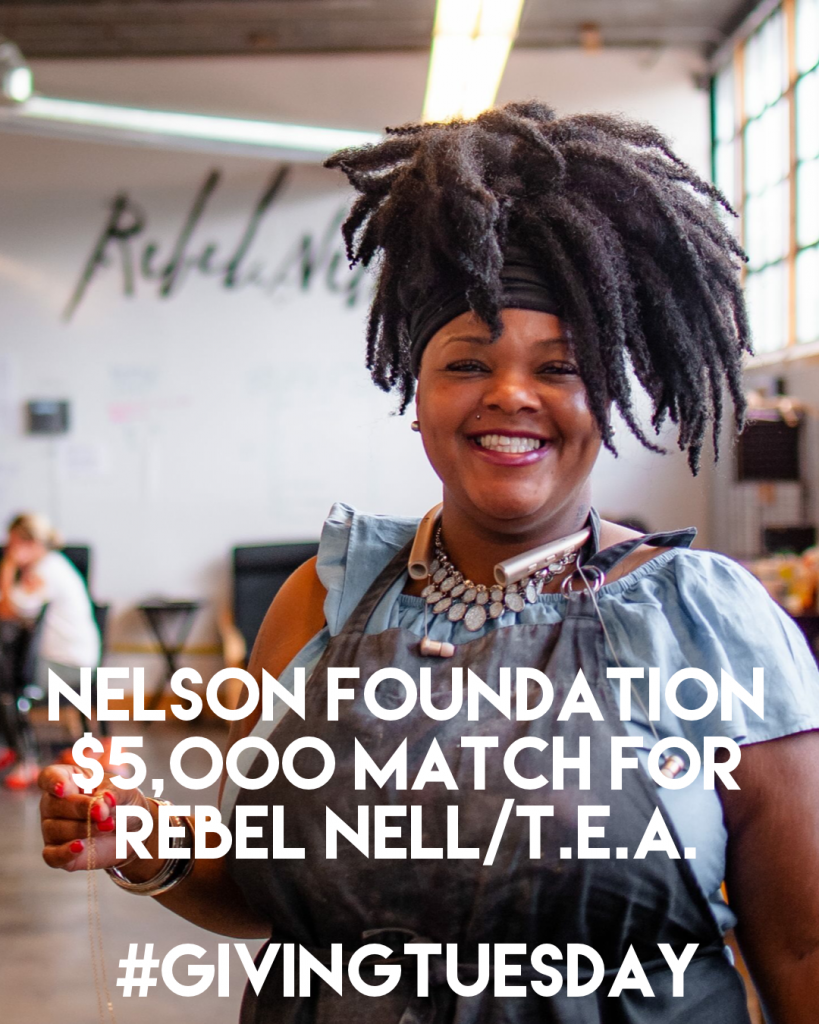
REBEL NELL X NELSON FOUNDATION #GIVINGTUESDAY

Rebel Nell works with local organizations to hire women transitioning from homelessness and teaches them to craft unique, wearable accessories made from the fallen layers of graffiti that grace the buildings and underpasses of Detroit.

DISCLOSURE: I’m from the Detroit Metro Area. My dad was born and raised in Detroit. We love that stupid city, my family has planted their hearts there, and I’ve bought Rebel Nell jewelry for my wife. It’s neat stuff!

But Rebel Nell isn’t just mining the lead-flecked ruins of Detroit to sell bougie baubles.  Through their non-profit arm—Teaching. Empowering. Achieving. (T.E.A.)—Rebel Nell provides all the wrap-around services to empower vulnerable women and families as they transition to a life of independence.  T.E.A. invests in training, education, skills development, coaching, and mentorship services (including basic employment opportunities), in addition to other support and assistance to these women. 

This ain’t giving away fish; it’s teaching folks how to fish, and making sure they’ve got a decent rod and reel to get them started.

This is Azzie. She’s Rebel Nell's production manager and an alum of their programs.
This is Azzie. She’s Rebel Nell’s production manager and an alum of their programs.

The Nelson Foundation provides financial support to individuals and organizations that use art to create opportunities that better our community.  (Note conspicuous name similarity—this is something my folks and older sister make happen.)  These usually take the form of direct grants and tuition support to underrepresented students in the arts in Michigan.

This Tuesday—November 27, 2018—The Nelson Foundation will be giving up to $5,000 to Rebel Nell/T.E.A. in matching funds. 

You give $1, and the Nelson Foundation matches that.  Everyone together gives $5,000 and the Nelson Foundation doubles that—boom!, $10,000 goes directly to supporting women and families getting free and building up their communities.

Click to give! Pay it forward. Spread the word. 

Thanks!

image1 

An interesting and worthwhile thread about Trabalism in American Politics

The news item that incited this thread is now Old News™️ (sadly), but the insights are ever timely.🇺🇸🔥

Michigan Voters: Please “Plunk” for Sam Bagenstos for MI Supreme Court on Nov 6

“Plunking” means voting for just one person, even when you could vote for several.

On Nov 6, Please plunk for Sam Bagenstos for Michigan Supreme Court

This is easy to remember, because he’s the only candidate who has a hobbit-sounding name.  Sometimes he wears little half-glasses while reading, which really underscores the hobbit thing, although he’s sort of a tall dude.

Voting for Michigan Supreme Court

This year we have six candidates running for two open seats in the Michigan Supreme Court. This is on the “non-partisan” portion of the ballot—that is, even though the nominees have a party affiliation, that affiliation isn’t listed on the ballot.  As a result, in general, only about 50–60% of voters even bother to vote for a Michigan supreme court justice.  When they do, they overwhelmingly pick the incumbent (who have “Justice of Supreme Court” listed under their names on the ballot—generally, the rational voters have is “Well, I can’t think of anything terrible the supreme court did this year, so whoever is on it must be doing a good job.”)

My point is two-fold: 1) It is a small number of well-informed voters, coupled with a bunch of people who just like ticking boxes, who elect our supreme court justices and 2) once you’re on, it’s easy to stay on.

Why am I asking you to vote for Sam?

  1. He’s a solid dude.  I know him a little bit, personally, and know his wife and kids much better (we’re active in the same congregation). Sam isn’t in anyone’s pocket. He is smart and fair and works his ass off.
  2. He’s a civil rights dray horse. He was a top official in DoJ’s Civil Rights Division under Obama.  In the last couple years Sam has argued and won important victories for pregnant workers and disabled children before the Supreme Court of the United States.  He’s fighting for the people of Flint to hold the state accountable for their poisoned city water.

Why am I asking you to “plunk” for Sam?

You can vote for up to two supreme court justices.  You could vote for both Sam and the other Dem nominee, Megan Cavanagh—with your rationale being that this brings us closer to getting at least one progressive justice on the court.  But this is the midwest, and “Democrat” is not a reliable proxy for “progressive.” Megan Cavanagh has actually spent her career restricting civil rights, representing municipalities, police, and businesses against the sorts of clients that Sam has stuck up for.  (FUN FACT: One time Cavanagh argued before the Michigan supreme court, representing an oil company that accidentally dumped 396 gallons of fuel oil into a woman’s basement, destroying her home.)

So, on the one hand, you have Cavanagh who worked to get an oil company out of paying $100,000 in damages to a woman whose home they destroyed. On the other, you have Sam representing the people of Flint after they suffered heavy metals poisoning at the hands of incompetent city admins.

If you plunk for Sam (voting for him and only him), you essentially double the value of your vote.  This is important because, if trends persist (and there’s no reason they wouldn’t), the incumbents are going to devour the vast majority of the votes.  Effectively, only one supreme court seat is open (if even). Voting for both Sam and Cavanagh is essentially saying that you figure it’s a coin-toss between the two, as to which will better bend the arc of the moral universe toward justice.

That simply isn’t true in this case.  Sam is your justice. Please plunk for Sam.  Please spread the word.

usa-american-flag-waving-animated-gif-26


These Aren’t Concentration Camps (Yet)—But That Doesn’t Mean They’re Good

I strongly urge you to watch this video:

and read this article (“Inside the Former Walmart That Is Now a Shelter for Almost 1,500 Migrant Children” ) all the way through, then call your reps.

My point here: This is not a “concentration camp” by any modern conventional standard (in that “concentration camp” connotes harsh conditions, overcrowding, and general neglect if not outright abuse). Here’s a New York Times description at what they saw at this specific migrant internment center:

Most of the boys are from Central America. Many of them smiled, waved at or shook the hands of the reporters touring the site. They were asked by the reporters and Southwest Key executives, in Spanish, “How are you?”

The constant reply was “Bien, bien,” meaning “OK, OK.” The media was not allowed to interview the children.

Some were leaning back, getting a shampoo at the sinks in the shelter’s barbershop, where a striped lit-up barber’s pole spun outside the door. They lined up in the cafeteria for dinner — chicken, mashed potatoes, mixed vegetables. Some played pool, or joined a tai chi session in the rec room. One teenager sat at a cafeteria table with his head bowed and hands clasped, praying silently. Another told the cafeteria worker who served him dinner, “Gracias, Miss.”

Everywhere, some of the shelter’s more than 1,000 employees hovered nearby — they sat at the ends of the cafeteria tables while the boys ate dinner, watched “Moana” with the children in the old loading docks and escorted lines of boys in the hallways.

The vast majority, Southwest Key officials said, crossed the border unaccompanied.

That said, these certainly fit within the broad dictionary denotation of “concentration camp”—in that they are “a camp where persons (such as prisoners of war, political prisoners, or refugees) are detained or confined”.  (And we have no idea if other such centers are better, worse, or about the same).

Still, calling these “concentration camps” runs the risk of continuing to erode the general American understanding of the heinous magnitude of suffering endured by  the Jews and others interned and enslaved by the Third Reich, or the Americans of Japanese descent imprisoned by the U.S. government, or the countless others who have been confined, reeducated, absorbed, and exterminated by the smooth-grinding wheels of governments.

On top of that, calling these “concentration camps” is a disservice to progress and to these specific children.

That said, saying that “these aren’t concentration camps” is in no way meant to suggest that what’s happening here is good; it’s getting overcrowded, it’s unsustainable, they’re starting to set up tent villages (in Texas, in the summer—lack of rigid shelter and HVAC is a huge drop in livability outside El Paso). This is precariously close to starting the inevitable slide into what we all would recognize as concentration camps.

But, goddamit, right now we are very close to doing the Right Thing here: Most of these kids are showing up at the border without parents or guardians; it is right and good to shelter them, feed them, protect them, show them Moana. That’s what a country dedicated to the huddled masses yearning to be free should be doing.  With proper action, there is an opportunity here for these centers to level up to being well-run refugee centers.

We should call our reps, and say as much: I want unaccompanied minors to be sheltered and fed.  I want those who’ve been abused, or whose home places have been made unlivable by gangs or failed governments, to have access to asylum.  Kids who have braved the elements and the slings and arrows of outrageous fortune, they’ve got True Grit; I want to know how they can become my neighbors and fellow citizens.🇺🇸

Joyner Lucas’s “I’m Not Racist” — a perfect musical example of the 45/45/10 Formula

The 45/45/10 Formula for narrative/argument is one of the perpetual bees bumbling around my bonnet.  This video for this song is such a stone cold perfect example (and, subsequently, so rhetorically devastating) that I just had to share.  PRO-TIP: The first two-and-a-half minutes will likely be almost unbearable to watch for most white Americans.  If it helps, know that Joyner Lucas (the musician and the voice you hear throughout the song) is black (although not the black guy in the video).

At any rate, to review my 45/45/10 Formula:

  • The first 45% of a piece is the Setup: Characters/concepts/situations/dynamics are presented and relationships among these made clear
  • The next 45% is the Tangle: Complication(s) disrupt (or at least complicate) the situation laid out in the Setup
  • The last 10% is the Resolution: The knot is Untangled, for better or worse

In the case of this track, the Setup runs from the open to ~2:50. The Tangle then runs to ~5:50, and from that point to the cut to black is the Resolution. What especially thrills me here—beyond the hard body impact of the rhetoric itself and the lean power of the videography—is how shifts in the music mark out the transitions between stages in the argument: Each section break is marked out be an abrupt shift in the tone and mood of the backing track.

This is a wonderful primer on how to structure an narrative argument to hold an audience and not persuade them, per se—because that’s not the goal—but rather to enduringly stick in their craw, so they keep troubling over your argument long after they’re done with the piece of entertainment.  This is how you write moral fiction.  This is how you plant the seeds that grow the trees that, indefatigably and seemingly effortlessly, bend the arc of that moral universe back toward justice.

And that, kids, is our business.  Go, watch … and learn.